
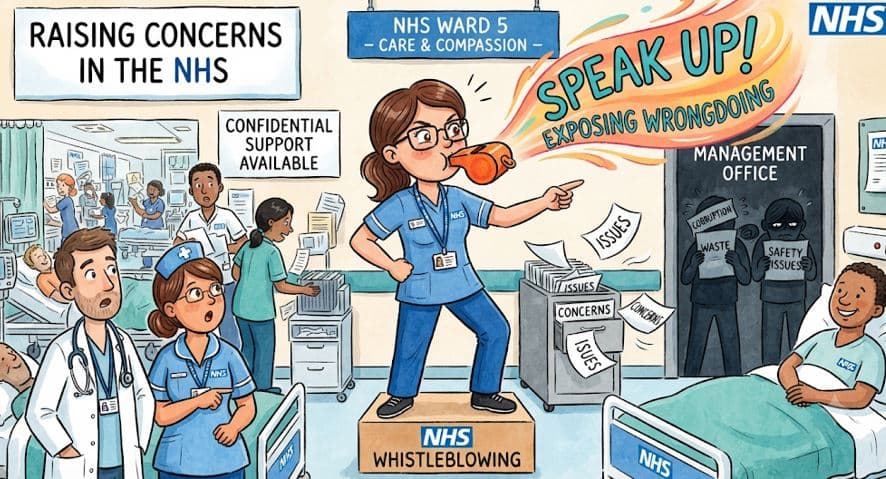
Whistleblowing in the NHS
Why Whistleblowing Matters for the UCAT
In the Situational Judgement (SJT) section, you will be tested on your ability to identify appropriate and inappropriate responses to workplace scenarios. Whistleblowing is a common theme because it involves balancing patient safety, professional duty, and personal risk.
Understanding the NHS whistleblowing process, the Freedom to Speak Up policy, and real-life case studies will help you rank responses correctly.
Key Definition
Whistleblowing = raising a concern about unsafe, unethical, or illegal practice within the workplace, usually to a supervisor, manager, or external body.
In the NHS, whistleblowing is in the public interest, especially when patient safety is at risk.
GMC & NHS Core Values (SJT Relevance)
The GMC states: A doctor must take immediate action if patient safety is being compromised.
NHS Core Values to remember for SJT:
- Commitment to quality of care
- Compassion
- Improving lives
- Working together for patients
UCAT tip: If an SJT option suggests delaying reporting to avoid conflict, that is usually inappropriate.
Appropriate Reporting Channels
You may be asked to rank the most appropriate first step in a whistleblowing scenario.
Channel | When to use |
Direct supervisor/manager | First port of call (unless they are the problem) |
Dedicated whistleblowing unit (within trust) | If supervisor unresponsive or involved |
NHS Improvement | For systemic or trust-level concerns |
Care Quality Commission (CQC) | For concerns about care quality/safety |
Confidential helpline / online portal | If anonymity is needed |
Going straight to the media is almost always inappropriate unless all internal channels have failed.
Barriers to Whistleblowing (Recognise for SJT)
Doctors may hesitate due to:
- Fear of retaliation or job loss
- Damaged relationships with colleagues
- Stress and emotional toll
- Laborious reporting processes
- Rotational training (short time in each post)
- Hierarchical culture (junior vs. senior)
The Freedom to Speak Up policy (2018) was introduced to reduce these barriers.
Ethical Principles Justification
Principle | Application to Whistleblowing |
Beneficence (act in patient's best interest) | Reporting harm prevents future suffering |
Non-maleficence (do no harm) | Failing to report allows harm to continue |
Autonomy | Patient's right to safe care; staff's right to ethical workplace |
Justice | Fair distribution of care; exposing favouritism or misuse of resources |
Tip: In SJT, answers that prioritise patient safety over team harmony are usually appropriate.
Key Case Studies
You don't need deep detail, but recognising the lesson from each case helps with SJT scenarios.
Case | Key Lesson |
Lucy Letby | Early concerns were raised but ignored. Timely action could have saved lives. |
Francis Report (Mid-Staffs) | Toxic culture of fear prevented whistleblowing. Patients received substandard care. |
Harold Shipman | Anomalies went unnoticed. Active surveillance and training are essential. |
Hampshire Hospitals | Consultant was dismissed after raising safety concerns. Retaliation is a real risk. |
Tip: The recurring lesson = systems must listen to and protect whistleblowers.
Quick Recap
Key Point | SJT Implication |
Whistleblowing = duty, not choice | Patient safety always comes first |
Report internally first | Supervisor → trust unit → external regulator |
Legal protection exists (PIDA 1998) | Fear of retaliation is real but not a reason to stay silent |
Case study lesson: ignoring concerns = tragedy | Early reporting saves lives |
Four principles: beneficence & non-maleficence key | Use these to justify appropriate actions |
Example SJT Scenarios
Scenario 1 (Appropriateness Ranking)
A junior doctor notices a senior nurse regularly skipping hand hygiene. The doctor has mentioned it privately, but the behaviour continues.
Rank the following actions from most to least appropriate:
A. Report the nurse to the ward manager immediately
B. Speak to the nurse again, this time formally warning them you will escalate
C. Do nothing to avoid damaging the working relationship
D. Report the issue anonymously via the trust’s online portal
Suggested ranking (most to least appropriate):
- B – Formal warning gives chance to change before escalation
- A – Direct reporting is appropriate if risk is significant
- D – Anonymous reporting is acceptable but less direct
- C – Doing nothing is inappropriate (violates GMC duty)
Scenario 2 (Most Appropriate Action)
A foundation year doctor discovers that a colleague is falsifying patient records to meet waiting time targets. The colleague is popular and well-liked.
Which single action is most appropriate?
A. Confront the colleague in private and threaten to report them
B. Ignore it because the targets are unrealistic
C. Report the concern to their immediate supervisor with evidence
D. Post about it anonymously on social media to raise awareness
Correct answer: C
Reporting with evidence to a supervisor follows proper channels. Social media (D) is inappropriate. Ignoring (B) is unethical. Threatening (A) is confrontational and unprofessional.
Scenario 3 (Ethical Justification)
A doctor is considering whistleblowing about unsafe staffing levels. Their manager has told them to stay quiet to avoid "rocking the boat."
Which ethical principle most strongly supports the decision to whistleblow?
A. Autonomy
B. Beneficence
C. Non-maleficence
D. Justice
Correct answer: C (Non-maleficence)
The primary duty is to avoid harm to patients. Unsafe staffing directly risks patient harm. (Beneficence is also relevant, but non-maleficence is the stronger justification here.)
UCAT Decision Making: Data Interpretation
You may be given data showing that trusts with stronger whistleblowing protections have fewer serious incidents.
Example question:
A study found that Trust A (with a Freedom to Speak Up guardian) had 40% more staff concerns raised but 30% fewer serious patient safety incidents than Trust B (without one). Which of the following is most strongly supported?
- Correct answer: Encouraging staff to speak up may reduce patient harm.
- Incorrect: More concerns means the trust is worse (correlation ≠ causation).
Common SJT Traps to Avoid
"Wait and see if it happens again" → Inappropriate (GMC says immediate action)
"Confront the person publicly" → Inappropriate (humiliating, unprofessional)
"Resign instead of reporting" → Inappropriate (passes the problem on)
"Follow the trust’s whistleblowing policy" → Appropriate
"Report to a supervisor or guardian" → Appropriate
"Use an anonymous channel if fear is genuine" → Appropriate
Twelve Questions and Answers
1. What is whistleblowing?
Strong answer points:
- Raising concerns about unsafe, unethical, or illegal behaviour
- Done in the public interest
- Protects patients and staff
- Supported by NHS Freedom to Speak Up policies
2. Why is whistleblowing important in healthcare?
Include:
- Prevents patient harm
- Maintains public trust
- Encourages accountability
- Improves healthcare quality
- Supports NHS values
3. What kinds of situations may require whistleblowing?
Examples:
- Unsafe staffing levels
- Repeated medication errors
- Abuse or neglect
- Fraud
- Bullying affecting patient care
- Colleague working intoxicated
- Serious breaches of infection control
ETHICS-STYLE QUESTIONS
4. What would you do if you saw a doctor repeatedly making mistakes?
Good structure:
Step 1:
Ensure immediate patient safety
Step 2:
Gather facts objectively
Step 3:
Speak to the colleague if appropriate
Step 4:
Escalate to senior staff/supervisor
Step 5:
Document concerns appropriately
Step 6:
Use formal whistleblowing channels if unresolved
5. A friend asks you not to report their dangerous mistake. What would you do?
Key points:
- Be empathetic and supportive
- Encourage self-reporting first
- Duty to patients overrides friendship
- Escalate if patient safety is at risk
- Avoid blame culture
6. Should whistleblowers remain anonymous?
Balanced discussion:
Advantages
- Protects staff from retaliation
- Encourages reporting
- Reduces fear
Disadvantages
- Harder to investigate
- May reduce transparency
- Risk of malicious accusations
Conclusion:
Anonymous reporting can help initially, but evidence and fairness remain essential.
NHS HOT TOPIC QUESTIONS
7. Can you name an NHS case involving whistleblowing?
Possible examples:
Case | Key lesson |
Lucy Letby | Importance of acting early on concerns |
Mid Staffordshire NHS Foundation Trust scandal | Culture of fear and ignored warnings |
Harold Shipman | Failure to identify suspicious patterns |
8. What lessons did the NHS learn from Mid Staffordshire?
Strong points:
- Patient safety must come before targets
- Staff must feel safe raising concerns
- Importance of transparency
- Need for compassionate leadership
- Led to Freedom to Speak Up reforms
HARDER QUESTIONS
9. Do the benefits of whistleblowing outweigh the risks?
Balanced answer:
Benefits
- Saves lives
- Protects patients
- Improves systems
- Promotes accountability
Risks
- Stress for whistleblower
- Career repercussions
- Workplace tension
- False accusations possible
Judgement:
Overall, patient safety and public trust make whistleblowing essential despite challenges.
10. Why might healthcare workers hesitate to whistleblow?
Barrier | Explanation |
Fear of retaliation | Career damage or exclusion |
Hierarchy | Junior staff fear seniors |
Stress | Emotional burden |
Loyalty | Fear of harming colleagues |
Bureaucracy | Reporting systems can feel difficult |
ROLEPLAY / SJT STYLE QUESTIONS
11. You overhear a nurse discussing confidential patient information loudly in a café. What do you do?
Good approach:
- Stay calm and professional
- Ask them privately to stop
- Protect confidentiality
- Escalate if repeated behaviour continues
12. You are an F1 doctor and see a consultant shouting aggressively at staff regularly. What would you do?
Mention:
- Support affected staff
- Document patterns
- Raise concerns through supervisor/guardian/Freedom to Speak Up
- Focus on patient safety and team functioning
Useful Links:
https://www.gmc-uk.org/professional-standards/the-professional-standards/good-medical-practice
https://www.england.nhs.uk/wp-content/uploads/2020/08/External_whistleblowing_policy_for_NHSI.pdf