
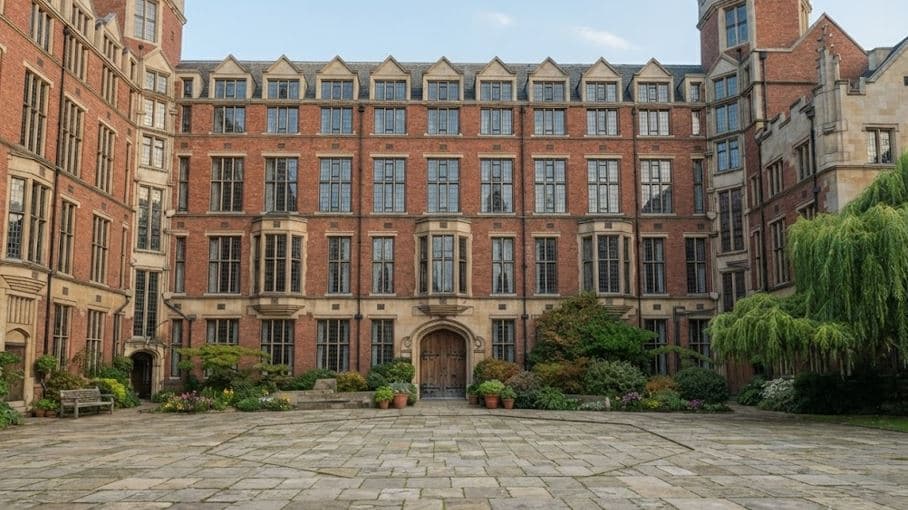
University of Sheffield Medicine
University of Sheffield Medicine: The Complete Applicant's Guide
A Cambridge Clinical admissions guide
The University of Sheffield's School of Medicine and Population Health runs two undergraduate routes: the five-year MBChB Medicine (A100), with 273 home and 18 international places, and the four-year MBChB Graduate Entry Medicine (A101), a 24-place widening-participation route for life science graduates with no international places. Teaching is integrated and systems-based, with GP placements starting in Year 1 and increasing clinical responsibility building toward a six-week student assistantship in the final year, delivered in close partnership with Sheffield Teaching Hospitals NHS Foundation Trust.
Sheffield runs one of the most mechanically explicit selection processes of any UK medical school, and it's worth understanding precisely: three sequential, pass/fail-then-ranking stages, where you cannot compensate for a UCAT score below the published threshold with stronger academic grades, or vice versa — each hurdle has to be cleared independently. This guide covers entry requirements, exactly how the three-stage academic/UCAT/MMI process works (including Sheffield's published historic thresholds), the eight-station MMI and SJT scoring, and the practical realities of Sheffield's interview logistics and reserve list.
Quick facts
Course | MBChB Medicine (A100), plus MBChB Graduate Entry Medicine (A101, widening participation only) |
Location | Sheffield, England |
Admissions test | UCAT — mandatory, sat in the year of application; minimum threshold 1800/2700 for 2027 entry |
Interview format | Eight-station MMI in person for home applicants; online panel interview for international applicants |
Shortlisting | Three sequential stages: pass/fail academic check → UCAT threshold and ranking → MMI + SJT combined score out of 45 |
UCAS deadline | 15 October, no late applications, no UCAS Extra/Clearing (except two specific widening-participation pathways) |
Why applicants consider Sheffield
Sheffield's curriculum runs early patient contact from Year 1 — including a structured General Practice placement across Years 1–2 — building toward extended clinical placements and specialty attachments in the later years, culminating in a student assistantship that prepares graduates directly for Foundation Year training. The school runs the Patients as Educators programme, one of the largest of its kind in the UK, partnering students with over 130 charities and community organisations, and its Anatomy Lab includes Anatomage tables for advanced 3D anatomy teaching. Students can intercalate through a dedicated BSc in Medical Sciences Research or an intercalated master's degree, and Sheffield sits within a Russell Group university that's been named a UK top-100 institution and won University of the Year for Student Experience (Times Good University Guide 2026).
Entry requirements
A-level: AAA, including Chemistry or Biology at grade A, plus a second science subject (Biology, Chemistry, Mathematics, Physics or Psychology), taken in one sitting. Further Maths, Critical Thinking and General Studies are not accepted. An alternative AAB offer is available if you're also taking an EPQ at grade A in the same sitting as your A-levels — but this alternative offer only applies to your first sitting: if you go on to resit any A-level, the standard AAA requirement applies regardless of your EPQ grade, since Sheffield's policy specifically requires you to resit enough subjects to reach AAA.
GCSE: A minimum of five GCSEs at grade 7 (A), with at least grade 6 (B) in Mathematics, English Language and a science subject (Dual Award Science is acceptable). GCSEs are checked against this minimum threshold only — Sheffield does not rank or score GCSEs, so exceeding the minimum gives you no additional advantage at this stage. An EPQ taken during your GCSE years, rather than alongside your A-levels, does not count toward meeting this requirement.
Scottish Advanced Highers: AA, including Chemistry or Biology plus another science subject (Biology, Chemistry, Mathematics, Physics or Psychology).
International Baccalaureate and other qualifications: Considered on the same underlying principles as A-level — contact admissions directly for your specific qualification profile if it isn't A-level, Advanced Higher or a standard graduate degree.
Graduate applicants (via A100): A 2:1 Honours degree, plus at least BBB at A-level including Chemistry or Biology. If you don't meet the A-level requirement, resitting the relevant qualification is an option before reapplying.
Graduate Entry Medicine (A101) specifically: This route is genuinely distinct from a general graduate-entry course — it's reserved exclusively for life science graduates from backgrounds under-represented in higher education, and eligibility requires both a qualifying life-science degree and meeting Sheffield's widening participation criteria; a strong degree alone doesn't qualify you for this route. A101 applicants complete a separate widening-participation form (due 31 October) alongside their UCAS application. English language requirements are GCSE English Language grade 4 (C), IELTS 7.5 overall with at least 7.0 in every component, or an accepted equivalent.
Currently mid-degree applicants: With the specific exception of University of Bradford BSc Clinical Sciences (B990) and Sheffield Hallam University BSc Biomedical Science (B960) widening-participation pathway students, Sheffield does not generally consider applicants who are only partway through an unrelated degree — you're welcome to apply once you've reached your final year.
Mature students: Welcomed, with no upper age limit, though Sheffield notes that offers are typically reserved for those who can provide a reasonable period of service in healthcare after graduation.
Work experience: Expected, though Sheffield is explicit it doesn't specify a fixed type or amount, since availability varies hugely by where you live — a caring environment of some kind is what matters (a hospice, working with children or adults with disabilities, or a healthcare assistant role), and it doesn't need to have involved a doctor specifically. Sheffield recommends keeping a reflective journal and undertaking your work experience within two years of applying.
How the three-stage selection process works
Sheffield's Medicine admissions page sets out the process in unusual detail:
Stage 1 — Academic entry requirements (pass/fail only). After the October UCAS deadline, Sheffield checks your achieved and predicted grades against the minimum requirements above. This is a threshold check, not a ranking — an applicant who exceeds the minimum requirements gains no advantage over one who just meets them. The personal statement is not read or scored at this stage (or at any stage) except in the rare case UCAS flags it as potentially plagiarised, in which case a confirmed finding results in automatic rejection regardless of academic or UCAT performance.
Stage 2 — UCAT threshold and ranking. You must sit the UCAT in your year of application and meet a minimum score threshold — 1800/2700 for 2027 entry — calculated as roughly the 40th centile of scores across the three preceding entry cycles. Two specific groups skip UCAT ranking entirely and progress straight to interview once they clear the threshold: participants in the Access to Sheffield (Medicine) programme, and applicants on the recognised University of Bradford or Sheffield Hallam University widening-participation pathways. Everyone else who clears both the academic and UCAT thresholds is then ranked purely by UCAT score, with only the highest scorers proceeding — home A100, international A100, and A101 applicants are ranked in three entirely separate pools. Sheffield publishes its actual historic cut-points, which is genuinely useful context (note the UCAT scale itself changed from /3600 to /2700 for 2025 entry onward, following the removal of Abstract Reasoning):
Entry cycle | Minimum threshold | A100 Home cut-point | A100 Overseas cut-point | A101 Home cut-point |
|---|---|---|---|---|
2024–25 | 2430/3600 | 2760/3600 | 2590/3600 | 2430/3600 |
2025–26 | 1800/2700 | 2120/2700 | 2070/2700 | 1800/2700 |
Sheffield is explicit and unambiguous on one point worth repeating: you cannot compensate for a UCAT score below the minimum threshold with higher academic attainment, or vice versa — both thresholds must be cleared independently before ranking even begins.
Stage 3 — Multiple Mini Interviews. Home applicants who clear stages 1 and 2 are invited to an eight-station MMI, attended in person, covering knowledge of Sheffield, medicine in a wider context, good medical practice, attitudes and values, the candidate as a person, communication skills, ethics, and information processing. International applicants interview via an online panel interview instead. Each MMI station is scored 1 (unsatisfactory) to 5 (excellent), and your UCAT Situational Judgement Test result is converted into its own score out of 5 based on which SJT quartile you fall into. Your eight MMI scores plus your converted SJT score are added together for a total out of 45, and you're ranked against all other interviewed applicants on this combined total — with applicants scoring 3 or better across every single section specifically prioritised in the final ranking.
For 2027 entry, Sheffield expects to interview roughly 1,100 home and 100 international applicants for A100, and 40–60 applicants for A101 — against roughly 2,700 total applications for 315 places across both courses in the most recent cycle reported.
Interview logistics and offer decisions
A few practical rules are worth knowing before interview day: you're expected to arrive at least 30 minutes early, since late arrivals aren't permitted to join and rescheduling isn't guaranteed; once you've booked and confirmed an interview slot, it cannot be changed; and no notes or crib sheets are allowed in the room, since interviewers want to hear your own reasoning rather than a rehearsed script. Interview panels are made up of medical educators, senior hospital doctors, GPs, biomedical scientists, senior nurses, senior pharmacists, medical students and lay people. After interviews conclude, offers are made purely on your combined MMI/SJT ranking, subject to satisfactory references, health clearance and an enhanced DBS check. Unsuccessful applicants may be placed on a reserve list, and some may also be considered for Sheffield's Biomedical Science or Orthoptics courses instead.
Application process
Applications go through UCAS by the standard 15 October deadline; Sheffield does not accept late applications, and does not process applications through UCAS Extra or Clearing except for the University of Bradford and Sheffield Hallam widening-participation routes specifically. If you want to be considered for both A100 and A101, you need to apply to both as separate UCAS choices. Transfers — from other universities' medicine courses, or from another Sheffield degree — are not accepted, since UK medical school places are centrally capped by government and Sheffield is already at its numbers limit. Deferred entry is welcomed (and required if you won't be 18 before the course starts); if you want to defer partway through the selection process itself, you'll need to request this in writing with your reasons, though it can't be guaranteed. International applicants can sit the UCAT at Sheffield's South East Asia test centre in Kuala Lumpur, the only one in that city, so early booking is recommended.
Key 2027-entry dates: UCAT registration opens 20 May 2026; UCAT booking opens 23 June 2026; UCAT testing runs 13 July–24 September 2026; UCAS deadline 15 October 2026; MMIs run December 2026–January 2027 (with international panel interviews in January 2027); decisions are shared February/March 2027.
Tips
Because Sheffield ranks purely on UCAT score once you clear both thresholds, and explicitly won't let a strong academic record compensate for a UCAT score below the published minimum, treat UCAT preparation as the single highest-leverage part of your Sheffield application — a middling UCAT score genuinely can't be offset here the way it can at schools using a combined academic/UCAT formula.
Sheffield's published historic cut-points are a rare, genuinely useful data source — use the actual table rather than secondhand summaries, and remember the UCAT scale itself changed in 2025, so older /3600 figures aren't directly comparable to the current /2700 scale.
If you're applying to A101 Graduate Entry Medicine, check the widening-participation eligibility criteria carefully before assuming a strong life-science degree alone qualifies you — this route is exclusively for WP-eligible applicants, unlike the graduate route through the standard A100 course.
Since your SJT result converts directly into a fifth of your final interview ranking (alongside eight MMI stations), don't treat SJT preparation as an afterthought relative to the cognitive UCAT subtests — it carries real, quantifiable weight in Sheffield's final combined score.
How Cambridge Clinical can help
We help Sheffield applicants build a UCAT-first strategy given Sheffield's pure ranking system, alongside MMI coaching for the specific eight-station format and guidance on how the SJT-to-interview-score conversion affects overall ranking.
If you'd like a hand with any stage, visit cambridgeclinical.co.uk to find out more about our UCAT tuition and Sheffield-specific interview coaching.
Entry requirements, UCAT thresholds, and application deadlines can and do shift between application cycles — Sheffield's published cut-points move every year based on that cycle's applicant pool. Always confirm current requirements against The University of Sheffield's official Medicine admissions page before finalising your application.