
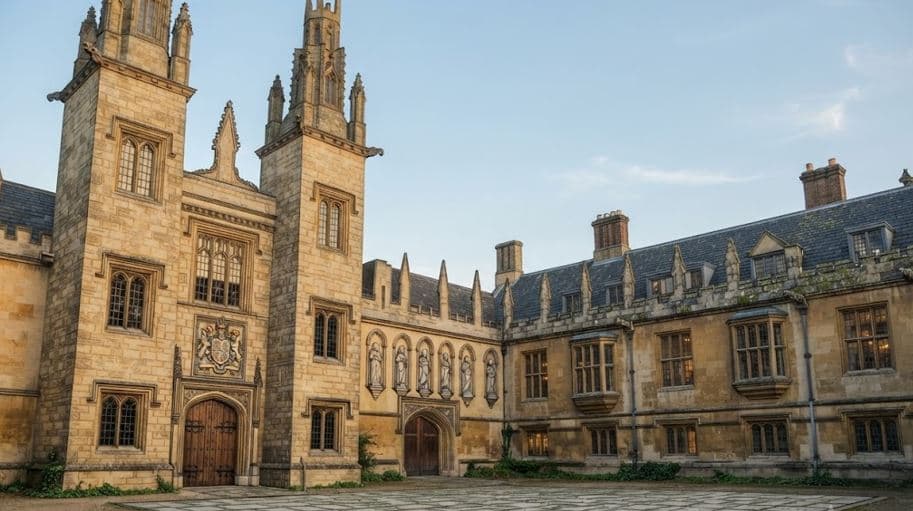
University of Oxford Medicine
University of Oxford Medicine: The Complete Applicant's Guide
A Cambridge Clinical admissions guide
The University of Oxford's Medical Sciences Division runs the Medicine A100 course (BM BCh), a six-year degree split into three pre-clinical years (culminating in a BA in Medical Sciences, with the option to intercalate further) and three clinical years, delivered through Oxford's unique collegiate system alongside the John Radcliffe Hospital and other NHS teaching sites across Oxfordshire.
Oxford's process differs from most UK medical schools in several genuinely structural ways worth understanding before anything else: it shortlists using a contextualised 50:50 combination of GCSE attainment and UCAT score, doesn't currently factor the UCAT's Situational Judgement Test into shortlisting at all (though it's disclosed to colleges afterward), runs a second safety-net review of near-miss applicants before finalising the shortlist, and interviews using traditional panel interviews at multiple colleges rather than an MMI circuit. It also switched from the BMAT to the UCAT relatively recently — for 2025 entry onward — a change worth knowing about if you come across older Oxford admissions guidance still referencing BMAT.
This guide covers entry requirements, the shortlisting formula and its safety-net review, the college interview system, and Oxford's Graduate Entry Medicine route.
Quick facts
Course | Medicine A100 (BM BCh, 6 years), plus Graduate Entry Medicine A101 (4 years, accelerated) |
Location | Oxford, England — delivered through the collegiate system |
Admissions test | UCAT — mandatory since 2025 entry (replaced the BMAT); required for both A100 and A101 from 2027 entry |
Interview format | Traditional panel interviews, typically 2–3 across different colleges, in person for most applicants |
Shortlisting | Contextualised GCSE score combined 50:50 with normalised UCAT score; SJT not used pre-interview; a further ~80 borderline applicants added after individual tutor review |
UCAS deadline | 15 October — the same early deadline as Cambridge, roughly a month ahead of most other UK medical schools |
Why applicants consider Oxford
Oxford has been ranked first in the world for medical and health subjects in the Times Higher Education subject rankings for fourteen consecutive years, and its pre-clinical/clinical split gives students an unusually deep grounding in the academic basis of medicine — including the chance to intercalate in Year 3 into a wide range of other subjects — before moving into hospital-based clinical training for the final three years. Teaching combines lectures and practicals with Oxford's distinctive tutorial system: small-group or one-to-one teaching with an academic tutor at your college, which is also why "compatibility with the tutorial format" appears explicitly in Oxford's own selection criteria. The UNIQ summer school offers Year 12 state-school students in the UK two dedicated Medicine-oriented courses each year, and Oxford Opportunity Bursaries and Crankstart Scholarships provide meaningful financial support to students from lower-income households.
Entry requirements
A-level: A*AA in three A-levels taken in one academic year, excluding Critical Thinking and General Studies. You need at least grade A in both Chemistry and at least one of Biology, Physics or Mathematics. Where a practical component forms part of any A-level taken, Oxford expects you to have taken and passed it.
GCSE: There's no formal minimum GCSE requirement, but Oxford expects a basic education in Biology, Physics and Mathematics (broadly grade C/4 or equivalent), and is explicit that strong GCSE grades are effectively a prerequisite in practice, since GCSE attainment is combined with your UCAT score in shortlisting — successful applicants typically present very high GCSE profiles.
International Baccalaureate: 39 points overall including core points (Extended Essay and Theory of Knowledge), with 7,6,6 at Higher Level, including Chemistry and at least one of Biology, Physics or Mathematics at Higher Level (both the Analysis & Approaches and Applications & Interpretation Maths courses are accepted).
Scottish Advanced Highers: AA in Advanced Highers, taken in the same academic year, including Chemistry plus one of Biology, Physics or Mathematics.
Age requirement: All applicants must be at least 18 years old by 1 November in the year they intend to start the course — a relatively recent, explicitly stated policy that catches out some younger applicants who assume the usual 18-by-September rule applies.
Graduate applicants: Assessed against the same standard A100 academic requirements (A*AA including Chemistry plus one of Biology, Physics or Mathematics, or the international equivalent). A first-class or strong upper-second-class degree is generally expected, but Oxford is explicit that a strong degree cannot compensate for A-level results that fall meaningfully short of the standard. Science graduates are pointed instead toward the dedicated 4-year A101 Graduate Entry Medicine course, an accelerated route.
International students: Oxford Medicine operates under a government-set quota — currently a maximum of 14 international-fee-status places per year across both the standard A100 course and the A101 Graduate Entry course combined, making international competition for Oxford notably tighter than the home applicant pool.
Written work: Not required for A100 Medicine, unlike some other Oxford courses.
UCAT and the switch from BMAT
Every applicant to Oxford Medicine — undergraduate A100 and, from 2027 entry, Graduate Entry A101 too — must register for and sit the UCAT. This is a genuinely significant change from Oxford's admissions history: Oxford used the BMAT for years and switched to the UCAT for 2025 entry onward, so any admissions guidance you find still referencing BMAT preparation is now out of date. The UCAT itself changed too — Abstract Reasoning was removed from the test from 2025 onward, meaning total scores are now out of 2,700 rather than the previous 3,600, so historic score benchmarks aren't directly comparable to the current scale either.
Oxford states plainly that it doesn't require or recommend any formal UCAT preparation course, pointing instead to the UCAT consortium's free official practice materials.
How shortlisting actually works: 50:50 GCSE + UCAT, plus a safety-net review
Oxford's shortlisting process is genuinely one of the more mechanically transparent in UK medicine admissions, and it works in two distinct stages:
Stage 1 — algorithmic shortlisting. A contextualised measure of your GCSE attainment is combined 50:50 with your UCAT score, which is normalised against the scores of all Oxford applicants that year (not the national UCAT population). If you don't have GCSEs — or sat fewer than six, or sat them in summer 2020/2021 when grading was disrupted — your UCAT score is given double weight instead, and Oxford states this won't disadvantage your application. There's no fixed, published cut-off on either measure; the threshold depends entirely on that cycle's applicant pool. The Situational Judgement Test is not currently used in this shortlisting stage, though your SJT band is disclosed to colleges after interviews to help with final ranking decisions.
Stage 2 — individual tutor review. Every application not shortlisted algorithmically is then reviewed individually by admissions tutors, specifically to catch candidates whose academic potential the algorithm may have underestimated — including those with individual GCSEs from disrupted 2020/2021 sittings or fewer than six GCSEs. Tutor-nominated applications, together with those sitting just below the initial cut-off, are then reviewed further by the Shortlisting Committee; in the most recent cycle reported, this process added roughly 80 additional applicants to the shortlist who wouldn't otherwise have made it through algorithmically.
Wherever possible, your grades are considered in the context in which they were achieved, and applicants from the most disadvantaged backgrounds are strongly recommended for shortlisting provided the evidence suggests they're likely to meet the standard conditional offer and perform to a suitable UCAT standard.
The interview: traditional college panel interviews
Unlike the vast majority of UK medical schools, Oxford does not use a Multiple Mini Interview circuit for Medicine. Instead, shortlisted candidates typically attend two to three traditional panel interviews at different colleges over several days in early December — you may be interviewed at your own college choice (or the college you were allocated to via open application) and at one or more additional colleges, since Oxford deliberately reallocates and cross-interviews to balance competition across colleges. Interviews assess the personal characteristics and academic potential Oxford has explicitly published as its selection criteria: empathy, motivation, communication, honesty and integrity, ethical awareness, ability to work with others, capacity for sustained work, and — reflecting the tutorial-based teaching style — problem-solving, intellectual curiosity, and compatibility with a tutorial format specifically.
Oxford is explicit that college choice shouldn't be used tactically — because of the reallocation and open-offer mechanisms in place, many successful applicants ultimately receive offers from a college other than the one they originally applied to.
Application process
Applications go through UCAS by 15 October, the same early deadline as Cambridge and roughly a month ahead of most other UK medical schools — this is easy to miss if you're used to the standard mid-October medicine deadline elsewhere, since it can feel like the same date but catches people off guard when Oxford-specific supplementary steps (like UCAT booking) are left too late. Oxford does not currently offer a Foundation or Gateway Year route for Medicine. Deferred entry is possible but genuinely rare in practice — in the most recent cycle reported, only a small number of eligible deferred applicants were shortlisted and interviewed, and fewer still received an offer. If you have relevant extenuating circumstances, Oxford has a dedicated mitigating circumstances process for notifying admissions ahead of shortlisting. UK tuition fees for medicine follow the same government-set cap as other English medical schools; see Oxford's own fees and funding page for the current confirmed figures and international rates.
Tips
Because GCSE attainment is contextualised and combined 50:50 with UCAT, don't treat GCSEs as a formality just because Oxford states there's no formal minimum — in practice, a strong GCSE profile carries real, quantifiable weight here in a way it doesn't at every UK medical school.
If your UCAT sitting or GCSE circumstances were disrupted (fewer than six GCSEs, or GCSEs sat in 2020/2021), don't assume you're automatically disadvantaged — Oxford's stated process specifically builds in an individual tutor review to catch exactly this situation, so make sure any relevant context is clearly flagged in your application.
Because Oxford uses traditional panel interviews rather than an MMI circuit, and expects "compatibility with the tutorial format" as an explicit selection criterion, prepare differently than you would for a rotating MMI station format — practice sustained, in-depth discussion and being pushed on your reasoning by a small panel, rather than rapid-fire station-based scenarios.
Don't get caught out by the earlier UCAS deadline — 15 October, the same as Cambridge — and make sure your UCAT is booked and sat well before then, since the test itself typically needs to be completed by mid-to-late September.
How Cambridge Clinical can help
We help Oxford applicants build a strategy around the specific 50:50 GCSE/UCAT shortlisting formula, alongside interview coaching calibrated to Oxford's traditional panel format and tutorial-style questioning — a genuinely different skill from MMI preparation used at most other UK medical schools.
If you'd like a hand with any stage, visit cambridgeclinical.co.uk to find out more about our UCAT tuition and Oxford-specific interview coaching.
Entry requirements, shortlisting formulas, and application deadlines can and do shift between application cycles — Oxford's move from BMAT to UCAT is a recent example of exactly this kind of change. Always confirm current requirements against The University of Oxford's official Medicine: Requirements page before finalising your application.