
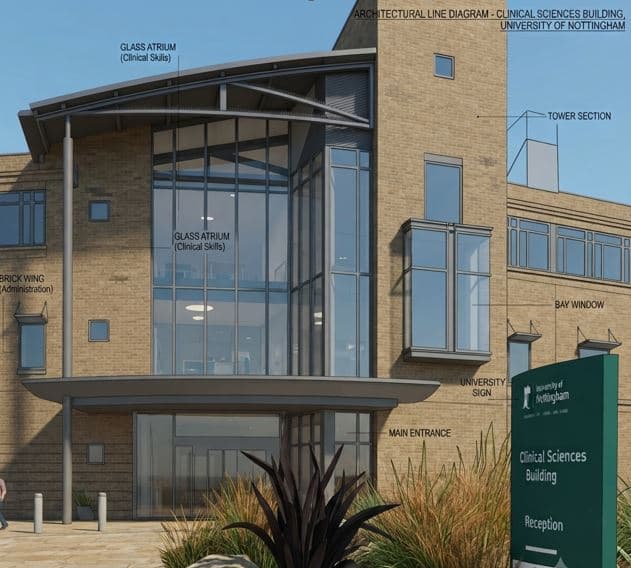
University of Nottingham Medicine
University of Nottingham Medicine: The Complete Applicant's Guide
A Cambridge Clinical admissions guide
The University of Nottingham School of Medicine runs the Medicine BMBS (A100), a five-year course based primarily at Queen's Medical Centre — one of the UK's largest and busiest hospitals — alongside teaching labs on University Park and clinical placements across Nottinghamshire Healthcare Trust, Derbyshire Healthcare Trust, Royal Derby Hospital, King's Mill Hospital, Chesterfield Royal Hospital, and GP practices throughout the region.
Nottingham's process is worth understanding on one specific point that surprises a lot of applicants: A-levels, predicted grades and personal statements play no part whatsoever in shortlisting for interview. Only your GCSEs and UCAT score are scored pre-interview, and the final offer decision then rests entirely on interview performance. This guide covers entry requirements, exactly how the GCSE + UCAT scoring system works, the six-scenario MMI format, and Nottingham's Foundation Year and graduate-entry routes.
Quick facts
Course | Medicine BMBS (A100), plus Medicine with a Foundation Year (A108) and Graduate Entry Medicine (A101) |
Location | Nottingham, England |
Admissions test | UCAT — mandatory, sat in the year of application |
Interview format | Six-scenario MMI (including at least one role play), up to one hour; likely in person for home applicants, online via MS Teams for international applicants (2027 entry) |
Shortlisting | GCSE score + UCAT score, no fixed threshold; SJT Band 4 automatically excluded; A-levels and personal statement not scored pre-interview |
Final offer | Based solely on interview performance |
Why applicants consider Nottingham
Nottingham's newly redesigned course follows a "spiral curriculum," revisiting core topics with increasing depth across all five years, structured broadly as the Art of Medicine (Year 1, focused on consultation skills and introductory clinical knowledge), the Science of Medicine (Year 2, with primary care placements one day a week alongside deeper physiology, anatomy, biochemistry and pharmacology), and increasingly placement-heavy clinical rotations from Year 3 onward across medicine, surgery, integrated specialities, child health, women's health, primary care and emergency medicine. Nottingham is ranked 16th in the UK and in the world's top 100 for Medicine (QS World University Rankings 2025), is consistently named among the UK's most-targeted universities by leading graduate employers, and offers final-year elective placements in the UK or abroad.
Entry requirements
A-level: AAA, must include Biology (or Human Biology) and Chemistry. A pass is required in separately assessed science practical components. Citizenship Studies, Critical Thinking, General Studies and Global Perspectives are not accepted as your third subject. A-levels must be studied over a maximum two-year period, with all three passed at the required grades in one sitting.
A-level resits: Considered for up to two A-levels, provided you completed your A-levels within the last 12 months, already held at least ABB (with an A in Biology/Human Biology or Chemistry) at first sitting, and your resit grades reach AAA including Biology (or Human Biology) and Chemistry.
GCSE: A minimum of six GCSEs at Grade 7 (A), including both Biology and Chemistry, plus a minimum grade 6 (B) in Maths and English Language. These six should be studied over a two-year period and the required grades achieved in one sitting. One GCSE resit is considered, in Maths, English Language, Biology, Human Biology, Chemistry or Double Science — the resit grade must still reach at least a 6 (B) for Maths/English or a 7 (A) for the sciences.
International Baccalaureate: 34 points overall, including HL6 in Biology and HL6 in Chemistry, or 6,6,6 across three Higher Level certificates with HL6 in Biology and Chemistry.
Scottish qualifications, Irish Leaving Certificate and other international equivalents: Considered individually — Nottingham states plainly that all candidates are assessed on an individual basis across a broad range of qualifications, so if your qualification isn't A-level or IB, it's worth checking directly with admissions for your specific profile.
BTEC and Access to HE Diploma: Neither is currently accepted for entry to this course — a notably stricter position than several other UK medical schools that do accept one or both.
Graduate applicants: A 2:1 Honours degree in any subject, plus A-level Biology at grade B specifically for non-bioscience degrees with insufficient biology content, plus a minimum GCSE grade 6 (B) in Maths. Nottingham will also consider a 2:2 undergraduate degree if you've completed, or are due to complete, a taught master's at merit or above. If you're still studying, you can apply during any year of your current degree without withdrawing — just don't let your offer rely on a result you haven't yet achieved unless you're applying at the start of your final year, with ratified documentation due by 6 August. Graduates choose between the five-year A100 route and the four-year Graduate Entry Medicine (A101) route, but can't apply to both in the same cycle.
Age: Applicants aged 17 or above are accepted; those who will be under 18 at registration need a parent or guardian to complete an under-18 consent form.
English language (home students who moved to the UK after Year 10 without GCSE English Language at grade 6/B): IELTS 7.5 (no element below 7.0), or an accepted equivalent such as Pearson PTE Academic 79, or Cambridge Proficiency/Advanced 191.
Work experience: Usually expected — care-related volunteering, work with disadvantaged groups, or paid public-facing employment all count — but Nottingham is explicit that it does not expect in-person NHS work experience specifically, and your application won't be marked down for not having secured any. What matters is being able to speak to your understanding of the profession at interview.
How the GCSE + UCAT scoring system works
Nottingham's Undergraduate Selection Process page sets out the actual points system in detail — one of the more transparent breakdowns among UK medical schools:
GCSE scoring (up to 32 points): Eight GCSEs are scored — Biology (or Human Biology), Chemistry (or Double Science), Maths, English Language, and your four highest-scoring other subjects — using a fixed points table:
Grade | Points |
|---|---|
9 or A* | 4 |
8 | 3 |
7 or A | 2 |
6 or B | 1 |
UCAT scoring (up to 50 points): The three cognitive subtests (Verbal Reasoning, Quantitative Reasoning, Decision Making) contribute up to 40 points combined — Verbal Reasoning is specifically doubled in Nottingham's formula, based on published UCAT research evidence — scored on a banded scale from 0 points (raw score under 400) up to 10 points per section (raw score 801–900). The Situational Judgement Test contributes up to a further 10 points: Band 1 scores 10, Band 2 scores 6, Band 3 scores 2, and Band 4 results in automatic exclusion from consideration entirely.
Your GCSE and UCAT scores are simply added together, with no fixed threshold — the bar moves every year depending on applicant numbers and the overall quality of that cycle's cohort, and Nottingham doesn't publish historic thresholds. If you haven't taken GCSEs, or you're applying with a degree instead, only your UCAT score is used, and Nottingham states this won't disadvantage your application relative to school-leavers. Elite athletes meeting the university's sport department criteria can fast-track directly to interview provided minimum entry requirements are met.
Foundation Year and contextual admissions
Medicine with a Foundation Year (A108) is a six-year route for UK applicants from underrepresented or disadvantaged backgrounds who don't meet the standard A100 requirements — it's the same course with an additional preparatory year, and its own separate, lower academic thresholds (five GCSEs at grade 6 including the core science and language requirements, and a reduced A-level offer). You cannot apply to both A100 and A108 in the same UCAS cycle.
Nottingham's standard contextual offers for home applicants are AAB (with at least one A in Biology or Chemistry), rising to an Enhanced Contextual Offer of ABB (same subject condition) for applicants meeting additional widening-participation criteria — including care experience of more than three months, or completion of programmes like Realising Opportunities, a Sutton Trust Summer School or Pathways to Medicine at Nottingham, or the university's own Ambition 16–18 scheme as a Tier 1 member. International fee-status applicants meeting Nottingham's separate contextual mitigations policy can receive an AAB contextual offer. Elite athletes also qualify for an AAB contextual offer. Full detail sits on the contextual admissions policy page.
The interview: six-scenario MMI, and a purely interview-based offer
Nottingham's interview runs for up to an hour and consists of six scenarios, including at least one role play, assessing communication and listening skills, understanding of professional issues like teamwork, and respect for patients and allied healthcare professions — criteria drawn directly from the Medical Schools Council's core values framework. For 2027 entry, home fee-status applicants are likely to interview in person, while international fee-status applicants interview online via Microsoft Teams.
What happens after interview is the single most important thing to understand about Nottingham's process: your GCSE and UCAT scores, and your A-levels, personal statement and reference, are not scored again at this stage — they're simply reviewed to confirm they're satisfactory. Nottingham states plainly that it makes offers based solely on interview performance, subject to meeting your grade conditions, a satisfactory occupational health assessment, DBS clearance, and no outstanding fitness-to-practise concerns. This is a genuinely different final-stage logic from schools like Lincoln, where your pre-interview academic score is folded back into the final ranking.
Application process
Applications go through UCAS by the standard 15 October deadline, using course code A100 (or A108 for the Foundation Year, A101 for Graduate Entry Medicine — you can't apply to more than one of these Nottingham routes in the same cycle). Nottingham does not accept transfers from another medicine course, either within Nottingham or from another university, and does not consider applicants who've previously started and failed to complete a medicine degree at another UK institution. Deferred entry is welcomed for A100 (though not for Graduate Entry Medicine), with deferral requests accepted up to 1 May. UK tuition fees for 2027/28 are confirmed at £10,050 per year; international fees are yet to be confirmed. Budget separately for an enhanced DBS check (around £50) and, if you choose to register it, the government's DBS Update Service (£16/year).
Tips
Because A-levels and predicted grades genuinely carry zero weight in Nottingham's pre-interview scoring, strong GCSEs and a competitive UCAT score are what actually get you through the door here — don't assume a stellar set of predicted A-levels will compensate for a weaker GCSE profile, since Nottingham simply never looks at your A-level predictions at this stage.
The doubled weighting on Verbal Reasoning in Nottingham's UCAT formula is worth knowing before you sit the test — if VR has historically been your weaker cognitive subtest, it's disproportionately worth extra practice specifically for a Nottingham application.
Since the final offer decision rests solely on interview performance, with your academic/UCAT score not carrying forward, treat interview preparation as genuinely decisive — a strong pre-interview score gets you into the room, but it's the six MMI scenarios that determine the outcome.
If you're applying with a non-standard qualification (BTEC, Access to HE, or an international qualification not explicitly listed), contact admissions directly and early, since BTEC Nationals and Access to HE Diplomas are explicitly not accepted for this course, unlike some other UK medical schools.
How Cambridge Clinical can help
We help Nottingham applicants strengthen the two things that actually determine their shortlisting — GCSE profile and UCAT performance, with particular attention to Verbal Reasoning given its doubled weighting — alongside MMI coaching for Nottingham's six-scenario, role-play-inclusive interview format.
If you'd like a hand with any stage, visit cambridgeclinical.co.uk to find out more about our UCAT tuition and Nottingham-specific interview coaching.
Entry requirements, scoring bands, and application deadlines can and do shift between application cycles. Always confirm current requirements against The University of Nottingham's official Medicine BMBS course page before finalising your application.