
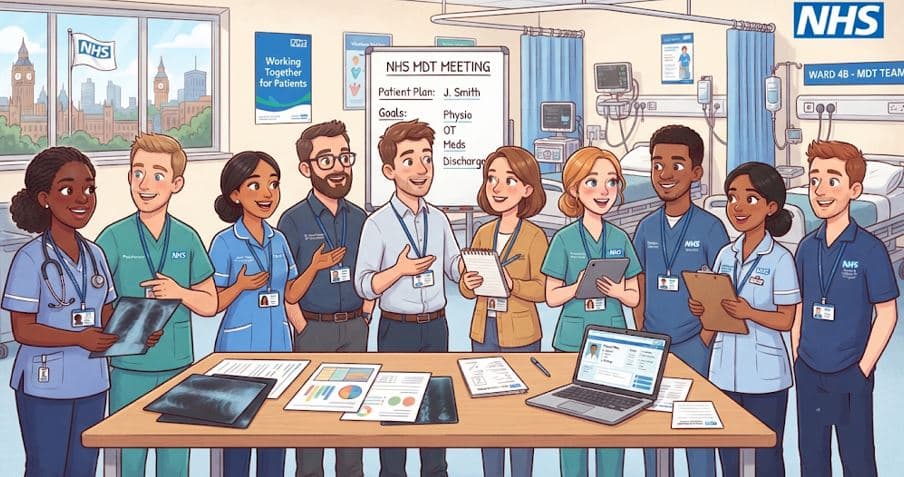
The multidisciplinary team (MDT)
What is an MDT?
An MDT is a collaborative team of healthcare professionals from different specialties working together to deliver coordinated, patient-centred care. It ensures decisions are made using a range of expertise to improve diagnosis, treatment planning, and outcomes.
Typical members include:
- Doctors (consultants, registrars, junior doctors)
- Nurses
- Allied health professionals (physiotherapists, occupational therapists, speech & language therapists)
- Pharmacists
- Radiologists / pathologists (case-dependent)
- Social workers and discharge coordinators
Why is MDT working important?
Key points:
- Improves patient outcomes through shared expertise
- Reduces medical errors and omissions
- Ensures holistic care (medical + functional + social needs)
- Supports complex decision-making (e.g. cancer, frailty, stroke)
- Improves discharge planning and flow through hospital
- Enhances patient safety and continuity of care
“What makes a good MDT?”
- Patient-centred – decisions focus on patient needs and preferences
- Collaborative – all members contribute equally
- Well-communicated – clear, structured discussions
- Respectful – values all professional input
- Organised – clear leadership and agenda
- Evidence-based – decisions guided by guidelines and data
- Documented – clear records of decisions and rationale
Ethical principles in MDT working
- Beneficence: acting in the patient’s best interest
- Non-maleficence: avoiding harm via coordinated care
- Autonomy: involving patient in decisions
- Justice: fair access to resources and treatments
- Accountability: shared responsibility across team
What are the challenges of MDT working?
- Communication breakdowns
- Hierarchical dominance (some voices not heard)
- Time constraints and workload
- Conflicting opinions between specialties
- Delays in decision-making
- Poor documentation or unclear responsibility
How to improve MDT effectiveness
- Structured meetings with clear agenda
- Strong leadership (usually consultant-led)
- Good documentation of decisions
- Encouraging equal participation
- Use of shared electronic records
- Regular audit and feedback
Example MDT scenarios
1. Cancer MDT
- Oncologist, surgeon, radiologist, pathologist, CNS nurse
- Decides staging and treatment plan
2. Stroke MDT
- Neurologist, physiotherapist, SALT, OT, nurse
- Focus on rehabilitation and functional recovery
3. Frailty/elderly care MDT
- Geriatrician, pharmacist, social worker, PT/OT
- Focus on function, discharge, and safety at home
“MDT working is essential in modern healthcare, particularly for complex patients. It ensures holistic, evidence-based, and patient-centred care. Effective communication and mutual respect are key to its success, and when functioning well, MDTs significantly improve patient outcomes and safety.”

Questions and Answers
What is a multidisciplinary team (MDT)?
Answer
A multidisciplinary team is a group of healthcare professionals from different specialties who work together to provide coordinated and patient-centred care.
Each professional contributes their own expertise to help create a holistic management plan that addresses the patient’s medical, psychological, social, and rehabilitation needs.
For example, in cancer care, the MDT may include surgeons, oncologists, radiologists, specialist nurses, pharmacists, and physiotherapists.
Why are MDTs important in modern healthcare?
Answer
Modern healthcare is increasingly complex, especially with ageing populations and chronic disease. No single professional has all the expertise needed to manage every aspect of patient care safely.
MDTs improve:
- communication
- patient safety
- continuity of care
- efficiency
- shared decision-making
They also reduce the risk of fragmented care and allow patients to benefit from multiple professional perspectives.
Who is the most important member of the MDT?
Answer
I would say the patient is the most important member because healthcare decisions should ultimately centre around the patient’s needs, values, and preferences.
However, I also think every MDT member plays a vital role, and effective care depends on respecting each professional’s expertise.
What role does a pharmacist play in the MDT?
Answer
Pharmacists help ensure medications are prescribed safely and effectively. They advise on:
- dosing
- side effects
- drug interactions
- medication optimisation
They are extremely important in reducing prescribing errors and improving patient safety.
What role does an occupational therapist play?
Answer
Occupational therapists help patients maintain independence and perform daily activities safely.
They often assess:
- mobility
- home environments
- discharge needs
- adaptive equipment requirements
For example, before an elderly patient is discharged, an OT may assess whether they can safely manage stairs or require support at home.
Why are nurses central to the MDT?
Model Answer
Nurses are often the professionals who spend the most time with patients, so they develop detailed insight into patients’ day-to-day condition and wellbeing.
They play a key role in:
- monitoring patients
- advocating for patient concerns
- coordinating care
- communication between professionals
Tell me about a time you worked in a team.
Model Answer Structure
1. Situation
“I worked in a sports team during sixth form…”
2. Task
“We had to coordinate training and communicate during matches…”
3. Action
“My role involved organising defensive communication and supporting newer players…”
4. Reflection (Most Important)
“This experience taught me the importance of listening, communication, and respecting different roles within a team. I realised that successful outcomes depend on collaboration rather than individuals working independently, which I think directly relates to MDT working in healthcare.”
“What would you do if there is disagreement in an MDT?”
Strong answer:
- Listen to all viewpoints respectfully
- Refer to evidence-based guidelines
- Prioritise patient safety and best outcomes
- Escalate to senior consultant if needed
- Ensure patient preferences are considered
- Document discussion and rationale clearly
What qualities make a good MDT member?
- communication
- active listening
- respect for others
- humility
- reliability
- professionalism
- adaptability
- willingness to escalate concerns
Scenario 1
You are a medical student on placement. A nurse tells you they are concerned a patient is deteriorating, but the junior doctor appears busy and dismissive.
What would you do?
Answer
My priority would be patient safety.
First, I would listen carefully to the nurse’s concerns because nurses often have detailed knowledge of the patient’s condition and may notice subtle deterioration early.
As a medical student, I would not independently assess or manage the patient beyond my competence, but I would ensure the concern is escalated appropriately.
If the junior doctor remained unavailable or dismissive, I would escalate the concern to a more senior clinician, such as the registrar or consultant, following local escalation procedures.
This situation highlights the importance of communication and psychological safety within MDTs, where all professionals should feel able to raise concerns.
Scenario 2
A physiotherapist believes a patient is unsafe for discharge, but the doctor believes they can go home.
How should this be resolved?
Answer
This should be resolved through professional discussion focused on patient safety rather than hierarchy.
The physiotherapist may have specialist expertise regarding mobility and functional independence, while the doctor may focus more on medical stability.
Ideally, the MDT should discuss:
- risks
- home support
- rehabilitation needs
- patient preferences
If disagreement remains, a senior review may be necessary. Ultimately, decisions should be evidence-based and centred around safe patient care.
Scenario 3
A consultant speaks rudely to a nurse during ward round.
What would you do?
Answer
Professional behaviour is important for both staff wellbeing and patient safety.
As a medical student, I would avoid confronting the consultant publicly in a way that could escalate tension during patient care.
However, I would reflect on the incident and consider escalating concerns through appropriate channels, particularly if the behaviour was repeated or affected patient safety.
A respectful MDT culture is essential because poor communication and intimidation can discourage staff from speaking up about concerns.
Why has the doctor’s role changed in modern MDTs?
Answer
Historically, medicine followed a more paternalistic “doctor knows best” model. Modern healthcare is now much more collaborative and patient-centred.
Doctors still play an important leadership role in diagnosis and medical management, but they increasingly work alongside other professionals whose expertise is equally valuable in different areas of care.
I think modern medicine requires humility, communication, and teamwork rather than isolated decision-making.
What challenges can MDTs face?
Answer
Some MDT challenges include:
- communication breakdowns
- time pressures
- conflicting opinions
- hierarchy issues
- unclear responsibilities
These challenges can affect efficiency and patient safety if not managed appropriately.
Good leadership, mutual respect, and structured communication are important for overcoming these difficulties.
MDT working is central to modern healthcare because complex patient care requires collaboration between multiple professionals to deliver safe, holistic, and patient-centred treatment.
Useful Links
https://www.nhs.uk/nhs-services/hospitals/what-is-a-multidisciplinary-team-mdt/
https://www.gmc-uk.org/ethical-guidance/ethical-guidance-for-doctors/good-medical-practice
https://www.nice.org.uk/guidance
https://www.rcplondon.ac.uk/guidelines-policy
https://www.kingsfund.org.uk/topics/integrated-care
https://digital.nhs.uk/data-and-information
https://www.bma.org.uk/advice-and-support/nhs-delivery-and-workforce/industrial-action
https://www.macmillan.org.uk/cancer-information-and-support/treatment/cancer-team
https://www.stroke.org.uk/stroke/treatment/rehabilitation
https://bsw.icb.nhs.uk/for-clinicians/anticipatory-care/multi-disciplinary-working/