
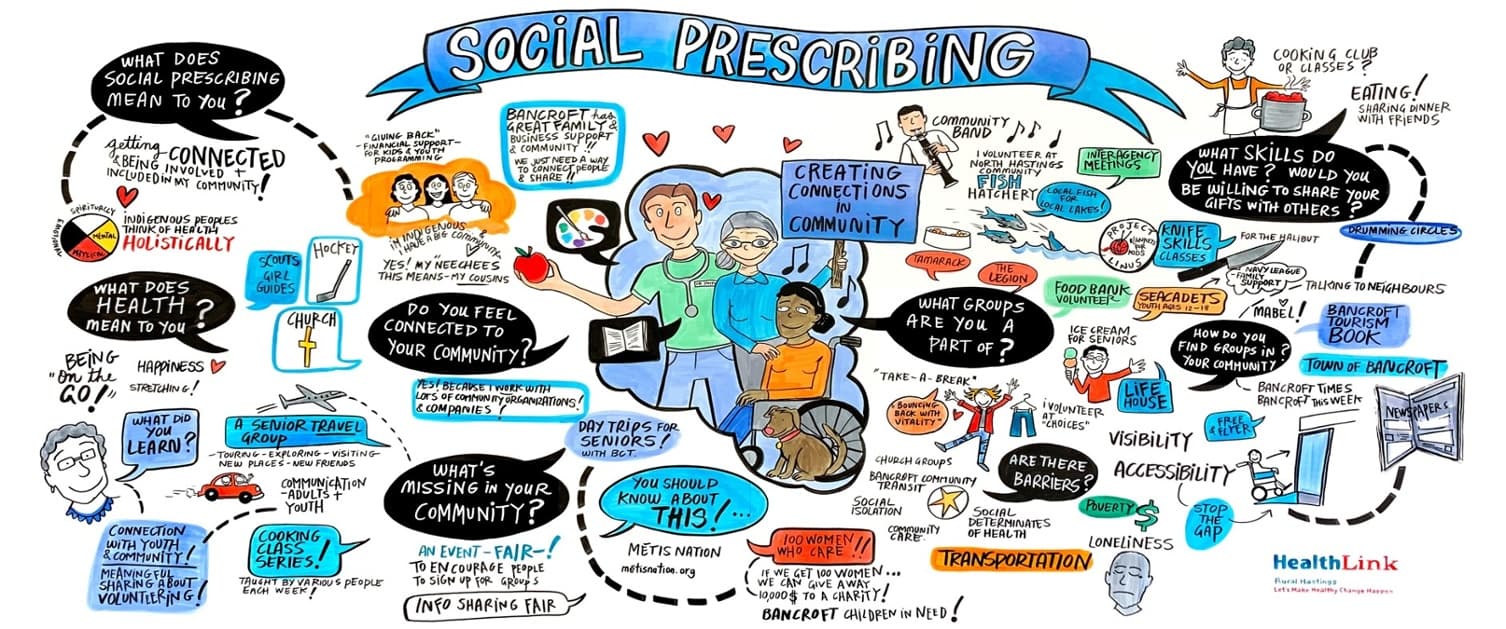
Social Prescribing
1. What is Social Prescribing
Social prescribing is a non-medical, holistic approach that connects patients to community-based activities and support services to improve their mental, physical, and social well-being. It is often described as "prescribing not pills, but people and purpose."
Aspect | Detail |
What it is | A non-pharmacological intervention delivered via voluntary/community organisations. |
Who refers | GPs, nurses, hospital discharge teams, social services, pharmacies. |
Who delivers | Social Prescribing Link Workers connect patients to local activities. |
Examples | Gardening clubs, befriending services, cookery classes, exercise groups, art therapy. |
Key goal | Treat the person holistically – not just the disease. |
Key Quote for Interview: "Social prescribing recognises that health is not just about tablets and tests. Loneliness, poverty, and isolation make people ill. Social prescribing treats those root causes."
2. Why Does Social Prescribing Exist? (The Problem It Solves)
Up to 20% of GP consultations are for social rather than purely medical problems – loneliness, housing issues, debt, bereavement, isolation.
Problem | How Social Prescribing Helps |
Loneliness and social isolation | Befriending services, community groups. |
Chronic conditions (diabetes, heart disease) | Exercise classes, cookery lessons (healthy eating). |
Mental health (anxiety, mild depression) | Gardening, art therapy, walking groups. |
Complex social needs (homelessness, debt) | Link workers connect to housing/financial advice. |
Frail elderly | Falls prevention classes, social clubs. |
Interview Hook: "A GP cannot prescribe a friend or a reason to get out of bed in the morning. But social prescribing can. It addresses the social determinants of health – the underlying causes of so much illness."
3. How Social Prescribing Works – The Process Flow (Text-Based Diagram)

4. The Role of the Social Prescribing Link Worker
This is a growing role in the NHS (over 2,500 link workers now employed).
Responsibility | What They Actually Do |
Deep listening | Spend 30–60 minutes understanding the patient's life, not just their symptoms. |
Goal setting | "What would you like to change? What matters to you?" |
Navigation | Know local services – from walking groups to debt advice. |
Empowerment | Help patients take control of their own well-being. |
Advocacy | Speak up for patients navigating complex systems. |
Follow-up | Check in to ensure activities are helping. |
Interview Hook: "A link worker does not 'fix' the patient. They empower the patient to fix their own situation – by connecting them to the right community resources. It is a coaching role, not a medical role."
5. Examples of Social Prescribing Activities
Activity | Who It Helps | Health Benefit |
Gardening club | Elderly, isolated, mild depression | Reduces loneliness; gentle exercise; purpose. |
Befriending service | Housebound, bereaved, anxious | Reduces isolation; improves mood. |
Cookery classes | Low-income families, diabetes | Healthy eating; weight management; social connection. |
Exercise classes | Obesity, heart disease, frailty | Physical health; confidence; peer support. |
Walking groups | Anxiety, depression, chronic pain | Exercise; nature; social contact. |
Art therapy | Mental health conditions | Emotional expression; relaxation. |
Debt/housing advice | Financial stress, homelessness | Reduces anxiety; improves stability. |
Real Example: A lonely 80-year-old widow with mild depression is referred to a weekly lunch club. She makes friends, has a reason to get dressed and leave the house, and her mood improves without antidepressants.
6. Benefits of Social Prescribing (The Evidence)
6.1 For Patients
Benefit | Evidence |
Reduced anxiety | Bristol evaluation project: patients reported less health-related anxiety. |
Improved quality of life | Patients reported increased well-being and social connectivity. |
Reduced loneliness | Community programmes decreased feelings of isolation. |
Empowerment | Patients feel more in control of their health. |
6.2 For the NHS
Benefit | Evidence |
40% reduction in GP consultations | Study comparing social prescribing patients to controls. |
Reduced A&E attendances | Rotherham scheme: >80% of patients had fewer inpatient and A&E visits after 3 months. |
Reduced hospital admissions | Same Rotherham scheme. |
Cost-effective | Reduces demand on expensive secondary care. |
Key Statistic to Memorise: "A study found that GP consultations decreased by 40% after social prescribing compared to a control group. A Rotherham scheme found that over 80% of patients had fewer A&E visits and inpatient appointments after just 3 months."
7. Visual Summary – Benefits Diagram (Text-Based)

8. Challenges and Limitations of Social Prescribing
A balanced answer acknowledges difficulties, not just benefits.
Challenge | Explanation |
Lack of standardised outcomes | More than half of social prescribing outcomes are not routinely measured – difficult to prove effectiveness. |
Variable quality of evidence | Public Health England concluded more evidence is needed on which patient populations benefit most. |
Availability varies geographically | "Postcode lottery" – some areas have rich voluntary sectors; others have very few activities. |
Link worker capacity | Growing demand; link workers often have heavy caseloads. |
Patient engagement | Some patients are reluctant to engage with community activities (e.g., social anxiety, transport issues). |
Funding uncertainty | Social prescribing relies on short-term or ring-fenced funding – not always sustainable. |
Not a replacement for medical care | Social prescribing should complement, not replace, evidence-based medical treatment. |
Interview Hook: "Social prescribing is promising, but it is not a magic bullet. The evidence base is still developing – Public Health England has called for more rigorous research. And it only works if the community infrastructure exists. A gardening club is no use if there is no gardening club."
9. Social Prescribing and the NHS Long-Term Plan
The NHS Long-Term Plan (2019) made social prescribing a central component of personalised care.
Commitment | Detail |
Target | 2.5 million patients referred to social prescribing by 2023/24. |
Link workers | Every Primary Care Network (PCN) to have a social prescribing link worker. |
Mandatory requirement (2022/23) | PCNs must offer social prescribing and work with patients facing health inequalities. |
Funding model | Funding goes to link workers, not directly to voluntary organisations. |
Related NHS Initiatives
Initiative | Year | Focus |
NHS Five Year Forward View | 2014 | Emphasised prevention and voluntary sector role. |
National Academy of Social Prescribing (NASP) | 2019 | £5 million DHSC investment to build evidence and awareness. |
Loneliness strategy | 2018 | Government promoted social prescribing to tackle loneliness. |
Green social prescribing | 2020 | Connecting patients with nature (walking, conservation, gardening). |
Interview Hook: *"The NHS Long-Term Plan set an ambitious target of 2.5 million social prescribing referrals by 2024. This shows that social prescribing is no longer a fringe idea – it is mainstream NHS policy. But meeting that target requires investment in both link workers and voluntary sector capacity."*
10. Who Benefits Most from Social Prescribing?
Patient Group | Why They Benefit |
Socially isolated elderly | Befriending, lunch clubs, coffee mornings. |
Patients with mild-moderate depression/anxiety | Gardening, walking groups, art therapy. |
Patients with long-term conditions (diabetes, COPD, heart disease) | Exercise classes, cookery lessons, condition-specific support groups. |
Frequent attenders (GP or A&E) | Addresses underlying social causes of repeat attendance. |
Patients with complex social needs (homelessness, debt, substance use) | Link workers connect to specialist advice services. |
Carers | Respite activities, peer support groups. |
Important Note: Social prescribing is not for patients with severe mental illness (e.g., psychosis, active suicidal ideation) or acute medical emergencies. It complements – does not replace – medical treatment.
11. Social Prescribing and Medical Ethics (4 Pillars)
Ethical Principle | How Social Prescribing Upholds It |
Beneficence (do good) | Improves quality of life, reduces anxiety, increases social connection. |
Non-maleficence (do no harm) | Avoids over-medicalisation (e.g., antidepressants for loneliness). Non-pharmacological. |
Autonomy (patient choice) | Patient chooses which activities to attend; personalised care plan. |
Justice (fairness) | Accessible to all, regardless of ability to pay. Reduces health inequalities. |
Interview Hook: "Social prescribing operationalises the biopsychosocial model of health. It recognises that a patient's biology (their illness) cannot be separated from their psychology (their mood) or their social context (their isolation, housing, finances). It treats the whole person."
12. Five Interview Questions & Answers
Q1 (Easy): "What is social prescribing?"
Answer:
"Social prescribing is a non-medical, holistic approach that connects patients to community-based activities and support services to improve their mental, physical, and social well-being. Instead of prescribing medication, a GP or nurse might refer a patient to a Social Prescribing Link Worker, who then connects them to local activities like gardening clubs, befriending services, exercise classes, or cookery lessons. It is particularly helpful for patients with loneliness, mild depression, long-term conditions, or complex social needs. The NHS Long-Term Plan has made social prescribing a central part of personalised care, with a target of 2.5 million referrals."
Quick Points
- Non-medical, holistic approach to healthcare
- Focuses on improving mental, physical, and social wellbeing
- Involves referring patients to a Social Prescribing Link Worker
- Link worker connects patients to community-based services
- Alternatives to medication rather than pharmacological treatment
- Examples include gardening groups, exercise classes, cookery groups, befriending services
- Commonly used for loneliness, mild depression, long-term conditions, social isolation
- Supports person-centred care rather than disease-only management
- Part of the NHS Long Term Plan
- Aims to expand personalised care and reduce pressure on GP services
- Target of around 2.5 million referrals across the NHS
- Encourages community engagement and social support networks
Q2 (Medium): "What are the benefits of social prescribing?"
Answer:
"Social prescribing has benefits for patients, the NHS, and the wider community.
For patients, evidence shows reduced anxiety, improved quality of life, decreased loneliness, and increased feelings of empowerment and social connection.
For the NHS, studies have found a 40% reduction in GP consultations and significant reductions in A&E attendances and hospital admissions. One Rotherham scheme found that over 80% of patients had fewer A&E visits after just 3 months. This frees up GPs and hospital staff to focus on complex medical cases.
For society, social prescribing builds stronger communities, supports the voluntary sector, and addresses the social determinants of health – like isolation, poverty, and poor housing – that underpin so much illness.
However, the evidence base is still developing, and outcomes are not always measured consistently."
Q3 (Medium): *"You are a GP. An 80-year-old patient says they feel lonely and isolated since their spouse died. They don't want antidepressants. What do you do?"*
Answer:
"First, I would listen empathically and acknowledge their loss. Loneliness after bereavement is normal, but it can also lead to depression and physical decline if untreated.
Since they do not want medication, I would discuss social prescribing. I would explain that I can refer them to a Social Prescribing Link Worker who specialises in connecting older adults to community activities. Depending on what is available locally, this might include a bereavement café, a lunch club, a gardening group, a walking group, or a befriending service where a volunteer visits regularly.
I would reassure them that this is not 'dismissing' their feelings – it is a positive, evidence-based intervention that helps many people in their situation. I would also check for any red flags (weight loss, not eating, thoughts of self-harm) that might indicate clinical depression requiring a different approach.
Finally, I would arrange a follow-up appointment to see how they are getting on, and I would remain open to medication or talking therapies if things do not improve."
Quick Points
- Listen empathically and acknowledge bereavement
- Validate that loneliness after loss is normal
- Explain risk of ongoing loneliness → depression / decline
- Explore patient preference (no medication)
- Introduce social prescribing
- Refer to Social Prescribing Link Worker
- Link worker connects to community support
- Examples of support:
- Bereavement café
- Lunch clubs
- Gardening groups
- Walking groups
- Befriending services
- Reassure it is not dismissing their concerns
- Explain it is a evidence-based, holistic approach
- Check for red flags:
- Weight loss / poor appetite
- Low mood / depression
- Self-harm thoughts
- Offer safety-net advice and support
- Arrange follow-up review
- Keep options open for talking therapy or medication if needed
Q4 (Hard): "What are the limitations of social prescribing?"
Answer:
"I think it is important to be balanced. Social prescribing has great potential, but it also has limitations.
First, the evidence base is still developing. Public Health England has stated that more rigorous research is needed to confirm which patient populations benefit most. Over half of social prescribing outcomes are not routinely measured, making it hard to prove effectiveness.
Second, availability varies geographically. A patient in a city with a rich voluntary sector may have many options; a patient in a rural area may have very few. This is a justice issue – a 'postcode lottery'.
Third, capacity is a challenge. Link workers are in high demand and may have heavy caseloads. Some patients may also be reluctant to engage with community activities due to social anxiety, transport difficulties, or lack of confidence.
Fourth, social prescribing is not a replacement for medical care. A lonely patient with severe depression may still need medication or talking therapy. Social prescribing should complement, not replace, evidence-based treatment.
Despite these limitations, I believe social prescribing is a valuable tool – but it must be properly funded, rigorously evaluated, and integrated with medical care, not seen as a cheap alternative."
Q5 (Advanced): "How does social prescribing relate to the biopsychosocial model of health?"
Model Answer:
"The biopsychosocial model, proposed by Engel, argues that health and illness are determined by the interaction of biological, psychological, and social factors. Traditional medicine often focuses only on the biological – the disease, the pill, the operation.
Social prescribing explicitly addresses the psychological and social dimensions. For example, a patient with type 2 diabetes (biological) may also have depression (psychological) and be isolated, lonely, and unable to afford healthy food (social).
Prescribing metformin (biological) is necessary but insufficient. Social prescribing might connect them to a cookery class (social: learning, connection), a walking group (psychological: mood; social: connection), and a debt advice service (social: financial stability).
This holistic approach is more likely to succeed than medication alone. Social prescribing is the biopsychosocial model put into practice."
Quick Points
- Proposed by George Engel
- Health is explained by biological, psychological, and social factors
- Moves away from purely biomedical model
- Biological factors: disease, pathology, medication, surgery
- Psychological factors: mood, stress, beliefs, motivation
- Social factors: isolation, finances, housing, support networks
- Traditional medicine often focuses mainly on biological disease treatment
- Social prescribing applies the biopsychosocial model in practice
- Example: Type 2 diabetes
- Biological: hyperglycaemia → metformin
- Psychological: low mood / poor motivation
- Social: loneliness, poverty, poor diet access
- Social prescribing interventions:
- Cookery classes
- Walking groups
- Befriending services
- Debt advice support
- Medication is necessary but not sufficient alone
- Best outcomes come from addressing all three domains together
- Social prescribing = holistic, person-centred care
Other Common Interview Questions – By Difficulty
Easy
- What is social prescribing?
- How does social prescribing work?
- Give three examples of social prescribing activities.
- Who can refer a patient to social prescribing?
Medium
- What are the benefits of social prescribing?
- What kind of patients benefit from social prescribing?
- How does social prescribing reduce pressure on the NHS?
- What is the role of a Social Prescribing Link Worker?
Hard
- What are the limitations and challenges of social prescribing?
- How does social prescribing relate to the biopsychosocial model?
- How does the NHS Long-Term Plan support social prescribing?
- A lonely elderly patient refuses antidepressants but also refuses social prescribing. What do you do?
13. Quick Revision Table – Must-Know Facts
Fact | Detail |
Definition | Non-medical intervention connecting patients to community activities. |
Who refers | GPs, nurses, hospital discharge teams, social services, pharmacies. |
Who delivers | Social Prescribing Link Worker. |
Examples | Gardening, befriending, cookery, exercise, art, walking groups. |
Key benefit (patients) | Reduced anxiety, loneliness; improved quality of life. |
Key benefit (NHS) | 40% reduction in GP visits; fewer A&E attendances. |
NHS policy | NHS Long-Term Plan: target 2.5 million referrals by 2023/24. |
Funding | Link workers (not directly to voluntary organisations). |
Challenge | Variable evidence base; postcode lottery; capacity. |
Related initiative | National Academy of Social Prescribing (NASP, 2019). |
Useful Links
https://www.england.nhs.uk/personalisedcare/social-prescribing/
https://www.nhs.uk/nhs-services/social-prescribing/
https://www.england.nhs.uk/personalisedcare/workforce-and-training/social-prescribing-link-workers/
https://www.longtermplan.nhs.uk/
https://www.kingsfund.org.uk/insight-and-analysis/long-reads/social-prescribing
https://commonslibrary.parliament.uk/research-briefings/cbp-8529/
https://www.socialprescribingacademy.org.uk/