
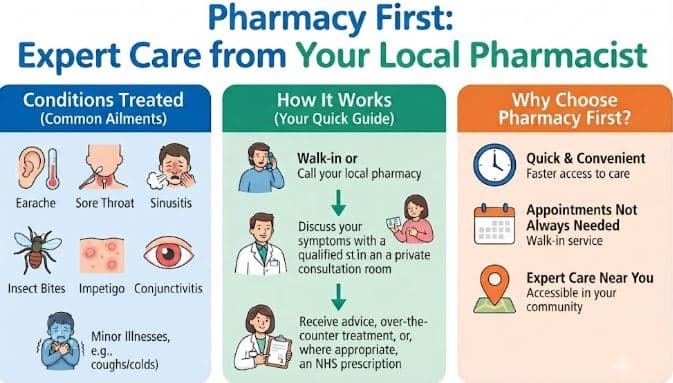
Pharmacy First Initiative
1. What Is the Pharmacy First Initiative?
The Pharmacy First Initiative is an NHS England service launched on 31 January 2024.
It allows trained community pharmacists to assess and treat patients for selected common illnesses without requiring the patient to see a GP first.
Importantly, pharmacists can now provide:
- Clinical assessments
- Advice and safety-netting
- Prescription-only medicines (including antibiotics and antivirals)
- Referral onwards if symptoms are serious
The initiative was introduced to:
- Improve access to healthcare
- Reduce GP workload
- Reduce NHS waiting times
- Improve efficiency in primary care
- Use pharmacists' clinical skills more effectively
2. Why Was It Introduced?
The NHS has faced:
- Rising GP appointment demand
- Workforce shortages
- Long waiting times
- Increasing emergency department attendance
- Growing population and ageing population
- Increasing chronic disease burden
Many GP appointments are for relatively minor illnesses.
The government recognised that pharmacists are highly trained healthcare professionals who could safely manage many of these cases.
NHS Pressure Diagram
Increasing NHS Demand
↓
GP Appointment Shortages
↓
Long Waiting Times
↓
Pressure on A&E and Hospitals
↓
Need for Alternative Pathways
↓
PHARMACY FIRST
3. The 7 Conditions Covered
Condition | Age Group | Typical Treatments |
Acute Otitis Media | 1–17 years | Pain relief, antibiotics |
Impetigo | 1+ years | Topical/oral antibiotics |
Infected Insect Bites | 1+ years | Antibiotics, creams |
Shingles | 18+ years | Antivirals |
Sinusitis | 12+ years | Nasal sprays, antibiotics |
Sore Throat | 5+ years | Conservative care, antibiotics |
Uncomplicated UTI (women) | Women 16–64 years | Nitrofurantoin/trimethoprim |
4. How Pharmacy First Works
Patient Pathway
Patient develops symptoms
↓
Visits community pharmacy
↓
Private consultation with pharmacist
↓
History + assessment
↓
Treatment OR referral
↓
Consultation shared with GP
Patients can access the service through:
- Walk-in appointments
- NHS 111 referrals
- GP referrals
- Telephone consultations
- Online/video consultation (limited conditions)
5. How Pharmacy First Helps the NHS
Main Goals
1. Reduce GP Workload
Minor illnesses can be treated in pharmacies.
2. Improve Access
Pharmacies are often:
- Closer to patients
- Open evenings/weekends
- Easier to access quickly
3. Reduce Waiting Times
Fewer unnecessary GP appointments means:
- Faster appointments for complex patients
- Better allocation of NHS resources
4. Reduce Pressure on A&E
Patients with minor illnesses may avoid unnecessary emergency department attendance.
6. NHS Pressure Graph
Estimated Pressure Distribution
GP Pressure Before Pharmacy First
Minor illnesses ████████████████████ 40%
Chronic disease ████████████ 25%
Mental health ██████ 15%
Complex disease ████████ 20%
GP Pressure After Pharmacy First
Minor illnesses ████████ 15%
Chronic disease ██████████████ 30%
Mental health ████████ 20%
Complex disease ████████████ 35%
This demonstrates how Pharmacy First aims to free GP time for more complex patients.
7. Advantages of Pharmacy First
Faster Access to Care
Patients can often be seen on the same day.
Convenience
Pharmacies are widely available and often open outside standard working hours.
Reduced NHS Burden
GPs and A&E departments can focus on more serious conditions.
Better Use of Healthcare Professionals
Pharmacists are highly trained and underutilised.
Improved Patient Satisfaction
Patients avoid long waits for simple conditions.
Cost-Effective
Treating minor illnesses in pharmacies is cheaper than GP or hospital appointments.
8. Disadvantages & Challenges
Risk of Misdiagnosis
Some serious conditions can initially appear mild.
Example:
- Meningitis may initially present as fever/sore throat
- Sepsis may mimic infection symptoms
Antibiotic Resistance
Greater antibiotic prescribing could worsen antimicrobial resistance.
Fragmentation of Care
GPs may not always receive complete information.
Training Variation
Different pharmacists may have different experience levels.
Patient Safety Concerns
Limited access to full patient history may increase risk.
Overburdening Pharmacies
Pharmacies themselves may become overwhelmed.
9. Ethical Considerations
Medical school interviewers LOVE ethics.
You should structure answers using:
- Autonomy
- Beneficence
- Non-maleficence
- Justice
Ethical Principle Table
Ethical Principle | Pharmacy First Example |
Autonomy | Patients can choose quicker pharmacy care |
Beneficence | Faster treatment benefits patients |
Non-maleficence | Need safe prescribing and referral systems |
Justice | Improves access and resource allocation |
10. Antibiotic Resistance — Important Interview Point
One of the biggest concerns surrounding Pharmacy First is inappropriate antibiotic prescribing.
Why?
If antibiotics are overused:
- Bacteria evolve resistance
- Antibiotics become less effective
- Future infections become harder to treat
Example Organisms
- MRSA
- Drug-resistant E. coli
- Resistant Streptococcus
Good Interview Point
You can say:
"While Pharmacy First improves access to care, safeguards are essential to ensure antibiotics are prescribed appropriately in order to avoid worsening antimicrobial resistance."
11. Stakeholders in Pharmacy First
Stakeholder | Interest |
Patients | Faster access and convenience |
Pharmacists | Expanded professional role |
GPs | Reduced workload |
NHS England | Lower system pressure |
Government | Improved healthcare efficiency |
Public Health Teams | Safe antibiotic stewardship |
12. Comparison — GP vs Pharmacy First
Feature | GP Appointment | Pharmacy First |
Wait time | Longer | Usually shorter |
Conditions treated | Broad range | Limited list |
Prescribing | Full prescribing | Limited prescribing pathways |
Continuity of care | Better | Variable |
Access to records | Full | More limited |
13. Important Interview Themes
NHS Resource Allocation
Pharmacy First demonstrates:
- Task redistribution
- Workforce optimisation
- Efficient healthcare delivery
Primary vs Secondary Care
Understand:
- Pharmacies = primary care
- GPs = primary care
- Hospitals = secondary care
Healthcare Accessibility
The service may improve access for:
- Rural patients
- Working adults
- Patients unable to get GP appointments
14. Potential Criticisms
Two-Tier Care Concerns
Some argue wealthier areas may benefit more.
Digital Exclusion
Online pharmacy consultations may disadvantage:
- Elderly patients
- Patients without internet access
Safety Netting Concerns
Patients may delay seeing a doctor if symptoms worsen.
15. Data Privacy & Confidentiality
Pharmacists must:
- Maintain confidentiality
- Secure patient records
- Share information safely with GPs
- Follow GDPR rules
This is especially important because healthcare data is sensitive.
16. Future of Pharmacy First
The initiative may expand further.
Potential future developments:
- More conditions treated
- Greater prescribing powers
- AI-supported triage systems
- Integration with electronic NHS records
- Expanded pharmacist clinical training
17. Flowchart — Safe Patient Pathway
Patient attends pharmacy
↓
Assessment completed
↓
Minor/self-limiting illness?
↙ ↘
YES NO
↓ ↓
Treatment Refer to GP/A&E
↓
Safety-net advice
↓
Follow-up if worsening
18. High-Level Interview Vocabulary
Using sophisticated vocabulary appropriately can improve answers.
Useful Terms
- Antimicrobial resistance
- Antibiotic stewardship
- Resource allocation
- Healthcare accessibility
- Primary care pressures
- Patient-centred care
- Clinical governance
- Safety-netting
- Healthcare sustainability
- Workforce optimisation
- Continuity of care
19. Common Interview Mistakes
Mistake 1: Only discussing positives
Always give balanced answers.
Mistake 2: Memorising statistics only
Interviewers prefer understanding.
Mistake 3: Ignoring ethics
Most NHS topics involve ethics.
Mistake 4: Forgetting patient safety
Patient safety must always come first.
20. Quick Revision Summary
Must-Know Facts
- Introduced: 31 January 2024
- NHS England initiative
- Pharmacists treat 7 conditions
- Includes prescription-only medicines
- Aims to reduce GP pressure
- Improves patient access
- Ethical concerns include safety and antibiotic resistance
Key Statistics
Reasons Pharmacy First Was Introduced
GP pressure ████████████████████
Waiting times ██████████████████
A&E overcrowding ███████████████
Workforce shortages ██████████████
Ageing population ████████████
If you remember ONLY FIVE things:
- Pharmacy First launched in January 2024.
- Pharmacists can now treat 7 common conditions.
- The aim is to reduce pressure on GPs and improve access.
- Main concerns include patient safety and antibiotic resistance.
- Balanced ethical discussion is essential in interviews.
Final Interview Tip
Medical school interviewers are NOT expecting you to be a healthcare policy expert.
They want to see:
- Logical reasoning
- Communication skills
- Balanced judgement
- Ethical awareness
- Understanding of NHS pressures
- Patient-centred thinking
Always remain balanced, compassionate, and realistic in your answers.
21.Sixteen Questions & Answers
Q1: What is the Pharmacy First Initiative?
Model Answer:
The Pharmacy First Initiative is an NHS England service launched in January 2024 that allows community pharmacists to assess and treat seven common conditions without patients needing to see a GP first. Pharmacists can now provide prescription-only medicines, such as antibiotics or antivirals, where clinically appropriate. The aim is to improve access to healthcare, reduce pressure on GP services, and make better use of pharmacists’ clinical skills.
Q2: Why was the Pharmacy First Initiative introduced?
Model Answer:
The initiative was introduced because NHS primary care services are under significant pressure, with increasing GP waiting times and workforce shortages. Many patients attend GP appointments for relatively minor illnesses that pharmacists are trained to manage safely. By allowing pharmacists to treat these conditions directly, the NHS hopes to improve patient access to care, reduce unnecessary GP appointments, and help tackle NHS backlogs.
Q3: Which conditions can pharmacists now treat under Pharmacy First?
Model Answer:
Pharmacists can treat seven common conditions:
- Acute otitis media (ear infections)
- Impetigo
- Infected insect bites
- Shingles
- Sinusitis
- Sore throat
- Uncomplicated urinary tract infections in women
For some of these conditions, pharmacists can prescribe prescription-only medications such as antibiotics or antivirals.
Q4: How does Pharmacy First differ from the old Community Pharmacist Consultation Service (CPCS)?
Model Answer:
Under the previous CPCS system, pharmacists mainly provided advice and over-the-counter treatments for minor illnesses. Pharmacy First expands their role significantly by allowing pharmacists to prescribe certain prescription-only medications independently for specific conditions. This makes the service more clinically useful and reduces the need for GP involvement in straightforward cases.
Q5: What are the advantages of the Pharmacy First Initiative?
Model Answer:
The initiative has several advantages:
- Improved access to healthcare because pharmacies are widely available and often open longer hours
- Reduced pressure on GP surgeries and A&E departments
- Faster treatment for patients with minor illnesses
- Better use of pharmacists’ expertise and training
- Increased convenience for patients
- Potential cost savings for the NHS
Overall, it helps streamline healthcare delivery and improve efficiency within the NHS.
Q6: What are the potential disadvantages or challenges of Pharmacy First?
Model Answer:
There are several challenges. Pharmacists may not have full access to patients’ medical histories or previous microbiology results, which could affect prescribing decisions. There may also be variation in training and experience between pharmacies. Some people worry about missed diagnoses if symptoms are more serious than they initially appear. Additionally, pharmacies themselves could become overwhelmed if demand increases significantly.
Q7: What ethical concerns are associated with Pharmacy First?
Model Answer:
One ethical concern is patient safety, ensuring pharmacists are properly trained and know when to refer patients to a doctor. Confidentiality is also important, especially because consultations occur in community settings. Another concern is equitable access, as some areas may have fewer participating pharmacies. There is also the issue of antimicrobial stewardship — pharmacists must avoid overprescribing antibiotics to reduce antibiotic resistance.
Q8: How does Pharmacy First help the NHS?
Model Answer:
Pharmacy First helps the NHS by reducing unnecessary GP appointments and allowing doctors to focus on more complex or urgent cases. It may also reduce pressure on emergency departments because patients can access advice and treatment more quickly in the community. This supports the NHS goal of improving efficiency while maintaining patient care quality.
Q9: Do you think pharmacists are qualified to take on this role?
Model Answer:
Yes, pharmacists are highly trained healthcare professionals with extensive knowledge of medications, prescribing, and common illnesses. However, it is important they work within clear clinical guidelines and know when referral to a GP or hospital is necessary. With appropriate training and safeguards, pharmacists can safely manage many minor conditions and improve healthcare accessibility.
Q10: How might Pharmacy First affect antibiotic resistance?
Model Answer:
There are both benefits and risks. On one hand, pharmacists following strict treatment protocols may help ensure antibiotics are prescribed appropriately. On the other hand, easier access to antibiotics could increase overprescribing if not carefully monitored. Antimicrobial stewardship is therefore extremely important, and pharmacists must ensure antibiotics are only prescribed when clinically indicated.
Q11: What is antimicrobial stewardship?
Model Answer:
Antimicrobial stewardship refers to the careful and responsible use of antibiotics and other antimicrobial medicines to reduce antibiotic resistance. It involves prescribing antibiotics only when necessary, choosing the correct drug and dose, and educating patients on proper use. This is important because antibiotic resistance is a growing global health threat.
Q12: How does Pharmacy First improve patient experience?
Model Answer:
Patients can access care more quickly and conveniently, often without needing to book a GP appointment. Pharmacies are usually close to home and open during evenings or weekends, which improves accessibility. Faster treatment may also reduce anxiety and prevent conditions from worsening.
Q13: Could Pharmacy First increase health inequalities?
Model Answer:
Potentially, yes. Some deprived or rural areas may have fewer pharmacies or fewer participating services, limiting access. Digital exclusion may also affect online or telephone access routes. Therefore, while Pharmacy First can improve access overall, the NHS must ensure services are distributed fairly to avoid widening inequalities.
Q14: How would you respond if a patient insisted on antibiotics for a viral sore throat?
Model Answer:
I would communicate calmly and empathetically, explaining that most sore throats are caused by viruses and antibiotics would not help. I would discuss the risks of unnecessary antibiotics, including side effects and antibiotic resistance. I would also provide advice on symptom relief and explain when the patient should seek further medical attention if symptoms worsen.
Q15: Do you think Pharmacy First will solve NHS pressures?
Model Answer:
I think it will help reduce some pressure on primary care services, but it is not a complete solution. NHS pressures are caused by multiple factors including workforce shortages, an ageing population, and increasing demand. Pharmacy First is one useful strategy among many, but wider investment in staffing, prevention, and healthcare infrastructure is also needed.
Q16. Should Pharmacists Prescribe Antibiotics?
Arguments For
- Faster treatment
- Reduced GP workload
- Pharmacists are trained professionals
- Improved patient access
Arguments Against
- Risk of inappropriate prescribing
- Limited access to patient records
- Possible diagnostic uncertainty
- Resistance concerns
Balanced Conclusion
Pharmacist prescribing can be highly beneficial if:
- Proper training exists
- Clear clinical pathways are followed
- Good communication systems exist
- Strong referral systems are available
Useful Links
Official NHS Resources
NHS Pharmacy First:
https://www.england.nhs.uk/primary-care/pharmacy/pharmacy-services/pharmacy-first/
NHS England Primary Care Recovery Plan:
https://www.england.nhs.uk/long-read/delivery-plan-for-recovering-access-to-primary-care/
NHS Community Pharmacy Information:
https://www.nhs.uk/nhs-services/pharmacies/
General NHS Hot Topics
NHS Long Term Plan:
https://www.longtermplan.nhs.uk/
NICE Guidelines:
https://www.nice.org.uk/
British Medical Association:
https://www.bma.org.uk/
Royal Pharmaceutical Society:
https://www.rpharms.com/
Antibiotic Resistance
WHO Antimicrobial Resistance:
https://www.who.int/health-topics/antimicrobial-resistance
UKHSA Antibiotic Resistance:
https://www.gov.uk/government/organisations/uk-health-security-agency