
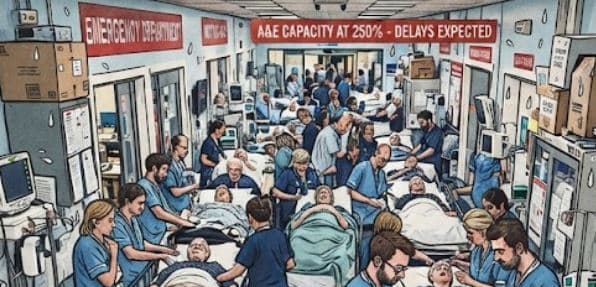
NHS WINTER PRESSURES & BED CRISIS
1. What the topic is really about
In UCAT and MMIs, this topic is not about memorising facts—it’s about showing you understand:
- Resource limitation in healthcare
- Patient safety vs system capacity
- Ethical decision-making under pressure
- Prioritisation (triage)
- GMC professionalism and fairness
You can think like a junior doctor in a strained NHS system.
2. Core definition
NHS Winter Pressures
Seasonal increase in demand (Nov–Mar) due to:
- Flu, pneumonia, RSV
- Falls and injuries (ice, cold weather)
- Exacerbation of chronic disease (COPD, asthma, heart failure)
Result: increased admissions + overcrowding
NHS Bed Crisis
A situation where hospitals operate above safe capacity.
- Safe occupancy ≈ 85%
- Many hospitals exceed this → reduced flexibility for emergencies
3. Why the problem exists
Use these 5 causes in answers:
1. Ageing population 10%
- More admissions
- Longer hospital stays
2. Reduced bed numbers 15%
- Long-term NHS capacity reduction
3. Delayed discharge (“bed blocking”) 30%
- Patients medically fit but cannot leave due to social care delays
4. Staffing shortages 20%
- Fewer staff = slower patient flow + inefficiency
5. Winter disease surge 25%
- Flu, pneumonia, viral infections spike in winter
· Winter admissions ≈ +40–50% increase
· Driven by:
- Flu
- Pneumonia
- RSV
- Falls (ice/weather)
- COPD/asthma exacerbations
- 200,000 minor A&E attendances (avoidable visits)
- ~50%+ increase in winter respiratory admissions (seasonal trend)
- high bed occupancy (>85–90% unsafe threshold concept)
4. Impact
On patients:
- Delayed treatment
- Longer waiting times
- Increased infection risk
- Reduced privacy (corridor care)
- Worse outcomes for urgent cases
On staff:
- Burnout
- Fatigue → increased errors
- Moral distress
On system:
- Ambulance delays
- A&E overcrowding
- Cancelled elective procedures
5. Ethical issues
Always link to GMC principles:
1. Justice (fair allocation)
- Who gets a bed first when demand exceeds supply?
2. Dignity
- Corridor care compromises privacy and respect
3. Beneficence vs practicality
- Doing best for patient vs system limits
4. Patient safety first
- Unsafe occupancy increases risk of harm
5. Duty of candour + escalation
- Raising concerns when system unsafe
6. What a doctor should do
If asked scenario questions, structure like this:
STEP 1: Patient safety first
- Assess urgency (ABCDE / triage logic)
STEP 2: Prioritise appropriately
- Most clinically urgent treated first
STEP 3: Escalate
- Senior doctor / bed manager / consultant
STEP 4: Communicate
- With patient and team honestly
STEP 5: Reflect/report if system issue
- Incident reporting / governance
7. High-yield interventions
Use a prevention + capacity + flow model:
Prevention
- Vaccination (flu, COVID, RSV)
- Public health messaging
Capacity
- More beds
- Virtual wards (hospital at home)
Flow improvement
- Faster discharge planning
- Social care integration
- “Care coordination hubs”
System efficiency
- Ambulance triage improvements
- Urgent care centres outside A&E
8. Common trap themes
- “First come, first served” ❌ (wrong)
- Ignoring escalation ❌
- Not mentioning patient safety ❌
- No ethical reasoning ❌
- No system-level thinking ❌
“Winter pressures are caused by increased demand, reduced capacity, and blocked discharge pathways.”
Fifteen Questions and Answers
1. What are NHS winter pressures?
Answer:
NHS winter pressures refer to the seasonal increase in demand for healthcare services, typically from November to March. This is driven by higher rates of respiratory infections, falls, and exacerbations of chronic illnesses, combined with limited hospital bed capacity. This leads to increased admissions, longer waiting times, and strain on staff and resources.
2. What is the NHS bed crisis?
Answer:
The NHS bed crisis describes a situation where hospital bed occupancy consistently exceeds safe levels, reducing the system’s ability to admit new patients. Safe occupancy is generally considered to be around 85%, but many hospitals operate above this, leading to delays, overcrowding, and compromised patient care.
3. Why are there NHS bed shortages?
Answer:
There are several reasons:
- Ageing population leading to more admissions and longer stays
- Reduced hospital bed numbers over time
- Delayed discharges due to limited social care capacity
- Staff shortages reducing efficiency
- Seasonal increases in illness during winter
- Post-pandemic system strain and infection control pressures
4. How do winter pressures affect patient care?
Answer:
Winter pressures negatively impact patient care by increasing waiting times, delaying treatment, and overcrowding hospitals. This can increase the risk of hospital-acquired infections, reduce privacy and dignity, and contribute to staff burnout, which may increase the risk of clinical errors.
5. What is a “safe bed occupancy level” and why does it matter?
Answer:
A safe bed occupancy level is around 85%, allowing flexibility for emergency admissions. When occupancy exceeds this, hospitals become overstretched, leading to delays in admissions, reduced patient flow, and increased pressure on staff and resources.
6. What ethical issues are created by NHS winter pressures?
Answer:
Winter pressures raise several ethical issues, including:
- Fair allocation of limited resources (justice)
- Prioritisation of patients based on clinical need (triage)
- Maintaining dignity and confidentiality in overcrowded environments
- Balancing quality of care with limited capacity
These challenges require clinicians to make difficult but fair decisions guided by patient safety.
7. What is the impact of delayed discharge?
Answer:
Delayed discharge occurs when patients who are medically fit remain in hospital due to lack of social or community care support. This blocks beds for new admissions, increases overcrowding, and reduces overall system efficiency.
8. How does winter affect A&E departments?
Answer:
A&E departments experience surges in demand due to flu, pneumonia, respiratory illness, and injury from falls. This leads to longer waiting times, corridor care in extreme cases, and increased pressure on staff and resources.
9. What role does social care play in the bed crisis?
Answer:
Social care plays a key role because delays in arranging care packages or residential placement prevent timely hospital discharge. This results in patients occupying beds despite being medically fit to leave, worsening bed shortages.
10. What is triage and how is it used during winter pressures?
Answer:
Triage is the process of prioritising patients based on clinical urgency rather than arrival time. During winter pressures, it ensures that the most seriously ill patients receive care first, helping manage limited resources safely and fairly.
11. What are the risks of overcrowded hospitals?
Answer:
Overcrowding increases the risk of:
- Infection spread
- Delayed treatment
- Reduced patient privacy and dignity
- Staff burnout and fatigue
- Increased likelihood of medical errors
12. What government or NHS measures are used to reduce winter pressures?
Answer:
Measures include:
- Increasing hospital bed capacity
- Expanding ambulance and emergency services
- Using virtual wards and remote monitoring
- Improving discharge coordination through integrated care systems
- Promoting vaccination for flu, COVID-19, and RSV
- Expanding urgent respiratory care hubs
13. How would you improve winter pressure management?
Answer:
A combined approach is needed:
- Prevention through vaccination and public health campaigns
- Improving social care capacity to reduce delayed discharge
- Expanding hospital and virtual bed capacity
- Strengthening primary care access to reduce unnecessary admissions
- Better workforce planning to reduce staffing shortages
14. How do winter pressures affect staff?
Answer:
Staff experience increased workload, stress, and burnout during winter pressures. This can reduce morale and increase the risk of errors, affecting overall patient safety and quality of care.
15. Why is this an ethical challenge for doctors?
Answer:
It forces doctors to balance limited resources with patient need, sometimes delaying or prioritising care. This can create tension between fairness, efficiency, and individual patient advocacy, requiring strong ethical judgement guided by GMC principles.
16. A&E overcrowding (ethical prioritisation)
A patient attends A&E with a sore throat. Waiting times are already very long, and staff are under pressure. What is the most appropriate response?
Answer:
The most appropriate response is to assess the patient’s condition using triage protocols, ensuring that those with life-threatening conditions are prioritised first.
The patient should be redirected to more appropriate services such as a pharmacy, GP, or NHS 111 if clinically safe.
It is important to remain non-judgemental and ensure the patient feels supported, as many attend A&E due to lack of access or awareness of alternatives.
UCAT principle:
Safety + triage system + non-judgemental communication
17. Resource allocation dilemma
There are only 2 beds left in A&E and 3 patients:
- One with chest pain
- One with suspected fracture
- One with sore throat
Who should be prioritised?
Answer:
The patient with chest pain should be prioritised first as this could indicate a life-threatening condition such as myocardial infarction.
The suspected fracture would be next due to potential complications.
The sore throat patient would be least urgent and could be redirected to primary care.
UCAT principle:
Prioritise life-threatening risk first (ABCDE logic)
18. Pharmacy First diversion
A patient complains they were told to go to a pharmacy instead of seeing a GP and is upset.
What should you do?
Model Answer:
I would acknowledge their frustration and explain calmly that pharmacies are part of the NHS system designed to manage minor conditions efficiently.
I would reassure them that pharmacists are trained healthcare professionals capable of treating common conditions safely.
If symptoms worsen or persist, I would advise GP follow-up.
UCAT principle:
Communication + reassurance + system understanding
UCAT DECISION MAKING QUESTIONS
20. Should A&E be restricted?
A proposal suggests charging patients for A&E visits if their condition is non-urgent.
Evaluate this proposal.
Model Answer:
There are arguments in favour and against this proposal.
Pros:
- Could reduce unnecessary A&E attendances
- May encourage appropriate use of primary care
- Reduces pressure during winter crisis
Cons:
- May deter vulnerable patients from seeking care
- Hard to define “non-urgent” safely
- Ethical concerns about equity and justice
Final judgement:
A better approach may be improving access to GP services, NHS 111, and Pharmacy First rather than introducing charges.
UCAT principle:
Balanced ethical reasoning (justice vs efficiency)
21. GP access crisis
A GP surgery is overwhelmed. What is the best long-term solution?
A. Increase A&E capacity
B. Expand Pharmacy First and MDT roles
C. Reduce opening hours
D. Encourage private healthcare
Correct answer: B
Explanation:
Expanding MDT roles (pharmacists, physios, paramedics) improves access and reduces GP workload sustainably.
UCAT principle:
System-level thinking > short-term fixes
UCAT VERBAL REASONING STYLE
22. Statement analysis
“Most A&E visits during winter are for life-threatening conditions.”
Answer: FALSE
Evidence shows many attendances are for minor conditions such as sore throats and earaches.
UCAT principle:
Distinguish extreme claims from evidence
Useful Links:
https://www.england.nhs.uk/urgent-emergency-care/?utm_source=chatgpt.com
https://www.bma.org.uk/advice-and-support/nhs-delivery-and-workforce?utm_source=chatgpt.com