
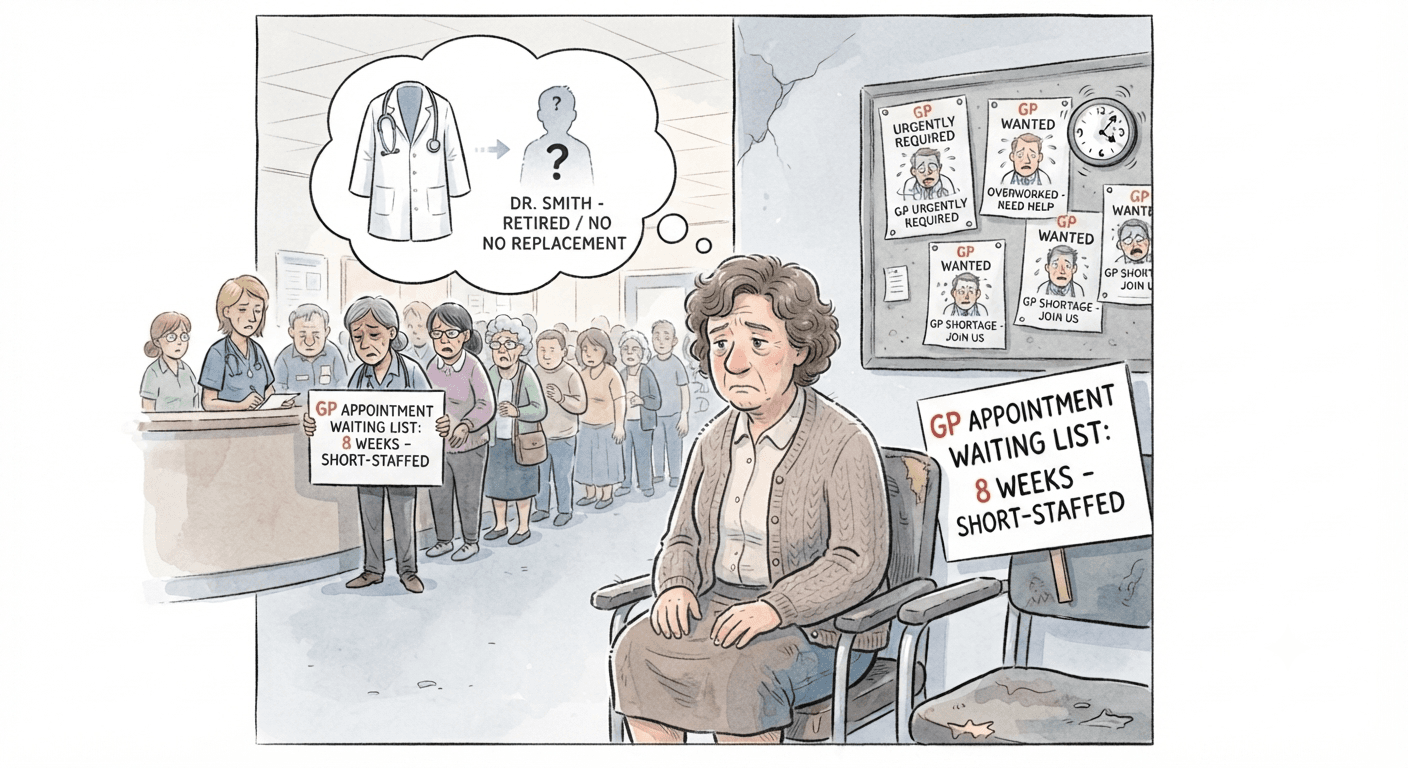
NHS - GP Shortages
GP Shortages
The NHS GP shortage is one of the most important modern NHS issues because it affects:
- patient access
- waiting times
- continuity of care
- health inequalities
- NHS pressure
- emergency department overload
It is a very common:
- MMI topic
- NHS hot topic
- ethics discussion
- healthcare policy question
Quick Summary
Key Facts
Issue | Current Situation |
GP shortage | >4,000 GP shortfall in England |
Net GP losses | Hundreds leaving yearly |
Main problems | Workload, burnout, retention |
Patient impact | Longer waits, reduced access |
Most affected | Deprived communities |
What Is a GP?
National Health Service GP (General Practitioner)
primary care doctor
GPs are usually:
- the first point of contact in healthcare
- community-based doctors
- responsible for holistic care
Role of a GP
GPs manage:
- acute illness
- chronic disease
- prevention
- mental health
- referrals
- safeguarding
- continuity of care
Examples of GP Work
Acute Problems
- chest pain
- infections
- shortness of breath
- abdominal pain
Chronic Disease
- diabetes
- asthma
- hypertension
- COPD
- depression
Why GPs Are So Important
GPs are often called:
“the front door of the NHS”
They:
- reduce hospital pressure
- detect disease early
- coordinate patient care
- prevent admissions
Why Is There a GP Shortage?
The main reason:
more GPs are leaving than entering
Main Causes of the GP Crisis
Workload Pressure
GP workload has increased massively.
Reasons include:
- ageing population
- chronic disease burden
- mental health demand
- administrative work
- NHS backlogs
10-Minute Appointments
A major issue.
GPs often must:
- take history
- examine patient
- explain diagnosis
- prescribe
- document notes
- arrange follow-up
within:
only 10 minutes
This creates:
- stress
- burnout
- rushed consultations
Administrative Burden
Large amounts of GP time involve:
- paperwork
- referrals
- insurance forms
- prescriptions
- test results
- NHS bureaucracy
Many GPs report:
admin reduces time with patients.
Burnout
Burnout is extremely common.
Symptoms include:
- exhaustion
- emotional fatigue
- reduced morale
- stress
- reduced job satisfaction
Positive Feedback Loop
The GP shortage worsens itself.
Fewer GPs
↓
Higher workload
↓
More burnout
↓
More GPs leave
↓
Even fewer GPs
Pay Differences
GPs can earn less than hospital consultants.
Approximate NHS Salaries
Role | Approx Salary |
GP | ~£65k–98k |
Consultant | ~£93k–126k |
Some GP partners earn more.
What Is a GP Partner?
GP partners:
- partly own/manage practices
- take financial responsibility
- share profits
Advantages of GP Partnership
- higher earnings
- autonomy
- leadership
Disadvantages
- financial risk
- heavy admin
- staffing responsibility
- stress
Many younger doctors:
- avoid partnerships
Retirement & Workforce Ageing
Many experienced GPs are:
- retiring early
- reducing sessions
- leaving due to pension/tax issues
This worsens shortages further.
Impact on Patients
The GP shortage directly affects:
access to care
Consequences for Patients
Longer Waiting Times
Patients may:
- wait weeks
- struggle to book appointments
- experience delays
Delayed Diagnosis
This may delay:
- cancer diagnosis
- chronic disease treatment
- mental health intervention
Pressure on A&E
If patients cannot access GPs:
- they may attend emergency departments instead
This worsens:
- NHS overcrowding
- ambulance delays
- waiting times
Continuity of Care Problems
Patients increasingly:
- see different doctors each visit
This reduces:
- trust
- relationship-building
- holistic care
Health Inequalities
The GP shortage disproportionately affects:
deprived communities
These areas often have:
- greater disease burden
- fewer doctors
- poorer access
Example of Health Inequality
In some deprived UK areas:
- life expectancy is dramatically lower
This demonstrates:
the inverse care law
What Is the Inverse Care Law?
Those who need healthcare most often have the poorest access to it.
Telemedicine & Digital Consultations
GP practices increasingly use:
- phone consultations
- online triage
- video appointments
Advantages
- convenience
- faster access
- efficiency
Disadvantages
- digital exclusion
- missed non-verbal cues
- poorer access for elderly patients
Solutions to the GP Crisis
A strong interview answer should discuss:
multiple solutions
1. Increase GP Recruitment
Methods:
- expand GP training places
- improve exposure during medical school
- encourage rural practice
2. Improve Working Conditions
Including:
- manageable workload
- longer appointments
- admin reduction
- flexible working
3. Improve Retention
Keep experienced GPs by:
- reducing burnout
- improving pension arrangements
- supporting wellbeing
4. Use Multidisciplinary Teams (MDTs)
Modern GP practices use:
- pharmacists
- physiotherapists
- nurses
- physician associates
- mental health practitioners
This reduces GP workload.
5. International Recruitment
Recruiting overseas doctors may help short-term shortages.
However:
- ethical concerns exist regarding “brain drain”
- poorer countries may lose doctors
Ethical Issues
Is It Fair to Charge for Missed GP Appointments?
This was politically debated.
Example proposal:
- £10 missed appointment charge
Arguments Supporting Charges
- reduce wasted appointments
- improve efficiency
- discourage non-attendance
Arguments Against Charges
Could disproportionately affect:
- poorer patients
- vulnerable groups
- mental health patients
May conflict with:
NHS principles of free access
NHS Principles Involved
Principle | Relevance |
Justice | Equal access |
Beneficence | Timely care |
Non-maleficence | Avoid delayed harm |
Equity | Support vulnerable groups |
Public Perception of the NHS
Difficulty accessing GP appointments has become one of the:
biggest public NHS frustrations
Many patients report:
- long waits
- “8am phone rush”
- inability to see same GP
This affects:
- trust in NHS
- satisfaction with healthcare
Key Organisations
Royal College of General Practitioners
Represents GPs professionally.
British Medical Association
Represents doctors in workforce disputes.
Questions and Answers
Common Interview Questions
- Why is there a GP shortage?
- What does a GP do?
- How does the GP shortage affect patients?
- What are health inequalities?
- How could we improve GP recruitment?
- What is the inverse care law?
- Should patients be charged for missed appointments?
GP Shortages in the NHS – Interview Questions & Model Answers
1. What do you understand by the GP shortage crisis in the NHS?
Answer:
The NHS is facing a shortage of GPs due to increasing patient demand, an ageing population with complex health needs, difficulties in recruitment and retention, workload pressures, burnout, and a significant number of experienced GPs retiring or reducing their hours. This has led to challenges in accessing primary care and increased pressure across the healthcare system.
2. Why are GPs important to the NHS?
Answer:
GPs are the first point of contact for most patients and play a crucial role in prevention, early diagnosis, chronic disease management, health promotion, and coordinating care. Strong primary care reduces unnecessary hospital admissions and supports more efficient use of NHS resources.
3. What factors have contributed to GP shortages?
Answer:
Several factors contribute:
- Increasing workload and administrative burden
- Burnout and stress
- Recruitment challenges
- Early retirement of experienced GPs
- Growing patient expectations and demand
- Increasing complexity of care due to multimorbidity
- Workforce planning challenges
4. How do GP shortages affect patients?
Answer:
Patients may experience:
- Longer waits for appointments
- Reduced continuity of care
- Delayed diagnosis and treatment
- Increased use of emergency departments
- Greater difficulty accessing preventive and chronic disease services
This can negatively affect both patient outcomes and satisfaction.
5. How do GP shortages affect hospitals?
Answer:
When patients struggle to access primary care, they may attend emergency departments or require hospital care for conditions that could have been managed earlier in the community. This increases pressure on urgent care services, outpatient clinics, and inpatient beds.
6. What solutions could help address GP shortages?
Answer:
Potential solutions include:
- Improving recruitment into general practice
- Retaining experienced GPs through flexible working
- Reducing administrative burden
- Expanding multidisciplinary teams
- Increasing training opportunities
- Supporting staff wellbeing and reducing burnout
- Improving workforce planning
A combination of these measures is likely to be most effective.
7. What role does the MDT play in addressing GP shortages?
Answer:
Multidisciplinary teams can support GPs by sharing workload and improving patient care. Team members may include:
- Advanced nurse practitioners
- Clinical pharmacists
- Physician associates (where appropriate and supervised)
- Physiotherapists
- Mental health practitioners
- Social prescribers
This allows patients to be seen by the most appropriate professional while maintaining quality of care.
8. What would you do if a patient complained about not being able to get a GP appointment?
Answer:
I would listen empathetically, acknowledge their frustration, and explain the pressures facing services without being defensive. I would assess whether urgent care is required, signpost alternative services if appropriate, and ensure the patient understands how to access further help. Good communication is essential to maintaining trust.
9. Is increasing the number of GPs alone enough to solve the problem?
Answer:
No. While increasing GP numbers is important, workforce expansion must be accompanied by measures to improve retention, reduce workload pressures, enhance MDT working, and improve healthcare system efficiency. Sustainable solutions require both recruitment and retention strategies.
10. What is the future of general practice in the NHS?
Answer:
General practice is likely to become increasingly multidisciplinary and technology-enabled. Digital consultations, integrated care systems, preventative healthcare, and collaborative working with other healthcare professionals will continue to play a larger role. However, continuity of care and the doctor-patient relationship will remain fundamental.
11."A patient is angry because they have waited three weeks for a GP appointment. How would you respond?"
Answer:
I would:
- Remain calm and professional.
- Listen actively to their concerns.
- Acknowledge their frustration.
- Assess whether there is an urgent clinical issue.
- Explain available options without making excuses.
- Ensure they know how to seek urgent help if needed.
- Escalate concerns appropriately if patient safety is affected.
This demonstrates empathy, professionalism, and a patient-centred approach.
"GP shortages are a significant challenge for the NHS because primary care forms the foundation of the healthcare system. Addressing the issue requires not only increasing workforce numbers but also improving retention, supporting staff wellbeing, embracing multidisciplinary working, and ensuring sustainable long-term workforce planning. Ultimately, strengthening general practice benefits patients and the wider NHS."
Useful URLs