
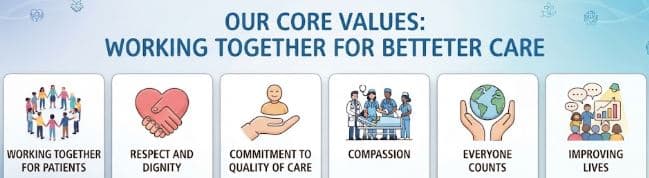
NHS 6 Core Values
The NHS 6 Core Values
1. Executive Summary (The "30-Second Answer")
The NHS 6 Core Values are the guiding principles that underpin everything the NHS does. They were formally enshrined in the NHS Constitution (2013) to set out the shared ethical framework for staff, patients, and the public.
Value | In One Sentence | |
1 | Respect and Dignity | Treat every person as an individual, with courtesy and compassion. |
2 | Commitment to Quality of Care | Strive for excellence and safety in everything you do. |
3 | Compassion | Show empathy, kindness, and understanding. |
4 | Improving Lives | Actively seek to make people's health and wellbeing better. |
5 | Working Together for Patients | Collaborate across teams and organisations. |
6 | Everyone Counts | No patient or colleague is left behind or treated unfairly. |
"Respect, Quality, Compassion, Improving, Together, Everyone."
2. The Legal Basis – The NHS Constitution
The NHS Core Values are formally set out in the NHS Constitution for England (first published in 2013, regularly updated).
Aspect | Detail |
What is it? | A legally binding document that sets out the rights, pledges, responsibilities, and values of the NHS. |
Who does it apply to? | All NHS staff, patients, and the public. |
Is it enforceable? | Some parts are legally enforceable (rights); values are guiding principles (not legally binding but central to regulation). |
Why was it created? | To codify what the NHS stands for – especially after high-profile scandals (Mid Staffordshire). |
Interview Insight: "Mentioning the NHS Constitution shows you have done deeper reading. Say: 'The values are enshrined in the NHS Constitution, which was strengthened after the Francis Report into Mid Staffordshire to ensure accountability and compassion are non-negotiable.'"
3. The 6 Values Explained in Depth
Value 1: Respect and Dignity
What It Means | How to Demonstrate in Interview | Link to Real NHS Examples |
Treating every patient and colleague as an individual. Respecting privacy, beliefs, culture, and choices. Using polite language. Maintaining confidentiality. | Give examples of respecting someone's autonomy (e.g., allowing a patient to refuse treatment). Show you understand cultural/religious sensitivity (e.g., prayer, diet, modesty). | Charlie Gard case – respecting parental views even in disagreement. Confidentiality breaches as a GMC FTP issue. |
Model Sentence: "Respect and dignity means recognising that a patient is not just a diagnosis – they are a person with a life, values, and preferences. It means knocking before entering a bay, explaining what you are doing, and never talking over a patient."
Value 2: Commitment to Quality of Care
What It Means | How to Demonstrate in Interview | Link to Real NHS Examples |
Striving for excellence. Using evidence-based medicine. Learning from mistakes. Participating in audits and quality improvement. | Mention any healthcare training, conferences, or reading you have done. Discuss a quality improvement project you observed or contributed to. | Shropshire Maternity Scandal – lack of quality care led to preventable harm. NICE guidelines exist to standardise quality. |
Model Sentence: "Commitment to quality of care means never being complacent. It means asking: 'Could we do this better?' – and then acting on the answer. That might mean an audit, a new protocol, or simply learning from a mistake."
Value 3: Compassion
What It Means | How to Demonstrate in Interview | Link to Real NHS Examples |
Showing empathy, kindness, and understanding. Putting yourself in the patient's shoes. Being present and listening. | Give a specific example of a time you showed empathy – to a patient, family member, or colleague. Use the Situation-Action-Result format. | The Francis Report (Mid Staffordshire) found a lack of compassion was central to failures. Compassion is the opposite of "task-focused" care. |
Model Sentence: "Compassion is not just being nice – it is a clinical skill. A compassionate doctor picks up on a patient's unspoken fear, holds a hand during bad news, and takes an extra minute to explain something. It directly improves outcomes and trust."
Value 4: Improving Lives
What It Means | How to Demonstrate in Interview | Link to Real NHS Examples |
Actively seeking to make health and wellbeing better – not just treating illness. Prevention, health promotion, research, and public health. | Mention volunteering, health promotion campaigns, fundraising, or public health initiatives you have been involved in. | Smoking cessation programmes, vaccine drives, diabetes prevention. Improving lives also means reducing health inequalities. |
Model Sentence: "Improving lives goes beyond the consultation room. It means advocating for public health, supporting health education in schools, and tackling the social determinants of health – like poverty, housing, and air pollution – that make people ill in the first place."
Value 5: Working Together for Patients
What It Means | How to Demonstrate in Interview | Link to Real NHS Examples |
Collaboration across disciplines, organisations, and sectors. No single doctor can do everything. Teamwork is essential for safety. | Give an example of successful teamwork from work experience, volunteering, or extracurriculars (e.g., sports, drama, part-time job). Mention conflict resolution skills. | Archie Battersbee case – required teamwork between hospital, legal teams, and parents. Integrated Care Systems (ICSs) are built on this value. |
Model Sentence: "Working together for patients means respecting the expertise of nurses, pharmacists, physiotherapists, and social workers – and communicating clearly. A surgeon working alone is dangerous. A team working together saves lives."
Value 6: Everyone Counts
What It Means | How to Demonstrate in Interview | Link to Real NHS Examples |
No patient or colleague is treated unfairly. Individual needs, backgrounds, and circumstances are recognised and accommodated. | Mention training or reading on diversity, equity, and inclusion. Give an example of advocating for someone marginalised or making reasonable adjustments. | Postcode lottery (unequal access). Organ donation and religious/cultural sensitivities. The 2024 GMC update on tackling discrimination. |
Model Sentence: "'Everyone counts' means a homeless patient with addiction deserves the same respect and treatment as a CEO. It means making adjustments for a patient with a learning disability or a colleague with a mental health condition. It is the NHS's commitment to justice."
4. Why the NHS Values Matter (For Patients, Staff, and the System)
Stakeholder | Why Values Matter |
Patients | Values ensure consistent, compassionate, respectful treatment regardless of where you live or who you are. |
Staff | Values provide a shared ethical framework, reduce moral distress, and guide difficult decisions. |
The NHS as a system | Values hold the organisation accountable. They are referenced in inquiries (e.g., Francis Report), regulation (CQC), and training (GMC). |
The public | Values maintain trust. When scandals happen, breaches of values explain why public confidence is damaged. |
Interview Hook: "The values are not abstract ideals. They are the yardstick against which every NHS scandal is measured. The Francis Report into Mid Staffordshire did not just find clinical failures – it found a 'culture of uncaring' and a 'lack of respect for patients'. That is why the values were enshrined in the NHS Constitution."
5. How to Demonstrate the Values in Your Interview (Practical Tips)
Value | How to Show It (Not Just Say It) |
Respect and Dignity | Use polite, professional language. Maintain eye contact. Listen without interrupting. Refer to patients by their preferred name. |
Commitment to Quality | Mention any reading, online courses, or conferences you have attended. Show you understand evidence-based medicine (e.g., NICE). |
Compassion | Give a specific, personal example of a time you showed kindness – ideally with a patient, elderly relative, or vulnerable person. |
Improving Lives | Discuss volunteering, fundraising, public health campaigns, or health education you have done. |
Working Together | Provide a concrete teamwork example – sports, music, part-time work, or a group project. Explain your role and how you resolved conflict. |
Everyone Counts | Mention diversity training, reading on health inequalities, or an experience advocating for someone marginalised. |
6. The Values Linked to Real NHS Scandals (Advanced Interview Discussion)
Using these examples shows applied knowledge and maturity.
Scandal / Case | Which Value Was Breached? | What Happened? |
Mid Staffordshire (Francis Report 2013) | Compassion, Respect and Dignity, Commitment to Quality | Hundreds of excess deaths due to neglect, uncaring culture, and prioritising targets over patients. |
Shropshire Maternity Scandal | Commitment to Quality, Working Together, Everyone Counts | Avoidable baby deaths and brain injuries due to poor staffing, lack of teamwork, and ignored warnings. |
Charlie Gard Case | Respect and Dignity, Working Together | Disagreement between parents and hospital over life-support treatment – highlighted need for respectful communication even in conflict. |
Archie Battersbee Case | Working Together, Compassion | Complex legal and ethical case requiring teamwork between clinicians, legal teams, and family. |
Postcode Lottery | Everyone Counts | Unequal access to treatments depending on where you live – contradicts "everyone counts." |
Junior Doctor Strikes | Working Together, Everyone Counts | Disputes over pay and conditions – tensions between values of collaboration and fair treatment of staff. |
Model Sentence: "The Francis Report found that Mid Staffordshire was not just a failure of systems – it was a failure of values. Nurses and doctors had stopped seeing patients as people. That is why the NHS Constitution now enshrines compassion and respect as non-negotiable."
7. The Values Linked to Medical Ethics
NHS Value | Corresponding Ethical Principle | How They Relate |
Respect and Dignity | Autonomy (patient choice) + Dignity | Respecting a patient's refusal of treatment, even if you disagree. |
Commitment to Quality | Beneficence (do good) | Using evidence-based medicine to achieve the best outcomes. |
Compassion | Beneficence + Non-maleficence (do no harm) | Kindness reduces harm (psychological distress) and does good. |
Improving Lives | Beneficence | Actively seeking to improve health, not just avoid harm. |
Working Together | Justice (fair distribution of work/risk) + Teamwork ethics | No single professional can achieve justice alone. |
Everyone Counts | Justice (fairness, equity) | Equal access and treatment regardless of background. |
8 . 4 Questions & Model Answers
Question 1: "Which NHS core value resonates most with you and why?"
Answer:
"The value that resonates most with me is compassion. I have seen firsthand how a simple act of kindness – a nurse holding an elderly patient's hand, a doctor taking an extra minute to explain a diagnosis – can transform a frightening experience into a bearable one. During my work experience in a care home, I sat with a resident who had no family visitors. She was anxious and withdrawn. Over several weeks, I just listened to her stories. Her mood visibly improved. That taught me that compassion is not a soft extra – it is a clinical intervention. It reduces anxiety, builds trust, and improves outcomes. Without compassion, the other values are hollow."
- Compassion is the NHS value that resonates most.
- Small acts of kindness can have a significant impact on a patient's experience.
- Examples of compassionate care: a nurse holding a patient's hand or a doctor taking extra time to explain a diagnosis.
- Personal experience in a care home: listening regularly to an isolated resident improved her mood and wellbeing.
- Compassion is not just an extra quality; it contributes to patient care.
- Benefits of compassion: reduces anxiety, builds trust, improves communication, and can improve outcomes.
- Compassion underpins all other NHS values and makes them meaningful in practice.
Question 2: "Tell me about a time you demonstrated 'working together for patients.'"
Answer (using STAR format):
- Situation: During my volunteering at a hospital ward, an elderly patient was ready for discharge but had no social care package in place. The nurse was frustrated because the bed was blocked.
- Task: I needed to help unblock the situation without overstepping my role.
- Action: I offered to call the patient's daughter to confirm what care package had been agreed. I then relayed this information accurately to the discharge coordinator, who had been waiting for that detail. I also made the patient a cup of tea while she waited, reducing her anxiety.
- Result: The discharge went ahead that afternoon. The bed was freed for an incoming A&E patient. The nurse thanked me for "joining the dots" between the family and the discharge team.
- Reflection: I learned that "working together" means everyone – even a volunteer – has a role in communication. A small action can have a big impact on patient flow and safety.
Question 3: "What does 'everyone counts' mean in practice?"
Answer
"'Everyone counts' means that no patient is treated as less important because of their background, condition, or behaviour. In practice, it means a doctor should give the same quality of care to a homeless patient with alcohol dependency as to a wealthy patient with private insurance. It also means making reasonable adjustments – for example, a longer appointment for a patient with a learning disability, or an interpreter for a patient who does not speak English. The NHS is a universal service. 'Everyone counts' is its promise that universality means genuine equity, not just theoretical access."
- Treat all patients equally regardless of background, condition, lifestyle, or behaviour.
- Provide the same quality of care to every patient (e.g., homeless patient and wealthy patient receive equal respect and attention).
- Make reasonable adjustments to meet individual needs.
- Improve accessibility through measures such as interpreters or longer appointments when needed.
- Promote equity, not just equality – give patients the support they need to achieve fair access to care.
- Uphold the NHS principle of universality – healthcare should be genuinely accessible and fair for everyone.
- Ensure everyone counts by recognising and addressing barriers that may disadvantage certain groups.
Question 4: "How would you uphold 'commitment to quality of care' as a medical student?"
Answer:
"As a medical student, I would uphold quality of care by being curious and self-critical. That means: reading around the cases I see on placement, asking 'why do we do it this way?', and never dismissing an error as 'just a mistake' – but instead learning from it. I would also participate in audits or quality improvement projects, which I have read are a core part of foundation training. Even simple things – like checking a drug chart twice, washing my hands properly, or flagging a concerning observation – are everyday acts of quality commitment. Excellence is not one big act; it is thousands of small, careful ones."
- Be curious and self-critical – constantly reflect on your practice and look for ways to improve.
- Read around clinical cases – deepen your knowledge beyond what you see on placement.
- Question and understand practice – ask "Why do we do it this way?" rather than accepting things at face value.
- Learn from errors – view mistakes as opportunities for learning and improvement.
- Engage in audits and quality improvement projects – contribute to improving patient care systems.
- Follow safe clinical practices – e.g., double-checking drug charts and adhering to infection-control measures.
- Speak up about concerns – flag abnormal observations or potential patient safety issues.
- Recognise that quality care comes from consistent attention to detail – excellence is achieved through many small, careful actions every day.
9. Common Interview Questions – By Difficulty
Easy
- What are the 6 NHS core values?
- Can you name the NHS values?
- Why are values important in healthcare?
- Which NHS value do you think is most important?
Medium
- Tell me about a time you demonstrated compassion.
- How would you uphold "respect and dignity" as a medical student?
- What does "working together for patients" mean in a hospital setting?
- How do the NHS values link to patient safety?
Hard / Advanced
- Which NHS value is most at risk under current NHS pressures (e.g., waiting lists, staff shortages)?
- How would you balance two conflicting values (e.g., respect for autonomy vs. commitment to quality)?
- Can you give an example from a real NHS scandal where a value was breached?
- How do the NHS values relate to the GMC's Good Medical Practice?
10. Summary
Value | One-Sentence Definition | Example from Work Experience | What to Say in Interview |
Respect and Dignity | Treat everyone as an individual. | Knocking before entering a patient's bay. | "I always introduce myself and explain what I am doing." |
Commitment to Quality | Strive for excellence. | Watching a nurse double-check medication. | "I saw a quality improvement poster on reducing falls." |
Compassion | Show empathy and kindness. | Sitting with an anxious patient. | "I learned that listening is as important as treating." |
Improving Lives | Actively make things better. | Volunteering at a food bank or vaccination clinic. | "I helped at a health awareness stall." |
Working Together | Collaborate across teams. | Helping with a handover or discharge. | "I saw physios, nurses, and doctors plan care together." |
Everyone Counts | No one is left behind. | Advocating for a patient with a language barrier. | "I found an interpreter for a non-English speaking patient." |
Useful Links
NHS Constitution for England:
Handbook to the NHS Constitution for England:
NHS Constitution publications page:
https://www.gov.uk/government/publications/the-nhs-constitution-for-england