
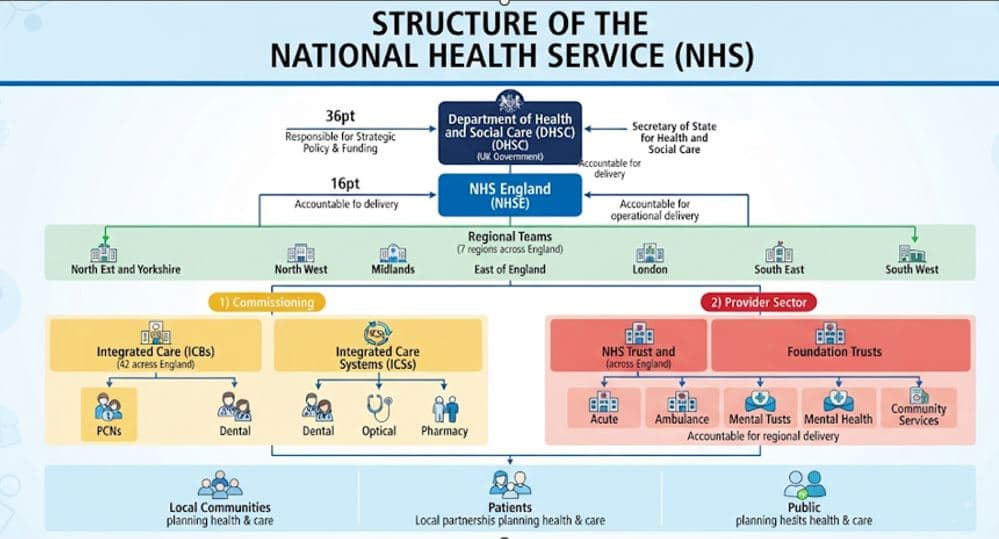
NHS Structure of the NHS
NHS Structure
The NHS is a publicly funded healthcare system, mainly financed through taxation, that provides healthcare free at the point of use for UK residents.
1. Who Runs the NHS?
NHS Structure Diagram
UK Government
↓
Secretary of State for Health & Social Care
↓
Department of Health & Social Care (DHSC)
↓
NHS England
↓
Integrated Care Boards (ICBs)
↓
NHS Trusts / GP Practices / Community Services
↓
Patients
2. Secretary of State for Health & Social Care
Currently: Wes Streeting
Key Responsibilities
- Sets NHS priorities
- Controls healthcare budget allocation
- Oversees national health policy
- Writes the NHS Mandate
- Accountable to Parliament
Interview Point
You should mention:
“The Secretary of State provides political leadership and determines national healthcare priorities, while operational delivery is delegated to NHS organisations.”
3. Department of Health & Social Care (DHSC)
Main Role
The DHSC creates national health policies and distributes funding.
Organisations Overseen
- NHS England
- UKHSA
- Local authorities
- Workforce and training bodies
4. NHS England
Main Functions
NHS England:
- Allocates NHS funding
- Monitors NHS performance
- Implements national policy
- Oversees waiting lists and service targets
- Supports workforce planning
Important 2025 Update
In 2025, the government announced plans to abolish NHS England and bring responsibilities back under DHSC control.
How it worked (before March 2025):
Taxpayer → DHSC (Wes Streeting) → NHS England (Mackey) → ICBs → NHS Trusts → Patient
How it works NOW (during 2025 transition):
Taxpayer → DHSC (Direct control) → ICBs → NHS Trusts → Patient
(NHS England is being bypassed and absorbed).
Local Level: Integrated Care Boards (ICBs)
- Who is in charge locally? Your local ICB (e.g., "North West London ICB").
- Role: They commission (buy) services for their local population. They now report directly to the DHSC, not via NHS England.
- 2025 Reality: ICBs have also been told to cut management costs by 50%.
Interview Insight
Possible reasons:
- Reduce bureaucracy
- Improve efficiency
- Simplify leadership structures
Possible concerns:
- Transition disruption
- Loss of operational independence
5. Integrated Care Systems (ICSs)
Introduced officially in 2022.
Purpose
To improve coordination between:
- Hospitals
- GPs
- Mental health services
- Social care
- Community care
ICS Structure
Integrated Care System (ICS) has:
Integrated Care Board (ICB)
Integrated Care Partnership (ICP)
Integrated Care Boards (ICBs)
Role
- Plan healthcare locally
- Allocate budgets
- Commission services
- Reduce regional health inequalities
Interview Phrase
“ICBs aim to tailor healthcare services to the specific needs of local populations.”
Integrated Care Partnerships (ICPs)
Role
Work with:
- Councils
- Community groups
- Charities
- Social care services
Goal:
- Improve population health
- Address social determinants of health
6. NHS Trusts vs Foundation Trusts
NHS Trust | Foundation Trust |
Managed centrally | More independent |
Less financial freedom | Greater financial autonomy |
Deliver healthcare services | Deliver healthcare services |
Accountable nationally | Accountable locally |
Diagram: How Funding Flows
Taxpayers
↓
Treasury
↓
DHSC
↓
NHS England
↓
ICBs
↓
Hospitals / GPs / Community Services
↓
Patient Care
7. How the NHS is Funded
Main Sources
General Taxation
Largest source of funding.
Examples:
- Income tax
- VAT
- Corporation tax
National Insurance Contributions (NICs)
Smaller Sources
- Prescription charges
- Dental fees
- Parking charges
NHS Funding Breakdown (Approximate)
General Taxation ████████████████████ 80%
National Insurance ██████ 15%
Patient Charges ██ 5%
8. NICE (National Institute for Health and Care Excellence)
Main Role
NICE determines:
- Which treatments are cost-effective
- Which drugs should be funded
- Clinical guidelines
QALY Concept
Quality Adjusted Life Year (QALY)
Used to assess:
- Cost vs benefit of treatment
Example
Treatment A:
- Costs £20,000
- Gives 2 extra healthy years
Cost per QALY:
\frac{£20,000}{2}=£10,000\text{ per QALY}
NICE generally considers treatments cost-effective if below around £20,000–£30,000 per QALY.
9. Care Quality Commission (CQC) and other bodies
Role
Independent regulator of healthcare quality.
Inspects
- Hospitals
- GP surgeries
- Care homes
- Dental practices
CQC Ratings
Outstanding
Good
Requires Improvement
Inadequate
Key Bodies Still in Charge (Even after NHSE abolition)
These regulators and bodies continue to operate independently:
Body | Role | Why mention in interview |
CQC (Care Quality Commission) | Inspects & rates hospitals (Outstanding to Inadequate). | Shows you understand quality assurance. |
NICE (National Institute for Health and Care Excellence) | Decides which drugs/treatments are cost-effective (uses QALYs). | Essential for ethical funding discussions. |
UKHSA (UK Health Security Agency) | Manages pandemics, infectious disease (replaced PHE). | Shows awareness of public health. |
NHS England (in 2025) | Being abolished. | Only mention it to show you know the change. |
10. NHS Timeline
Key NHS Reforms
1948 → NHS founded
1991 → GP fundholding introduced
2012 → Health & Social Care Act
2019 → NHS Long Term Plan
2022 → ICBs replace CCGs
2025 → NHS England abolition announced
11. Important NHS Interview Hot Topics (2025)
Waiting Lists
Over 7 million people waiting for treatment.
Causes
- COVID backlog
- Workforce shortages
- Increased demand
Impact
- Delayed diagnosis
- Poorer outcomes
- Staff burnout
Workforce Crisis
Key issues:
- Staff shortages
- Retention problems
- Burnout
- Industrial action
Mental Health Crisis
Challenges:
- Long CAMHS waits
- Lack of inpatient beds
- Increased demand post-pandemic
Prevention vs Treatment
NHS increasingly focusing on:
- Obesity prevention
- Smoking cessation
- Early diagnosis
12. NHS Digital Transformation
Examples
- NHS App
- Electronic patient records
- AI diagnostics
- Telemedicine
Benefits
- Faster access
- Better efficiency
- Improved communication
Risks
- Cybersecurity
- Data privacy
- Digital exclusion
13. Must-Know Facts for Your Interview
- The £1bn Figure: The government claims abolishing NHS England will save £1bn annually, which will go directly to frontline patient care.
- The 2022 Act: The Health and Care Act 2022 created ICBs (replacing CCGs). That was the last major reform before the 2025 abolition.
- The Francis Report (2013): Always mention this when discussing NHS accountability. It highlighted catastrophic failures at Mid Staffordshire and led to a focus on compassionate, safe care – a reason why clear leadership structures matter.
14. Eleven Questions & Answers
Q1: “What are Integrated Care Systems?”
Answer
“Integrated Care Systems are partnerships between NHS organisations, local authorities, and community services designed to improve coordination of care. Their aim is to deliver more joined-up healthcare and reduce health inequalities.”
Q2: “How is the NHS funded?”
Answer
“The NHS is mainly funded through general taxation and National Insurance contributions, with a smaller amount from prescription and dental charges.”
Q3: “What does NICE do?”
Answer
“NICE provides evidence-based guidance and assesses whether treatments are clinically effective and cost-effective using measures such as QALYs.”
Q4: “What challenges does the NHS face?”
Answer Structure
Use:
- Workforce shortages
- Waiting lists
- Ageing population
- Mental health demand
- Funding pressures
Then discuss:
- Impact on patients
- Possible solutions
Q5: "In your view, who has the most power in the NHS: the Secretary of State or the local GP?"
Answer:
"In 2025, the Secretary of State has more formal power because NHS England is being abolished, giving him direct control over funding and strategy. However, real-world power often lies with the local GP as the 'gatekeeper' to secondary care. A minister can set a target, but a GP controls the referral that meets it. The structural power is central; the clinical power is local."
Q6: "What is the biggest leadership challenge facing the NHS in 2025?"
Answer:
"The biggest challenge is managing the abolition of NHS England without destabilising frontline services. Staff are already exhausted. Adding a major reorganisation risks low morale and 'reorganisation fatigue'. The second challenge is financial: making the promised £1bn in savings from management cuts without affecting patient safety."
Q7: "Why was NHS England originally created, and why is it now being abolished?"
Answer:
"It was created after the 2012 Health and Social Care Act to give clinicians more autonomy and depoliticise day-to-day operations. It was meant to stop politicians interfering. However, over time, politicians felt they were blamed for failures but had no direct control. In 2025, Wes Streeting argues that the 'arms-length' distance just created bureaucracy, so he is bringing it back in-house for accountability."
Golden Interview Phrase
“The NHS is increasingly shifting from reactive treatment towards integrated, preventative, patient-centred care.”
Q8: "Is abolishing NHS England a good idea?"
Balanced Answer:
- For (Govt argument): Reduces duplication. Ends "passing the buck" between DHSC and NHSE. Saves £1bn for frontline care. Increases ministerial accountability (voters know who to blame).
- Against (Critics' argument): Politicises the NHS (politicians now directly control operations). Risk of "distraction" during transition. Loss of independent expert advice. 15,000 staff facing uncertainty.
Your conclusion (suggested): "The principle of reducing bureaucracy is sound, but the risk is that a major reorganisation distracts from the real crisis: staff burnout and waiting lists. Success depends on whether the £1bn savings actually reach the ward."
Q9: "Who is accountable if my local A&E fails?"
Answer:
- Local: The NHS Trust CEO (runs the hospital) and the ICB (commissioned the service).
- Regional: The regional director of the new unified DHSC.
- National: The Secretary of State (Wes Streeting) – because in 2025, he has direct operational control.
- Regulator: The CQC (gives the rating – Outstanding to Inadequate).
Q10: "How does funding flow from taxpayer to doctor?"
Answer:
The Pathway :
- Tax & NI → Government.
- Treasury allocates to DHSC (Wes Streeting).
- DHSC directly allocates to ICBs (via a funding formula based on population need).
- ICBs commission (pay) NHS Trusts & Foundation Trusts.
- Trusts pay doctors' salaries and run hospitals.
Q11. Excellent Final Interview Statement
Answer:
“Why is understanding NHS structure important?”
“Understanding NHS structure is important because healthcare professionals work within complex multidisciplinary systems. Knowing how services are commissioned, funded, regulated, and integrated helps clinicians advocate for patients effectively and understand how healthcare decisions impact patient outcomes.”
15. High-Level Interview Tips
What Interviewers Want
- Understanding of NHS structure
- Awareness of current issues
- Teamwork understanding
- Patient-centred thinking
- Communication skills
16. Quick Revision Summary
Remember These Key Organisations
Organisation | Role |
DHSC | National health policy |
NHS England | National NHS management |
ICBs | Local healthcare planning |
NICE | Cost-effectiveness guidance |
CQC | Quality inspection |
NHS Trusts | Deliver care |
Useful Links:
https://www.england.nhs.uk/about/
https://www.england.nhs.uk/nhs-services/
https://www.england.nhs.uk/long-read/structure-of-the-nhs/
https://commonslibrary.parliament.uk/research-briefings/cbp-7206/
https://www.kingsfund.org.uk/projects/nhs-in-a-nutshell/nhs-structure
https://www.kingsfund.org.uk/insight-and-analysis/long-reads/nhs-explained
https://www.nhs.uk/nhs-services/
https://www.health.org.uk/publications/nhs-structure-explained