
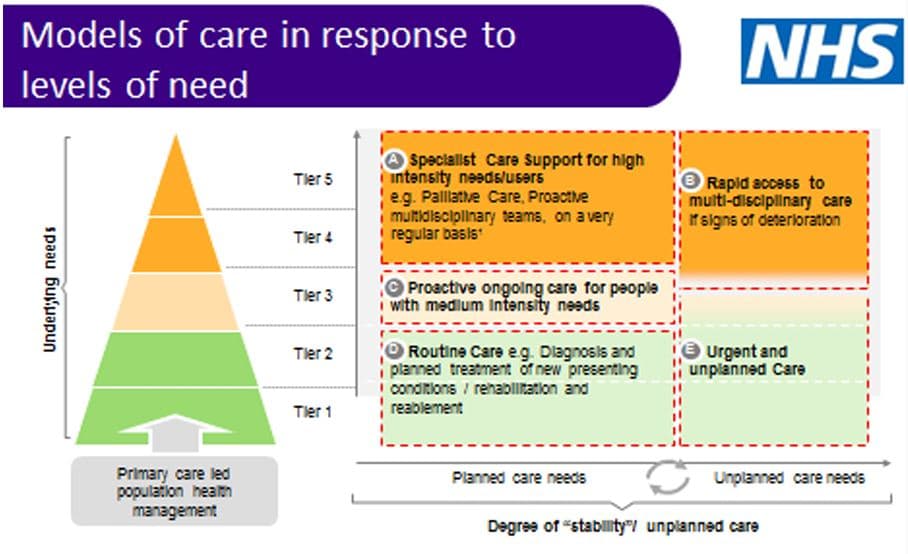
NHS Levels of Healthcare
NHS Levels of Healthcare

The 4 Levels of Healthcare in the NHS
Overview Diagram


1. PRIMARY CARE
Definition
Primary care is the first point of contact between the patient and the NHS.
Its main aim is:
- Prevention of disease
- Early diagnosis
- Management of chronic disease
- Health promotion
- Referral when necessary
Primary Care Flow Diagram

Examples of Primary Care
Service | Role |
GP surgeries | Diagnosis and referrals |
Pharmacies | Minor illness + medications |
Dentists | Oral health |
Opticians | Eye care |
Walk-in centres | Minor urgent issues |
Community nursing | Home-based care |
Primary Care Graph – NHS Pressure
Demand for GP Appointments
2015 ███████████████
2018 ███████████████████
2020 ██████████████████████
2023 ███████████████████████████
2025 ███████████████████████████████
Interview Point:
Demand is increasing due to:
- Ageing population
- More chronic disease
- Mental health burden
- GP shortages
- Earlier discharge from hospitals
Advantages of Primary Care
1. Cost-effective
GP appointments are far cheaper than hospital admissions.
2. Preventative medicine
Detects disease early:
- Hypertension
- Diabetes
- Cancer screening
3. Continuity of care
Long-term relationships improve:
- Trust
- Compliance
- Monitoring
4. Reduces hospital burden
Keeps mild illnesses out of A&E.
Problems Facing Primary Care
Workforce shortages
Patients ↑↑↑
GP numbers ↓
Pressure ↑↑↑
Waiting times ↑↑↑
Time pressure
10-minute consultations may be insufficient for:
- Elderly patients
- Multiple conditions
- Mental health issues
Access problems
Patients struggle to:
- Get appointments
- See the same GP
- Access rural healthcare
2. SECONDARY CARE
Definition
Secondary care is specialist care provided after referral from primary care.
Usually hospital-based.
Secondary Care Diagram

Examples of Secondary Care
Service | Example |
Outpatient clinics | Cardiology |
A&E | Emergency medicine |
Mental health | Psychiatry |
Imaging | MRI/CT |
Elective surgery | Orthopaedics |
Rehabilitation | Physiotherapy |
NHS Waiting List Crisis Graph
NHS Waiting Lists (Millions)
2012 ██
2015 ███
2018 ████
2020 █████
2023 █████████
2025 ████████
Major Problems in Secondary Care
Long waiting lists
Caused by:
- COVID backlog
- Staffing shortages
- Increased demand
- Underfunding
Delayed referrals
Poor communication between GP and hospital can lead to:
- Diagnostic delays
- Worse outcomes
- Duplication of tests
Bed pressures
More admissions
Fewer beds
Delayed discharges
results in:
A&E overcrowding
3. TERTIARY CARE
Definition
Tertiary care involves highly specialized care for severe or complex disease.
Usually delivered in major regional centers.
Tertiary Care Pyramid
Rare & Complex
▲
Neurosurgery
Organ transplant
Cancer centres
ICU
▼
Smaller patient numbers
Examples of Tertiary Care
Specialty | Example |
Cardiothoracic surgery | Open-heart surgery |
Neurosurgery | Brain tumours |
Oncology | Radiotherapy |
Transplant medicine | Liver transplant |
Neonatal ICU | Premature babies |
Why Tertiary Centres Exist
Concentration of expertise
Complex cases require:
- Highly trained staff
- Specialist equipment
- Advanced technology
Better outcomes
High-volume specialist centres often achieve:
- Lower mortality
- Better recovery
- More efficient care
Tertiary Care Example Journey
Chest pain
▼
Seen by GP
▼
Cardiology referral
▼
Local hospital tests
▼
Regional cardiac centre
▼
Open-heart surgery
4. QUATERNARY CARE
Definition
Ultra-specialised experimental medicine for very rare conditions.
Only available in a few centres.
Quaternary Care Diagram
Standard Treatment Failed
▼
Rare/complex condition
▼
Research hospital
▼
Experimental therapy
Examples
Treatment | Example |
CAR-T therapy | Leukaemia |
Experimental drugs | Rare diseases |
Robotic surgery | Advanced cancer |
Gene therapy | Genetic disorders |
Why the NHS Uses Different Levels of Care
Key Interview Answer
1. Efficiency
Patients are directed to the most appropriate service.
Minor illness:
→ GP
Complex surgery:
→ specialist centre
2. Cost-effectiveness
Simple illness at GP = LOW COST
Simple illness in A&E = HIGH COST
3. Better patient outcomes
Patients access specialists when needed.
4. Continuity of care
Smooth transfer between services improves safety.
5. Resource management
Specialist services are concentrated centrally.
Reason | Explanation | Interview Hook |
Efficient Referral (Triage) | Patients are directed to the right professional for their need – not a cardiologist for a cold. | "It prevents over-specialisation of scarce resources." |
Cost-Effectiveness | GPs and pharmacists are cheaper than hospital consultants. Managing minor illness in primary care saves millions. | *"It costs £30 for a GP visit vs. £300+ for a hospital outpatient appointment."* |
Continuity of Care | A patient with diabetes sees the same GP over years, building trust and enabling early detection of complications. | "Longitudinal relationships improve outcomes, especially in chronic disease." |
Prevention & Early Detection | Primary care can intervene before a condition becomes severe enough to require secondary care. | "Catching cancer early in primary care saves lives and reduces the burden on hospitals." |
5. Integration of Care
This is an extremely important NHS interview topic.
Definition
Integration means different services communicating effectively.
Integrated Care System (ICS) Diagram

Why Integration Matters
Without integration:
Poor communication
↓
Delayed referrals
↓
Duplicate tests
↓
Patient harm
Solutions to Improve Integration
Shared Electronic Records
GP ↔ Hospital ↔ Community Teams
Everyone sees the same patient information.
Care Coordinators
Useful for:
- Elderly patients
- Cancer patients
- Multiple chronic conditions
Integrated Care Boards (ICBs)
Coordinate local services:
- NHS
- Social care
- Community health
- Public health
Summary Table

NHS Patient Journey Diagram
Patient notices symptoms
▼
PRIMARY CARE
GP assessment
▼
Referral if needed
▼
SECONDARY CARE
Specialist review
▼
Complex condition?
YES
▼
TERTIARY CARE
Experimental treatment?
YES
▼
QUATERNARY CARE
6. High-Yield Interview Discussion Points
1. Ageing Population
More:
- Dementia
- Diabetes
- Frailty
- Polypharmacy
Creates pressure at ALL levels.
2. NHS Workforce Crisis
Shortages of:
- GPs
- Nurses
- Consultants
- Radiologists
Lead to:
- Delays
- Burnout
- Reduced access
3. Waiting List Crisis
Elective care backlog remains a major issue.
4. Digital Transformation
Electronic records improve:
- Communication
- Safety
- Continuity
7. Questions and Answers
Question1 : “Why are separate levels of healthcare important in the NHS?”
The NHS uses different levels of healthcare to ensure patients receive the most appropriate and cost-effective care according to the severity and complexity of their condition.
Primary care acts as the first point of contact and manages common illnesses, chronic diseases, prevention and referrals. Secondary care provides specialist treatment within hospitals, while tertiary care manages highly complex conditions such as organ transplants or neurosurgery. Quaternary care involves experimental medicine and highly specialised therapies.
Having separate levels improves efficiency because patients are directed to the correct service. It also improves patient outcomes, as specialist expertise can be concentrated in tertiary centres. In addition, it is more cost-effective for the NHS, as minor illnesses can be managed in primary care rather than expensive hospital settings.
The different levels also support continuity of care. For example, a GP can refer a patient to a cardiologist, and after treatment the patient can continue long-term monitoring back in primary care.
However, challenges still exist, particularly around communication between services, waiting times and workforce shortages. Integrated Care Systems and shared electronic patient records aim to improve coordination across the NHS.
Question 2: "Can you explain the difference between primary, secondary, and tertiary care – and why that distinction matters?"
Answer:
"Primary care is the first point of contact – typically a GP, pharmacist, or dentist – and manages common illness, chronic disease, and prevention. Secondary care is specialist care, usually in a hospital, accessed via GP referral – for example, a cardiologist for suspected heart failure. Tertiary care is for complex, severe conditions like neurosurgery or cancer treatment, often in regional centres.
*The distinction matters for three reasons: efficiency (you don't use a £500/hour surgeon for a sore throat), cost-effectiveness (primary care is cheaper), and continuity (a patient with diabetes benefits from seeing the same GP for years, while only seeing a specialist occasionally). Without these levels, the NHS would be overwhelmed by unnecessary specialist referrals."*
Question 3: "During your work experience, did you observe any problems at the interface between primary and secondary care?"
Answer:
"Yes. When shadowing a GP, I saw a patient with complex heart failure. The GP had requested a cardiology review, but the hospital wait was 4 months. In that time, the patient deteriorated and ended up in A&E with an acute admission.
This showed me the problem of delayed referrals and poor communication. The GP's clinic letter was detailed, but the hospital didn't acknowledge it until weeks later. I think this could be improved by shared electronic records – so the hospital can see the GP's concern immediately – and by 'advice and guidance' services, where a GP can email a specialist and get a response within days, avoiding the need for a full outpatient appointment."
Question 4: "Why is continuity of care in primary care important, and what threatens it?"
Answer:
"Continuity – seeing the same GP over years – builds trust, allows early detection of subtle changes (e.g., weight loss or mood change), and reduces unnecessary tests because the GP knows the patient's history. It is especially important in chronic disease like diabetes or dementia.
However, it is threatened by GP shortages (patients see whoever is available), part-time working (many GPs work less than full-time), and pressures to see more patients faster. The NHS is trying to preserve continuity through 'personal lists' where possible, but demand often forces a 'first available' model."
Question 5 (Hard): "What is quaternary care, and what ethical issues does it raise?"
Answer:
"Quaternary care is experimental medicine for the rarest conditions – for example, gene therapy or CAR-T-cell therapy. It often involves clinical trials and is available only in a few specialist centres.
The ethical issues include: resource allocation (these treatments are extremely expensive – often hundreds of thousands of pounds – for a small number of patients), informed consent (patients may not fully understand the experimental nature and risks), and equity (some patients may not live near a quaternary centre). NICE plays a role in deciding whether these treatments offer sufficient value to be funded by the NHS."
Final Rapid-Revision Table
Level | Main Role | Example |
Primary | First contact | GP |
Secondary | Specialist care | Hospital consultant |
Tertiary | Highly specialised | Transplant centre |
Quaternary | Experimental medicine | CAR-T therapy |
Useful Links
https://www.nhs.uk/nhs-services/
https://www.nhs.uk/nhs-services/gps/
https://www.nhs.uk/nhs-services/community-health-services/
https://www.nhs.uk/nhs-services/hospitals/
https://www.england.nhs.uk/commissioning/spec-services/
https://www.england.nhs.uk/commissioning/spec-services/highly-specialised-services/
https://www.england.nhs.uk/about/
https://mstrust.org.uk/a-z/care-in-the-nhs