
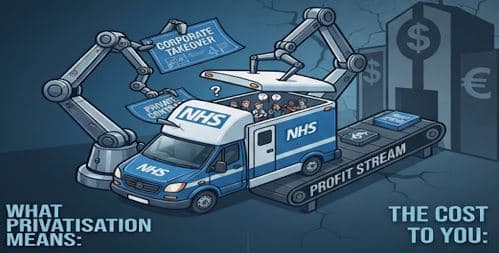
NHS Ethical Considerations of NHS Privatisation
1. Executive Summary (The "30-Second Answer")
NHS privatisation is not an "all or nothing" concept. The NHS has always used private providers for certain services (e.g., dental, optical, pharmacy, and outsourced surgeries). The debate is about the extent and nature of private involvement.
Term | What It Means |
Privatisation (broadly) | Private companies delivering NHS-funded care, or patients paying directly for private care. |
Current reality | The NHS already spends around 7% of its budget on private sector services (approx. £12bn in 2020/21). |
The ethical question | Does greater private involvement help patients (e.g., shorter waits) or harm them (e.g., two-tier system, profit motives)? |
Key Quote for Interview: "The debate is not whether the NHS should be 'privatised' – because it already uses private providers. The real question is: where should we draw the line, and who decides?"
2. The Current State – What You MUST Know
Many candidates think the NHS is 100% public. That is incorrect – and knowing the reality shows sophistication.
Service | How It Is Delivered |
GP surgeries | Mostly private partnerships (GPs are self-employed or work for private companies under NHS contract) |
Dentistry | Mostly private practices providing NHS-funded care (many now mixed NHS/private) |
Pharmacy | Largely private companies (e.g., Boots, Lloyds) delivering NHS prescriptions |
Optometry | Private opticians providing NHS eye tests and vouchers |
Hospital surgeries | NHS trusts + increasing use of private hospitals (e.g., Spire, Nuffield) to reduce waiting lists |
Diagnostics (MRI/CT) | Mix of NHS and private providers (e.g., In Health, Alliance Medical) |
Key Fact: During the COVID-19 pandemic, the NHS paid private hospitals to use their beds and staff. This is often cited as an example of pragmatic partnership – not ideological privatisation.
Interview Hook: "When people say 'privatisation', they often mean something that already exists. The real debate is about whether private involvement should expand beyond its current role."
3. The Ethical Framework – Using the 4 Pillars
Applying the four pillars of medical ethics to privatisation.
Four principles of medical ethics (Beauchamp and Childress):
- Autonomy – respecting a patient’s right to make informed decisions about their own care.
- Beneficence – acting in the patient’s best interests and promoting good outcomes.
- Non-maleficence – avoiding harm or minimising risk of harm (“do no harm”).
- Justice – ensuring fairness in the distribution of healthcare resources and treatment of patients.
These are commonly used in NHS ethics, clinical decision-making, and medical interviews/exams.
3.1 Autonomy – Patient Choice
Argument FOR Privatisation | Argument AGAINST Privatisation |
Patients could choose their doctor, hospital, and treatment time. | Choice is only real if you can afford it. Wealthy patients gain autonomy; poor patients lose it. |
Private sector offers faster access, respecting the patient's right to avoid suffering. | Autonomy without information is meaningless – private sector marketing may mislead. |
Balanced View: "Privatisation could enhance autonomy for those who can pay, but may reduce it for those who cannot. True autonomy requires equitable access – not just theoretical choice."
3.2 Beneficence (Do Good) & Non-Maleficence (Do No Harm)
These are best discussed together, as privatisation has both potential benefits and harms.
Potential Beneficence (Good) | Potential Non-Maleficence (Harm) |
Shorter waiting lists – patients get treatment sooner. | Profit motive may lead to over-treatment (unnecessary procedures) or under-treatment (cutting corners). |
Increased capacity – private hospitals add beds and staff. | Fragmentation of care – private providers may not share records or coordinate with GPs. |
Innovation and efficiency – competition can drive improvement. | Loss of transparency – private companies are not subject to FOI requests like NHS trusts. |
Reduced burden on NHS staff – outsourced work may relieve pressure. | Two-tier system – those who pay jump the queue, undermining the ethos of the NHS. |
Balanced View: "Privatisation could do good by reducing waiting times – a clear beneficence argument. But it could also cause harm by creating perverse incentives: private companies profit from more treatment, not necessarily better treatment. The net effect depends entirely on how privatisation is regulated."
3.3 Justice – The Most Contentious Pillar
This is where the strongest ethical case against privatisation lies.
Argument FOR Privatisation (Justice) | Argument AGAINST Privatisation (Justice) |
If private involvement reduces waiting lists for everyone (NHS and private patients), then justice is improved. | The NHS was founded on the principle of equal access based on need, not ability to pay. Privatisation undermines this. |
Taxpayers already fund the NHS – they should have some choice in where their care is delivered. | Privatisation creates a two-tier system where wealthy patients get faster, better care. This is a direct violation of distributive justice. |
Private sector can serve deprived areas if contracts are designed properly (e.g., GP-at-hand model). | In practice, private providers "cherry-pick" profitable services and avoid complex, expensive patients. |
Key Example: The Heart of England NHS Foundation Trust controversy (2010s) – a private company (Circle) was brought in to run Hinchingbrooke Hospital. The contract failed, and the hospital returned to NHS control, having wasted millions.
Balanced View: "Justice is the hardest principle to reconcile with privatisation. The NHS was built on the ideal that your postcode or bank balance should not determine your health outcome. Privatisation risks moving away from that ideal – unless carefully managed to ensure equity."
4. The Ethical Tension Diagram

5. Arguments For and Against NHS Privatisation (Balanced Table)
Build balanced answers – never present only one side.
FOR Privatisation | AGAINST Privatisation | |
Waiting lists | Private sector can reduce the 7.5 million+ waiting list by providing extra capacity. | Private sector treats simple, profitable cases – complex patients remain in NHS queues, so waiting lists may not fall. |
Patient choice | Patients can choose their provider, time, and consultant. | Choice is limited to those who can pay or who live near private hospitals. |
Efficiency | Competition drives efficiency and innovation. | Private sector has higher admin costs (marketing, shareholder dividends) – not necessarily more efficient. |
Staff morale | Doctors may earn more working privately. | Two-tier workforce – NHS staff feel devalued. Private sector may poach staff, worsening NHS shortages. |
Transparency | Private providers must meet NHS standards (CQC regulated). | Private companies are not subject to FOI requests – less public accountability. |
Ethos of NHS | Pragmatic use of private sector saves the NHS from collapse. | Privatisation erodes the founding principle of equal care for all. |
Some Key Statistics
Statistic | Source |
NHS spending on private sector: £12.2 billion (2020/21) | DHSC |
That is approx. 7% of the DHSC budget | DHSC |
2/3 of doctors uncomfortable with privatisation | BMA survey |
Majority of public support NHS remaining publicly funded | British Social Attitudes Survey |
Waiting list: over 7.5 million (as of 2025) | NHS England |
6. Real-World Examples to Use in Interviews
Using specific examples shows applied knowledge.
Example | What Happened | Ethical Lesson |
COVID-19 partnership | NHS paid private hospitals £400m+ for beds and staff during pandemic. | Pragmatic cooperation can benefit patients in a crisis – but should it become permanent? |
Hinchingbrooke Hospital (Circle) | Private company ran failing hospital; contract failed; hospital returned to NHS. | Privatisation is not a magic bullet – private sector can fail too. |
GP-at-hand | Private GP service (now operating as "Doctor Care Anywhere") offered 24/7 access – but criticised for "cherry-picking" healthy,年轻 patients. | Private providers may avoid expensive, complex patients – undermining equity. |
Independent Sector Treatment Centres (ISTCs) | Labour government (2000s) used private centres for routine surgeries. Mixed evidence on cost and quality. | Outsourcing routine care can work – but needs rigorous oversight. |
Dentistry | NHS dentistry is collapsing – most dentists now mixed or fully private. | Warning example: once a service becomes majority private, it is very hard to reverse. |
7. Impact on Medical Students and Doctors
Interviewers may ask: "How would privatisation affect you as a doctor?"
Stakeholder | Potential Positive Impact | Potential Negative Impact |
Medical students | More placement sites (private hospitals). Potential for funded places by private companies. | Fragmented training – different protocols across NHS/private. Placements harder to organise. |
Junior doctors | Opportunity to earn extra income through private work. | Two-tier workforce – resentment between NHS and private colleagues. Pressure to see more patients faster. |
Consultants | Increased private practice income (many already do private work). | Conflict of interest – do you prioritise NHS or private patients? |
The profession | Some argue competition raises standards. | BMA survey found 2/3 of doctors uncomfortable with privatisation – morale risk. |
Model Sentence: "As a future doctor, I am concerned about fragmentation. The NHS works best when care is coordinated – from GP to hospital to community. If private providers operate in silos, with different records and protocols, patient safety could suffer. I would also worry about a two-tier workforce, where NHS staff feel devalued."
8. Public Opinion – Useful Context
Finding | Source |
Majority of the public support the NHS remaining publicly funded and publicly provided. | British Social Attitudes Survey (annual) |
However, many support using private sector to reduce waiting lists temporarily. | Various polls |
Opposition to privatisation increases when people understand what it means (e.g., two-tier system). | King's Fund research |
Younger people are more open to private involvement than older generations. | YouGov |
Interview Hook: "Public opinion is nuanced. People love the NHS in principle, but many are willing to accept private involvement if it means shorter waits. The challenge is ensuring that 'temporary' measures do not become permanent."
9. Five Interview Questions & Answers
Q1 (Easy): "What is your view on privatising the NHS?"
Answer (Balanced):
"I think it is important to first clarify what 'privatisation' means. The NHS already uses private providers for dental, optical, pharmacy, and some surgical services – around 7% of its budget. The debate is about whether that role should expand.
On one hand, private sector involvement can reduce waiting lists, increase patient choice, and bring innovation. During COVID-19, private hospitals provided vital capacity. On the other hand, I worry about the ethical implications: profit motives could conflict with patient interests, and a two-tier system where wealthy patients jump the queue would undermine the NHS's founding principle of equal access based on need.*
My view is pragmatic but cautious. I support using private providers where it clearly benefits NHS patients – for example, outsourcing routine surgeries to reduce waiting lists – but I oppose any move towards charging patients at the point of care or creating a system where ability to pay determines quality of care. Strong regulation is essential to protect equity and transparency."
Quick Points
- Privatisation in the NHS should be clearly defined, as private providers already deliver some NHS-funded services.
- The debate focuses on whether private sector involvement should expand further.
- Private providers can help reduce waiting lists and increase system capacity.
- They may also improve patient choice and bring innovation into healthcare delivery.
- Private sector capacity was useful during COVID-19 in supporting NHS services.
- Concerns include conflicts between profit motives and patient-centred care.
- There is a risk of creating a two-tier system based on ability to pay.
- This could undermine the NHS principle of equal access based on clinical need.
- A balanced view supports private involvement only where it benefits NHS patients (e.g. elective surgery).
- Any expansion must be tightly regulated to protect equity and transparency.
Q2 (Medium): "Discuss the ethical considerations of NHS privatisation."
Answer (Using the 4 Pillars):
"I would use the four pillars of medical ethics to structure my answer.
First, autonomy: Privatisation could increase patient choice – where and when to be treated, and by whom. However, autonomy is only meaningful if all patients have genuine options. A wealthy patient has autonomy; a poor patient does not.
Second, beneficence: Shorter waiting lists are a clear benefit – patients suffer less, and outcomes improve. However, beneficence must consider all patients, not just those who can pay.
Third, non-maleficence: Privatisation carries risks of harm. Profit motives may lead to over-treatment (to maximise revenue) or under-treatment (to cut costs). Fragmentation of care – with private providers not sharing records – could cause medical errors.
Fourth, justice: This is the most challenging pillar. The NHS was founded on distributive justice – care based on need, not ability to pay. Privatisation risks creating a two-tier system, which violates that principle. However, if private involvement reduces waiting lists for everyone (not just private patients), justice could be enhanced.
In conclusion, privatisation is not inherently unethical – but it must be carefully regulated to prevent harm and protect equity. The current mixed model, with strong NHS oversight, is probably the right balance."
Quick Points
- The four pillars of medical ethics can be used to assess NHS privatisation.
- Autonomy: Private care may increase choice, but inequality can limit true patient autonomy.
- Beneficence: Private sector involvement may reduce waiting times and improve outcomes.
- Non-maleficence: Risks include harm from profit-driven decisions and fragmented care.
- Justice: There is concern about unequal access and a potential two-tier system.
- However, private involvement could support justice if it improves access for all patients.
- Privatisation is not inherently unethical but depends on regulation and implementation.
- A mixed NHS–private model may balance efficiency with equity.
Q3 (Hard): "Is privatisation of the NHS following the principle of justice?"
Answer:
"No – at least not in its pure form. The principle of justice, particularly distributive justice, holds that healthcare should be allocated based on clinical need, not ability to pay. The NHS was founded on exactly this principle in 1948.
If the NHS were significantly privatised – for example, if patients had to pay for GP appointments or hospital treatment – then a person's wealth would directly determine their access to care. This is a clear violation of justice.
However, there is a counterargument. If private sector involvement reduces waiting lists for everyone – for example, by adding capacity that benefits NHS and private patients alike – then justice could be improved. A patient who would have waited 12 months for a hip replacement might wait only 6 months because a private hospital is helping with the backlog. That patient has received fairer, more timely care – even though they did not pay.
Ultimately, I argue that justice requires that no patient is disadvantaged by privatisation. If private involvement creates a two-tier system, it is unjust. If it reduces waiting lists without harming equity, it may be justifiable. The evidence so far is mixed, so I remain cautious."
Quick Points
- Justice in healthcare means allocation based on clinical need, not ability to pay.
- The NHS was founded in 1948 on the principle of equal access for all.
- Full privatisation would risk access being determined by wealth, not need.
- This would create a two-tier system, which is ethically unjust.
- Private sector involvement could still be acceptable if it reduces waiting times for everyone.
- Outsourcing care may increase capacity and improve overall patient access.
- Justice is supported if no group is disadvantaged by private involvement.
- Justice is violated if privatisation increases inequality in access or outcomes.
- The ethical impact depends on implementation and effects on equity.
Q4 (Hard): "Should patients be charged a nominal fee to see a GP?"
Answer:
"I strongly oppose this. A nominal fee – say £10 or £20 – would violate the NHS's founding principle of free at the point of use. It would disproportionately harm the poor, who would delay seeking care, leading to worse outcomes and ultimately higher costs to the NHS when they present with advanced disease.
There is also evidence from other countries. Sweden introduced small co-payments for GP visits and saw a reduction in primary care attendance – but no reduction in A&E attendances. Patients did not stop being ill; they just sought care later and in more expensive settings.
Some argue a small fee would deter 'time-wasters' with minor issues. But GPs are gatekeepers – it is their job to triage. Charging patients would punish the worried well and the poor alike. I believe the NHS should remain free at the point of use – that is its ethical core."
Quick Points
- A nominal GP fee would violate the NHS principle of free at the point of use.
- It would disproportionately harm poorer patients.
- Patients may delay seeking care due to cost.
- Delayed presentation can lead to worse health outcomes.
- Late treatment may increase overall NHS costs.
- Evidence (e.g. Sweden) shows co-payments reduce GP visits but do not reduce A&E use.
- Patients still need care but present later and in more acute settings.
- GPs already act as effective triage gatekeepers.
- Charging would not effectively remove “inappropriate” attendances.
- It would risk increasing health inequalities and undermining NHS equity.
- Overall, free access is central to the NHS ethical model.
Q5 (Advanced – Unusual): "Some argue privatisation would be good because patients would be deterred from seeking care for minor issues. What do you think?"
Answer:
"This argument is ethically dangerous for three reasons.
First, it assumes that patients are the best judges of what is 'minor'. A symptom that seems trivial to a healthy person could be the first sign of cancer. Deterring patients from seeking help would delay diagnosis and worsen outcomes.
Second, it punishes the poor. Wealthy patients would still seek care; only poor patients would be deterred. This would widen health inequalities – the opposite of what the NHS should do.
*Third, it misunderstands the role of primary care. GPs are trained to triage – to distinguish minor illness from serious disease. The solution to 'time-wasters' is better public health education and efficient triage systems (e.g., NHS 111), not financial barriers.*
I believe that deterrence is never an acceptable healthcare policy. The NHS should remain accessible to all, regardless of how 'minor' their concern might seem."
Quick Points
- The argument is ethically risky because patients cannot reliably judge what is “minor” or not serious.
- Symptoms that seem minor may be early signs of serious disease (e.g. cancer).
- Deterring help-seeking could delay diagnosis and worsen outcomes.
- Financial deterrents would disproportionately affect poorer patients.
- This would widen health inequalities and reduce equitable access.
- Wealthier patients would still access care, creating unfairness.
- It conflicts with the NHS principle of universal, need-based access.
- GPs already provide clinical triage and assess urgency effectively.
- The solution is better triage systems (e.g. NHS 111) and public education, not charging barriers.
- Overall, deterrence-based healthcare policies risk harm and inequality.
10. Other Common Interview Questions – By Difficulty
Easy
- What is your view on privatising the NHS?
- Does the NHS already use private providers?
- What are the advantages of private healthcare in the NHS?
- What are the disadvantages of privatising the NHS?
Medium
- Discuss the ethical considerations of privatising the NHS.
- How would privatisation impact doctors and medical students?
- Should the NHS be fully public, or is a mixed model acceptable?
- Is privatisation following the principle of justice?
Hard / Advanced
- How would you regulate private providers to protect NHS values?
- Some argue privatisation would deter 'time-wasters' – what do you think?
- Should patients be charged a nominal fee to see a GP?
- Can profit and patient care ever be fully compatible?
10. Quick Revision Table – Pros and Cons and Tips
Pros (Beneficence arguments) | Cons (Non-maleficence / Justice arguments) |
Shorter waiting lists | Two-tier system (unjust) |
Increased patient choice | Profit motive may harm care |
Extra capacity (beds, staff, scanners) | Fragmentation and poor coordination |
Innovation and competition | Loss of transparency (no FOI) |
Reduced burden on NHS staff | 'Cherry-picking' profitable patients |
Potential for higher staff pay | Erodes NHS ethos and public trust |
Good Candidate | Great Candidate |
Says "I am against privatisation." | Says "I am cautious but pragmatic – here is why." |
Lists pros and cons generically. | Applies the 4 pillars of ethics to each argument. |
Says "the NHS should be free." | Explains why free at point of use matters (justice, equity, preventing delayed care). |
Ignores current private involvement. | States that the NHS already uses private providers (dentistry, pharmacy, outsourced surgery). |
Gives only opinion. | Gives evidence (e.g., Sweden co-payment study, Hinchingbrooke failure, BMA survey). |
Formula for distinction: Define the terms → Acknowledge current reality → Apply ethical framework (4 pillars) → Give balanced arguments → Use a real example → State your own balanced conclusion.
Useful Links
https://www.kingsfund.org.uk/projects/nhs-in-a-nutshell/private-sector-nhs
https://www.kingsfund.org.uk/insight-and-analysis/long-reads/nhs-private-provision
https://www.health.org.uk/publications/what-is-the-role-of-the-private-sector-in-the-nhs
https://www.nuffieldtrust.org.uk/resource/private-provision-of-nhs-services
https://www.nuffieldtrust.org.uk/news-item/the-role-of-the-private-sector-in-the-nhs-explained
https://www.nhsconfed.org/articles/private-sector-nhs-friend-or-foe
https://commonslibrary.parliament.uk/research-briefings/sn07073/
https://www.bma.org.uk/advice-and-support/nhs-delivery-and-workforce/nhs-privatisation