
Multiple Mini Interviews (MMI)
Multiple Mini Interviews (MMIs): The Complete Guide
Introduction
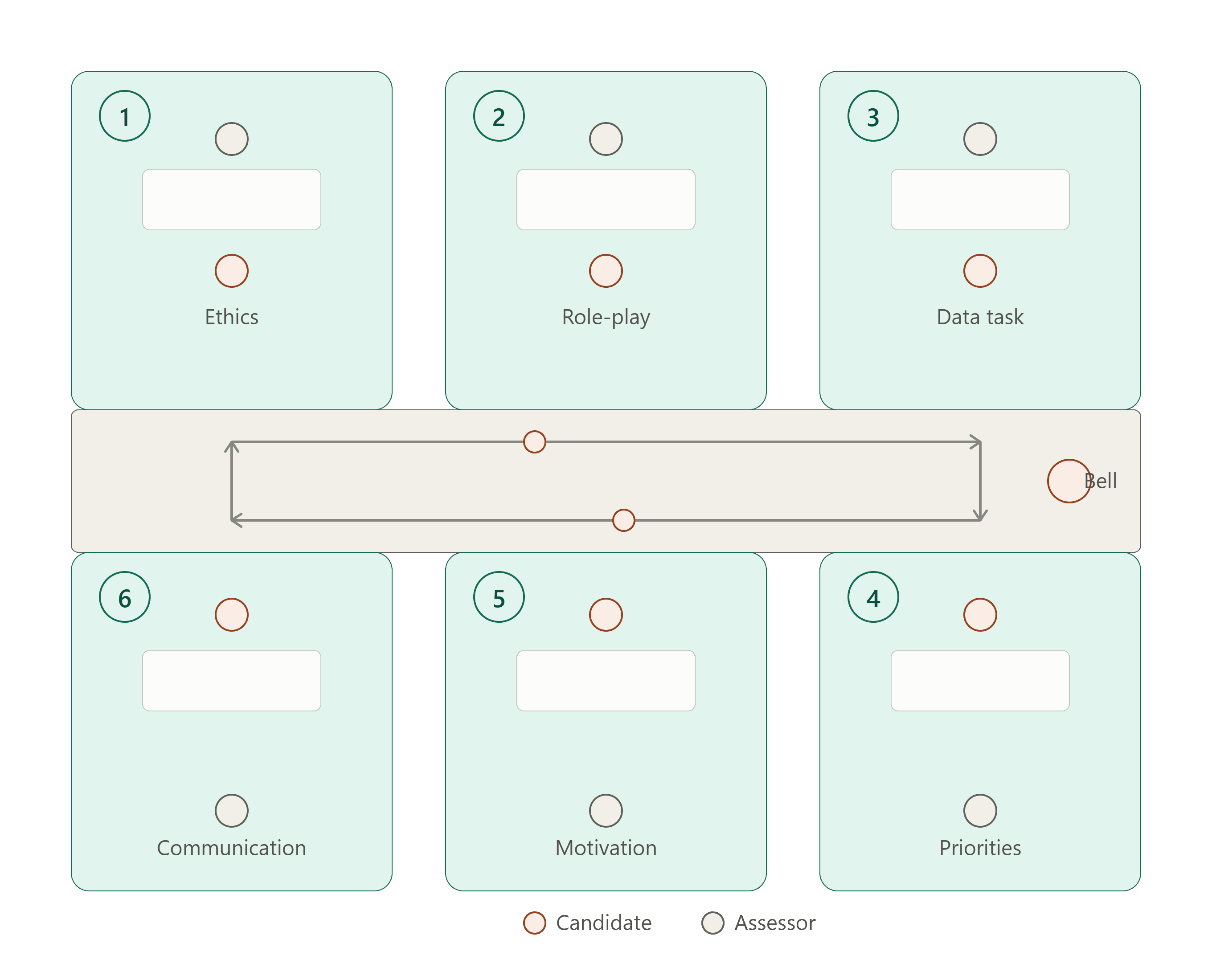
The Multiple Mini Interview (MMI) is now the most widely used interview format for admission to UK medical schools. Unlike a traditional panel interview, where you spend 20–30 minutes with the same interviewers, an MMI consists of a series of short, independent interview stations. Each station assesses a different skill or attribute that is important for a future doctor. MMIs are designed to evaluate qualities such as communication, empathy, ethical reasoning, teamwork, problem-solving, professionalism and resilience, rather than simply testing academic knowledge. Research suggests that MMIs are a fairer and more reliable way of assessing applicants because each station is independently scored by different assessors, reducing interviewer bias.
Why Do Medical Schools Use MMIs?
Medical schools recognise that excellent doctors require far more than high academic achievement.
The MMI enables interviewers to assess:
- Communication skills
- Empathy and compassion
- Ethical reasoning
- Professionalism
- Teamwork
- Leadership
- Problem-solving
- Resilience
- Integrity
- Reflection
- Motivation for medicine
- Ability to work under pressure
Because every station has a different assessor, one poor performance is unlikely to determine the outcome of the interview.
Typical MMI Format
Although every university differs slightly, most MMIs include:
- 6–10 stations
- 5–10 minutes per station
- 1–2 minutes reading time before entering
- Different interviewer at every station
- Independent scoring at each station
Some universities conduct interviews online, while others continue to use face-to-face circuits.
What Are Examiners Assessing?
Interviewers are asking themselves questions such as:
- Can I communicate clearly?
- Am I a good listener?
- Can I remain calm under pressure?
- Do I think logically?
- Am I empathetic?
- Can I justify my opinions?
- Do I behave professionally?
- Can I reflect on my experiences?
- Would I make a safe future doctor?
Common MMI Station Types
1. Personal Motivation
Examples:
- Why Medicine?
- Why this university?
- Tell me about yourself.
- What qualities make a good doctor?
- What challenges do doctors face?
Assesses:
- Motivation
- Insight
- Reflection
- Self-awareness
2. Ethical Scenarios
Examples:
- Confidentiality
- Consent
- Organ donation
- Resource allocation
- Assisted dying
- Artificial intelligence
- Social media
Assesses:
- Ethical reasoning
- Balanced judgement
- Respect for differing opinions
- Professionalism
Remember:
Interviewers are usually looking for your reasoning rather than a single "correct" answer.
3. Role Play
Examples:
- Breaking bad news.
- Speaking to an angry patient.
- Explaining a delay.
- Dealing with an upset parent.
- Resolving conflict.
Assesses:
- Empathy
- Communication
- Emotional intelligence
- Professionalism
4. Work Experience
Typical questions:
- What did you learn?
- What surprised you?
- What challenges did you observe?
- What did you learn about teamwork?
Remember:
Reflection is more important than describing what happened.
5. NHS & Current Issues
Topics may include:
- NHS values
- Workforce shortages
- Prevention versus treatment
- Public health
- Vaccination
- Health inequalities
- Artificial intelligence
- Climate change and healthcare
6. Teamwork
Examples include:
- Working with another candidate.
- Solving a practical problem.
- Giving instructions.
- Building an object.
Interviewers observe:
- Listening
- Cooperation
- Leadership
- Respect
- Adaptability
7. Data Interpretation
You may be shown:
- Graphs
- Tables
- Research summaries
- Clinical data
Assessment focuses on:
- Logical thinking
- Communication
- Interpretation
- Objectivity
8. Prioritisation
Examples:
You are a junior doctor with several competing tasks.
Who do you help first?
Interviewers assess:
- Decision making
- Organisation
- Patient safety
- Justification
9. Communication Stations
Examples:
Explain:
- Blood pressure
- Diabetes
- Antibiotics
- MRI scanning
Imagine explaining these concepts to a child or elderly patient.
Avoid jargon.
The Three Golden Rules
Every answer should demonstrate:
Safety
Always prioritise patient welfare.
Empathy
Recognise emotions.
Listen actively.
Show compassion.
Professionalism
Remain respectful.
Maintain confidentiality.
Know your limits.
Escalate concerns appropriately.
Answer Structure
A useful framework is:
SAFE
S – Summarise the problem.
A – Acknowledge different viewpoints.
F – Focus on patient safety.
E – Explain and justify your decision.
Role Play Tips
Always:
- Introduce yourself.
- Build rapport.
- Listen.
- Maintain eye contact.
- Speak slowly.
- Check understanding.
- Show empathy.
- Summarise.
Never:
- Interrupt.
- Judge.
- Argue.
- Rush.
- Use medical jargon.
Ethics Tips
Avoid giving one-sided opinions.
Instead:
- Identify competing principles.
- Consider benefits and risks.
- Respect patient autonomy.
- Consider confidentiality.
- Prioritise safety.
- Reach a balanced conclusion.
Communication Tips
Remember the LEARN approach:
L Listen actively.
E Empathise.
A Ask open questions.
R Respond clearly.
N Next steps.
Body Language
Interviewers assess non-verbal communication.
Good body language includes:
- Smile naturally.
- Sit upright.
- Open posture.
- Appropriate eye contact.
- Calm voice.
- Controlled gestures.
Avoid:
- Folding arms.
- Looking at the floor.
- Fidgeting.
- Speaking too quickly.
Time Management
Most stations are short.
A useful approach:
- First minute:
- Understand the scenario.
- Middle:
- Develop your reasoning.
- Final minute:
- Summarise your conclusion.
If interrupted, stop speaking politely.
Common Mistakes
Avoid:
- Memorised speeches.
- Overly rehearsed answers.
- Ignoring the question.
- Talking continuously.
- Forgetting empathy.
- Becoming argumentative.
- Guessing medical facts.
- Trying to impress with technical knowledge.
How MMIs Are Marked
Each station is scored independently.
Typical domains include:
- Communication
- Empathy
- Professionalism
- Ethical reasoning
- Organisation
- Confidence
- Insight
- Reflection
A weak station rarely ruins your interview because every station offers a fresh start.
Preparing for MMIs
Successful preparation includes:
- Reading about medical ethics.
- Understanding NHS values.
- Reflecting on work experience.
- Practising role play.
- Discussing current healthcare issues.
- Completing mock MMIs.
- Speaking answers aloud.
- Timing yourself.
Remember:
Interview skills improve through repeated practice rather than simply reading model answers.
What are the common themes covered during role play scenarios?
For those universities using MMI, the following are common themes:
- Breaking bad news
- Dealing with an angry patient
- Consoling a patient or friend
- Challenging a co-worker or friend about alcohol or drugs
Your role
You will be given a particular role to play, often that of a doctor or medical student. It can be quite difficult given that you are very unlikely to have undertaken such role play previously. It does require a degree of maturity, but advance preparation certainly helps. It is a good idea, if you have time, to practise the character role several times before the actual MMI station. Although some things are out of your control, others can be controlled:
- Always stay within the limit of the role you have been given. Not only does this give you a focus, but it also demonstrates that you’ve understood the role you’ve been asked to act.
- Generally the actors will also have limits to their roles. But they may also have been briefed to try and lead you away from your own, in whatever way, do be careful not to allow yourself be led down blind alleys.
- You should always be kind in your tone.
- Give your ‘patient’ opportunities for reflection.
- Be enthusiastic.
Empathy
Showing empathy can be difficult, particularly in a staged MMI scenario. When the actor shows concern or demonstrates sadness, however, it is insufficient simply to sympathise with their situation. Instead, you are expected to empathise: to ‘feel’ the actor’s feelings and react to them dynamically is really important. Good techniques/words are:
- Acknowledgement of their situation
- “I know it must be hard for you to find out………”
- “I understand why you are upset………..”
- “I may have reacted the same way given the circumstances………..”
Reflection:
- “So, how did that make you feel?”
- Use silence appropriately. A silent voice doesn’t mean a silent body! A slight pause can show that you are listening and that you are caring. Too much hesitation, however, may indicate a lack of comprehension or a lack of confidence.
- Even though you’re obviously not saying anything during a short period of silence, good body language, good eye contact, good posture and sympathetic facial gestures can ‘speak’ volumes. This is considered as active body language.
- Acknowledging the other person by nodding and smiling also demonstrates that you are listening and interacting.
If you’re asked to take a history from a patient or gain knowledge about scenario you must have a strategy.
We also recommend using the ICE technique.
What is the ICE method of consultation?
ICE (Ideas, Concerns and Expectations) is a concept in consultation skills training to elicit the patient’s agenda. It has been shown to reduce overdiagnosis and overtreatment.
Ideas
Find out what your patient is thinking:
- “Tell me about what you think may be of concern to you .”
- “Do you have any ideas about what might be occurring at the moment with you?”
- “It’ll be nice to know what you think.”
Concerns
And find out exactly what their concerns are (which may be different to yours):
- “What’s your biggest concern at the moment?”
- “Are you concerned about this today?”
- “What’s your number one issue regarding this condition today?”
Expectations
Find out where your patient expects the consultation to go:
- “What would you like to happen today?”
- “What are you aiming to get from today?”
- “What is the best plan of action for you?”
Remember never get angry, look fed up, or be rude.
Remember again, never get angry, look fed up, or be rude, however much your ‘patient’ might push you.
Final Advice
The purpose of the MMI is not to identify applicants who know the most medicine. Medical schools are looking for applicants with the potential to become safe, compassionate and reflective doctors.
Throughout every station, ask yourself:
Am I communicating clearly?
Am I demonstrating empathy?
Am I behaving professionally?
Am I considering patient safety?
Have I justified my reasoning?
If the answer to each of these questions is "yes", you are likely to perform well in almost any MMI station.
Preparation is key!