
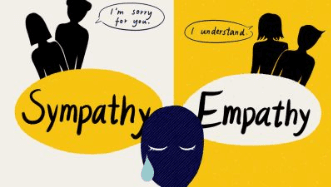
Medical Ethics - EMPATHY vs SYMPATHY
EMPATHY vs SYMPATHY
This is one of the most indirectly tested concepts in UCAT SJT, not as a definition question, but through:
- Communication judgement
- Professionalism ranking
- Patient interaction scenarios
- Ethical reasoning under time pressure
Sympathy = “Observer emotion”
- Recognise distress
- Feel concern about the patient
- Maintain emotional distance
Cognitive structure:
“I see that something bad has happened → I feel sorry → I respond politely”
Key limitation:
- No attempt to fully understand internal experience
- Can become superficial if overused alone
Empathy = “Shared perspective”
You:
- Actively try to understand emotional state
- Imagine patient’s experience
- Respond to emotional meaning, not just facts
Cognitive structure:
“What must this feel like for them → how would I feel → how do I respond to support them”
High-Resolution Comparison (Exam-relevant)
Quick Definitions
Term | Definition | Example |
Sympathy | Feeling for someone (external acknowledgment) | "I'm so sorry you're in pain." |
Empathy | Feeling with someone (active understanding) | "Help me understand what this is like for you." |
Golden Rule: Sympathy says "I feel sorry for you." Empathy says "I hear you, I see you, I want to understand."
MMI Roleplay: Empathy Framework (E.M.P.A.T.H.Y.)
Letter | Action | Example Phrase |
E | Eye contact & open body language | (Lean forward, nod, don't cross arms) |
M | Mirror the patient's emotion | "I can hear that you're feeling frustrated..." |
P | Perspective-taking | "Help me understand what this has been like for you." |
A | Acknowledge their distress | "It makes complete sense you would feel that way." |
T | Tone of voice (warm, calm) | Speak slowly and gently |
H | Hear them out without interrupting | Silence is okay – let them finish |
Y | Your response (collaborative) | "Thank you for sharing. Here's how we can work on this together." |
Testing:
🔹 1. Emotional intelligence under pressure
Can you identify emotional cues quickly?
🔹 2. Professional communication structure
Do you respond in a clinically appropriate way?
🔹 3. Prioritisation of patient-centred care
Do you put the patient’s emotional state before task completion?
🔹 4. Safe escalation vs independence
Do you know when empathy requires action (not just words)?
Why Medical Schools Care
Reason | Explanation |
Patient Trust | Empathetic doctors get better disclosure of symptoms |
Treatment Adherence | Patients follow plans when they feel understood |
Burnout Prevention | Empathy with boundaries protects you; unchecked sympathy leads to exhaustion |
GMC Guidance | Good Medical Practice requires treating patients as individuals |
Dimension | Sympathy | Empathy |
Emotional depth | Surface-level recognition | Deep perspective-taking |
Communication goal | Comfort | Understanding + support |
Patient interaction | Passive | Active |
UCAT scoring value | Medium | High |
Risk | Can sound detached | Can still be misused if over-emotional |
APPLICATION FRAMEWORK
When you see ANY emotional scenario, follow this mental algorithm:
STEP 1 — Identify emotion
- Fear
- Anxiety
- Anger
- Confusion
- Distress
STEP 2 — Choose response type
Empathy response (preferred):
- Acknowledge feeling explicitly
- Validate emotional experience
- Invite discussion
- Offer explanation or support
Sympathy response (acceptable but weaker):
- General condolence
- No deeper exploration
Non-empathetic response (low scoring):
- Dismissal
- Over-focus on facts
- Ignoring emotional content
High-scoring empathy phrases: Language Signals
- “I can see this is distressing for you”
- “That sounds really difficult”
- “It’s understandable you feel this way”
- “Would you like to talk more about that?”
- “Let’s go through this together”
These show:
- validation
- engagement
- shared understanding
Sympathy phrases (limited marks alone):
- “I’m sorry to hear that”
- “That’s unfortunate”
- “That must be hard”
These lack:
- exploration
- action
- engagement
Ranking Logic (SJT Deep Strategy)
Top tier responses:
- Empathy + action
- Emotional validation + professionalism
- Encouraging patient expression
Middle tier:
- Polite sympathy
- Partial acknowledgement but no exploration
Low tier:
- Task-focused ignoring emotion
- Dismissive tone
- Over-authoritative communication
“Doctor Thinking Model” (Advanced UCAT reasoning)
Strong candidates unconsciously do this:
Step A:
“What is the patient feeling?”
Step B:
“What is the emotional need behind this?”
Step C:
“What response reduces distress AND maintains professionalism?”
Common traps and mistakes to avoid!
Trap 1: Over-sympathy
- Too emotional
- Not solution-oriented
Trap 2: Over-clinical response
- Focus only on diagnosis or logistics
- Ignores feelings
Trap 3: Fake reassurance
- “You’ll be fine”
- UCAT hates uncertainty denial
Trap 4: No engagement
- Treating patient as a task, not a person
Common Mistakes to Avoid
Mistake | ❌ Wrong | ✅ Right | |
1 | Superficial cultural sensitivity | "I respect their culture." | "I asked: 'What's important to you in your care?'" |
2 | Making assumptions | "They're Muslim, so they want a same-sex doctor." | "Everyone is different. Please tell me your preference." |
3 | Lack of reflection | "The patient was happy." | "Using Gibbs, I learned my bias was... Now I always..." |
4 | Emotional over-identification | "I cried with the patient." | "I stayed composed, validated them, then debriefed with a supervisor." |
5 | Fixing before listening | "Here are the success rates." | "I can see you're anxious. What would help right now?" |
Examiner Pattern Recognition (Important insight)
✔ Recognition of emotion
✔ Exploration of concerns
✔ Respectful tone
✔ Patient autonomy
✔ Collaborative language
Cultural Mistakes When Answering Empathy Questions
Mistake | What It Means | How To Avoid It |
1. Superficial Understanding of Cultural Sensitivity | Giving a vague, general answer without mentioning specific cultural factors or how you adapted your approach. | Name the specific cultural consideration (e.g., religious fasting, family decision-making, language barriers) and explain exactly what you did to accommodate it. |
2. Making Assumptions About Cultural Beliefs | Assuming you know what a patient believes or wants based on their ethnicity, religion, or appearance (stereotyping). | Say: "I didn't assume anything. I asked open questions and listened to understand their individual perspective." |
3. Lack of Reflective Practice | Describing what happened without explaining what you learned or how you changed your future practice. | End your answer with: "This taught me that... [lesson]. Now I always... [changed behaviour] |
Reasons for Failure to Express Empathy & Sympathy
Reason | What It Means | Key Takeaway | |
1 | Compassion Fatigue | Excessive emotional involvement with patients leads to emotional burnout. You become so drained that you can no longer empathise effectively. | Learn to manage your emotional resources. Empathy with boundaries is sustainable; over-identification is not. |
2 | Misinterpreted Sympathy | Sympathy can be misunderstood as pity if communicated poorly. Pity feels condescending and damages the doctor-patient relationship. | Communicate sympathy as genuine care, not as "feeling sorry for" someone from above. |
3 | Cultural Differences | The expression of empathy and sympathy varies across cultures. What feels empathetic in one culture may feel cold – or intrusive – in another. | Adapt your communication style. Ask, don't assume. Learn the patient's preferences. |
4 | Overcoming Challenges (Lack of Strategy) | Many doctors and students fail because they have no explicit strategy for handling the above challenges. They react emotionally rather than responding deliberately. | Showcase your resilience and adaptability. Have a plan: debrief with colleagues, use reflection, set emotional boundaries. |
Sympathy notices pain.
Empathy enters it, understands it, and responds to it.
Scenario Breakdown
A patient says:
“I feel like nobody is listening to me and I’m really anxious about my diagnosis.”
Weak (sympathy-only)
“I’m sorry to hear that.”
Why it scores poorly:
No engagement
No validation of specific concern
No invitation to talk further
Strong (empathy-based)
“I can see you’re feeling really anxious and unheard. That must be upsetting. Would you like to tell me more about your concerns so I can help address them?”
Why this is high scoring:
Identifies emotion (anxiety)
Validates experience
Encourages communication
Patient-centred structure
Fourteen Questions and Answers
1. What is empathy?
Answer:
Empathy is the ability to understand and share the feelings of another person, and to communicate that understanding back to them. In medicine, it helps build trust and improves patient-centred care.
2. What is sympathy?
Answer:
Sympathy is feeling pity or sorrow for someone’s situation without necessarily understanding their emotional experience from their perspective. It is more about feeling sorry for the patient rather than understanding them.
3. What is the difference between empathy and sympathy?
Answer:
Sympathy involves feeling sorry for a patient, whereas empathy involves understanding how the patient feels and expressing that understanding. Empathy is more useful in healthcare because it strengthens communication and trust.
4. Why is empathy important in healthcare?
Answer:
Empathy is important because it improves doctor–patient communication, builds trust, encourages patients to share important information, and supports shared decision-making. It can also improve patient satisfaction and outcomes.
5. Can you give an example of empathy in practice?
Answer:
If a patient says they are scared about surgery, an empathetic response would be:
“I can see that you’re feeling anxious about the operation. Can you tell me what specifically worries you so I can help address it?”
6. What would a sympathetic response look like?
Answer:
A sympathetic response would be:
“I’m sorry you’re going through this.”
While this shows concern, it does not explore the patient’s feelings further.
7. How would you show empathy to a distressed patient?
Answer:
I would listen actively, acknowledge their feelings, and use open-ended questions. For example, “That sounds very difficult. Would you like to tell me more about how you’re feeling?” I would avoid interrupting and allow them time to express themselves.
8. Is sympathy ever appropriate in medicine?
Answer:
Yes, sympathy can be appropriate in expressing genuine concern, but it should not replace empathy. Empathy is generally more effective because it promotes deeper understanding and better communication.
9. A patient is crying after receiving bad news. What do you do?
Answer:
I would remain calm and give them space to express their emotions. I would acknowledge their feelings, for example: “I can see this is very upsetting. I’m here to support you.” I would then offer to discuss their concerns when they feel ready.
10. Why might excessive sympathy be unhelpful?
Answer:
Excessive sympathy can lead to emotional distance or make the patient feel pitied rather than understood. It may also prevent effective communication and shared decision-making.
11. What is the NURSE framework for empathy?
Answer:
NURSE stands for:
- Name the emotion
- Understand the emotion
- Respect the patient
- Support the patient
- Explore further
It is a structured way to show empathy in clinical conversations.
12. How does empathy improve patient care?
Answer:
Empathy improves patient care by building trust, improving adherence to treatment, reducing anxiety, and ensuring patients feel heard and valued. It leads to more effective and personalised care.
13. Can empathy be taught?
Answer:
Yes, empathy can be developed through communication training, reflective practice, patient interaction, and role-play scenarios such as MMIs. It is a key skill in medical education.
14. What would you say to a patient who has just been diagnosed with a chronic illness?
Answer:
“I can understand that this diagnosis may feel overwhelming. Would you like to talk about what this means for you and what concerns you most right now?”
Useful Links
https://www.gmc-uk.org/ethical-guidance/ethical-guidance-for-doctors/communication-and-partnership
https://www.gmc-uk.org/ethical-guidance/ethical-guidance-for-doctors/good-medical-practice
https://www.nhs.uk/nhs-services/hospitals/what-to-expect-from-your-nhs-hospital/
https://www.england.nhs.uk/personalisedcare/shared-decision-making/
https://www.medicalprotection.org/uk/guidance
https://www.nice.org.uk/guidance/cg138
https://www.hee.nhs.uk/our-work/medical-education
https://www.leadershipacademy.nhs.uk/resources/
https://www.rcplondon.ac.uk/guidelines-policy