
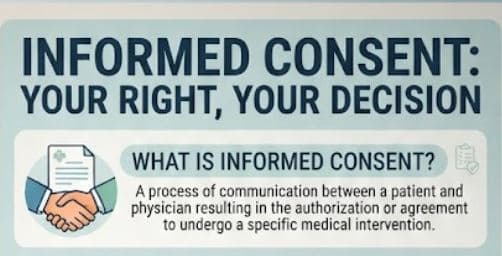
Medical Ethics - Medical Consent
What is Medical Consent?
Medical consent is the permission a patient gives a healthcare professional before any examination, investigation, treatment, or procedure is performed.
Consent is fundamental in medicine because it:
- Respects patient autonomy
- Protects patient rights
- Builds trust
- Is a legal and ethical requirement
Without valid consent, treatment may legally amount to battery or assault.
Medical Consent: Quick Summary
- Consent must usually be obtained before treatment.
- Valid consent must be:
- Voluntary
- Informed
- Given by someone with capacity
- Consent can be verbal, written, or non-verbal.
- Patients can withdraw consent at any time.
- Different rules apply for:
- Adults
- Children
- Emergencies
- Patients lacking capacity
- Consent links closely with:
- Capacity
- Confidentiality
- Medical ethics
Why Consent Is Important
Consent is important because it:
- Protects patient autonomy
- Allows shared decision-making
- Ensures patients understand risks and benefits
- Maintains trust in healthcare
- Prevents coercion or unwanted treatment
Good consent is not simply “getting a signature.” It is a communication process.
Types of Consent
1. Verbal Consent
Spoken agreement.
Example:
“Is it okay if I examine your abdomen?”
“Yes.”
Used for:
- Simple examinations
- Routine procedures
2. Written Consent
Signed consent form.
Used for:
- Surgery
- Anaesthesia
- Major procedures
- Procedures with significant risks
3. Non-Verbal Consent
Consent communicated through actions.
Example:
A patient rolls up their sleeve for a blood pressure reading.
Still requires:
- Explanation
- Understanding
- Capacity
The 3 Requirements of Valid Consent
1. Voluntary
The patient must decide freely without:
- Pressure
- Manipulation
- Coercion
Example:
A patient should not be forced by relatives into agreeing to surgery.
2. Informed
The patient must understand:
- What the treatment involves
- Risks
- Benefits
- Alternatives
- Consequences of refusing treatment
This is called informed consent.
3. Capacity
The patient must have mental capacity to decide.
Under the Mental Capacity Act 2005, capacity means the patient can:
- Understand information
- Retain information
- Weigh information
- Communicate a decision
Informed Consent
Informed consent is one of the most important concepts in modern medicine.
Doctors must explain:
- Procedure details
- Material risks
- Alternative options
- Potential complications
- Recovery expectations
The explanation should be:
- Clear
- Honest
- Tailored to the patient
The Montgomery Case
A key legal case in UK consent law is Montgomery v Lanarkshire Health Board.
Why it matters:
The case changed the standard for informed consent.
Doctors must now disclose:
Any material risk a reasonable patient would want to know.
This strengthened:
- Patient autonomy
- Shared decision-making
Capacity and Consent
Capacity and consent are heavily linked.
A patient with capacity:
- Can consent
- Can refuse treatment
- Can withdraw consent
Even if refusal may lead to harm or death.
Example:
A patient with capacity can refuse chemotherapy or blood transfusions.
Can Consent Be Withdrawn?
Yes.
A patient with capacity may withdraw consent:
- Before treatment
- During treatment
Example:
A patient may initially agree to surgery but later change their mind.
Healthcare professionals must respect this.
Situations Where Consent Is Not Needed
Emergencies
If a patient:
- Is unconscious
- Needs urgent life-saving treatment
Doctors may act under implied consent.
The assumption is:
The patient would likely want life-saving treatment.
Mental Health Act
Under certain circumstances, patients with severe mental illness may be treated without consent under the Mental Health Act 1983.
Consent in Children
Under 16
Children may consent if they are:
- Gillick competent
This means they have enough maturity and understanding.
Example:
A 15-year-old requesting contraception.
Age 16–17
Patients aged 16–17 can usually consent independently if they have capacity.
However:
- Courts or parents may override refusal of life-saving treatment.
Gillick Competence
Gillick competence assesses whether a child under 16 understands:
- The treatment
- Risks
- Consequences
If competent:
- They may consent without parental permission.
Patients Who Lack Capacity
If a patient lacks capacity:
- Nobody can simply “consent for them” (except specific legal arrangements like LPA).
Instead:
- Doctors act in the patient’s best interests.
Factors considered:
- Clinical benefit
- Patient wishes
- Beliefs and values
- Family input
- Previous statements
Best Interests
Best interests means choosing the option that:
- Most benefits the patient
- Minimises harm
- Respects patient values
It does NOT simply mean:
“Do everything possible.”
Sometimes best interests may involve:
- Palliative care
- Limiting burdensome treatment
- Comfort-focused care
Consent and Ethics
Autonomy
Patients control decisions about their own bodies.
Beneficence
Doctors act in patients’ best interests.
Non-maleficence
Avoid causing harm.
Justice
Treat patients fairly and equally.
Common Challenges in Consent
Language Barriers
Use:
- Professional interpreters
- Clear language
Avoid:
- Using relatives as translators
Hearing or Communication Difficulties
May require:
- Written communication
- Sign-language interpreters
- Visual aids
Complex Procedures
Doctors must explain complicated concepts in understandable terms.
Good communication is essential.
Consent in Medical School MMIs
Consent commonly appears in:
- Ethics stations
- Roleplay stations
- Communication stations
Examples:
- Asking to examine a patient
- Dressing a wound
- Explaining a procedure
Example MMI Consent Structure
Step-by-step approach:
- Introduce yourself
- Confirm patient identity
- Explain procedure clearly
- Explain risks/benefits
- Check understanding
- Ask if they have questions
- Gain consent
- Document consent
Emergency Consent Example
Question
“An unconscious patient arrives in A&E needing urgent surgery. What happens with consent?”
Model Points
- Patient cannot provide consent
- Emergency treatment proceeds under implied consent
- Doctors act in best interests
- Treatment should not be delayed
- Once conscious, patient should be informed afterwards
High-Yield Interview Tips
DO:
- Mention capacity frequently
- Use ethical pillars
- Prioritise patient autonomy
- Mention communication
- Show empathy
DON’T:
- Assume family automatically decides
- Ignore patient wishes
- Forget emergencies are exceptions
- Confuse consent with simply signing a form
One-Line Definitions for Interviews
Medical Consent
“Permission given by a patient for medical examination or treatment.”
Informed Consent
“Consent given after understanding risks, benefits, and alternatives.”
Capacity
“The ability to understand, retain, weigh, and communicate decisions.”
Best Interests
“The option that most benefits the patient while respecting their values and minimising harm.”
Questions & Answers
1. What is consent in medicine?
Consent is the voluntary, informed agreement by a patient to undergo examination, treatment, or investigation, after they have been given adequate information to make an informed decision.
It is a legal and ethical requirement before any intervention.
2. What are the types of consent?
- Implied consent: inferred from actions (e.g. holding out arm for blood pressure)
- Verbal consent: spoken agreement (e.g. most examinations)
- Written consent: documented agreement (e.g. surgery, anaesthesia)
3. What are the key elements of valid consent?
For consent to be valid, it must be:
- Voluntary (no coercion)
- Informed (adequate information provided)
- Given by a competent patient
4. What information must be provided for informed consent?
You must explain:
- Diagnosis/condition
- Purpose of treatment
- Benefits
- Risks (common and serious)
- Alternatives, including no treatment
- Likely consequences of refusal
5. How do you assess capacity?
A patient has capacity if they can:
- Understand information
- Retain it
- Weigh it up
- Communicate a decision
This is decision-specific and time-specific.
6. What is Gillick competence?
It refers to children under 16 being able to consent if they have sufficient understanding and intelligence to fully understand the treatment.
It comes from Gillick v West Norfolk and Wisbech Area Health Authority.
7. What is the difference between capacity and competence?
- Capacity: applies to adults (Mental Capacity Act framework)
- Competence (Gillick): applies to children under 16
Both assess ability to make a specific decision.
8. What is Fraser guidelines?
They are specific criteria allowing clinicians to give contraception advice/treatment to under-16s without parental involvement, if certain safeguarding criteria are met.
9. Can consent be withdrawn?
Yes. A patient can withdraw consent at any time, even immediately before or during treatment.
10. What happens if a patient lacks capacity?
If a patient lacks capacity:
- Act in their best interests
- Involve family/representatives where appropriate
- Follow legal frameworks (e.g. Mental Capacity Act)
- Consider advance directives or lasting power of attorney
11. When can treatment be given without consent?
Only in limited situations:
- Emergency life-saving treatment when patient lacks capacity
- Mental Health Act provisions (specific circumstances)
- Court-authorised treatment
12. Can family consent for adults lacking capacity?
No. Decisions are made in the patient’s best interests.
13. What does “best interests” mean?
Choosing the option that most benefits the patient while respecting their wishes and wellbeing.
14. What is the Montgomery case?
Montgomery v Lanarkshire Health Board ruled doctors must explain all material risks a reasonable patient would want to know.
15. Can parents refuse treatment for an under 16 year old in the UK?
Parents can refuse consent for an under 16, however courts can authorise medically necessary treatment against parental wishes.
16.“A patient refuses a life-saving blood transfusion. What would you do?”
Answer
“I would first assess whether the patient has capacity by checking they can understand, retain, weigh, and communicate information about the decision.
If they have capacity, I would respect their autonomy even if refusing treatment may result in death. I would ensure they fully understand the risks and alternatives and explore their concerns sensitively and without judgement.
I would involve senior clinicians and consider alternative treatments where possible. Ethically, this situation involves balancing autonomy with beneficence and non-maleficence.”
Useful Links
https://www.nhs.uk/conditions/consent-to-treatment/
https://www.nhs.uk/conditions/consent-to-treatment/children/
https://www.gmc-uk.org/ethical-guidance/ethical-guidance-for-doctors/decision-making-and-consent
https://www.gmc-uk.org/ethical-guidance/ethical-guidance-for-doctors/0-18-years
https://www.medicalprotection.org/uk/guidance/consent
https://www.bma.org.uk/advice-and-support/ethics
https://www.nice.org.uk/about/what-we-do
https://www.mdu.com/guidance-and-advice/guides/consent-and-mental-capacity
https://www.rcpch.ac.uk/resources/consent
https://www.gov.uk/government/publications/mental-capacity-act-code-of-practice