
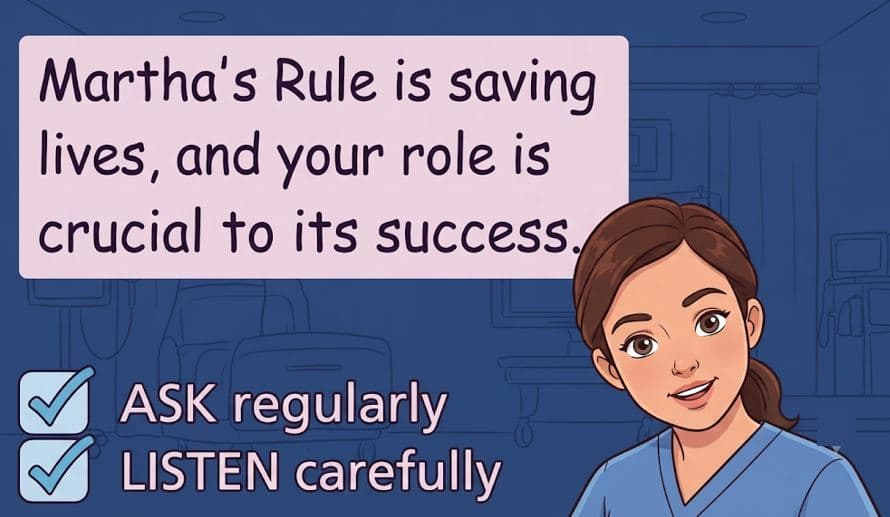
Martha's Rule
What Is Martha’s Rule?
Martha’s Rule is an NHS patient safety initiative that allows patients, families, carers, and NHS staff to request an urgent independent review if they are worried that a patient’s condition is deteriorating and their concerns are not being acted upon.
It was introduced following the death of Martha Mills, a 13-year-old girl who died from sepsis after repeated concerns from her family were not escalated appropriately.
The rule aims to:
- Improve patient safety
- Encourage speaking up
- Reduce communication failures
- Empower patients and families
- Flatten harmful medical hierarchies
Martha’s Rule is now being implemented across NHS acute hospitals in England.
Why Was Martha’s Rule Created?
Martha Mills suffered a pancreatic injury after a bicycle accident in 2021 and was treated at King's College Hospital.
Her condition deteriorated and her parents repeatedly raised concerns. However:
- Signs of sepsis were missed
- Escalation to intensive care was delayed
- Concerns from family members were not properly acted upon
- Junior staff reportedly felt unable to challenge senior clinicians
The coroner later concluded that Martha would likely have survived with earlier escalation and treatment.
This case highlighted major NHS issues involving:
- Communication failures
- Hierarchy in medicine
- Failure to escalate deteriorating patients
- Lack of patient empowerment
- Poor listening to families
The Three Core Components of Martha’s Rule
1. Daily Check-Ins With Patients and Families
Healthcare staff must proactively ask patients and families whether they are worried about the patient’s condition.
This encourages:
- Open communication
- Early identification of deterioration
- Shared decision-making
- Patient-centred care
2. 24/7 Escalation Pathway for Patients and Families
Patients or relatives can request an urgent independent review if they believe deterioration is not being addressed.
This review is usually conducted by:
- Critical Care Outreach Teams (CCOTs)
- Independent senior clinicians
- Rapid response teams
The purpose is to ensure concerns are independently reassessed.
3. 24/7 Escalation Pathway for NHS Staff
Junior doctors, nurses, and allied healthcare professionals can escalate concerns if they feel patient deterioration is being ignored.
This is important because:
- Hierarchy can prevent staff from speaking up
- Junior staff may fear criticism
- Escalation culture improves patient safety
This links strongly to NHS whistleblowing and duty of candour principles.
Why Martha’s Rule Matters for Patient Safety
NHS England introduced Martha’s Rule to address preventable harm caused by failures in escalation and communication.
Benefits may include:
- Earlier recognition of sepsis and deterioration
- Faster treatment escalation
- Improved communication
- Greater patient autonomy
- Increased trust and transparency
- Reduced preventable deaths
Research consistently shows communication breakdowns contribute significantly to patient harm. Martha’s Rule creates a formal safety net for escalation.
Ethical Principles Linked to Martha’s Rule
Autonomy
Patients and families gain more involvement in care decisions.
Martha’s Rule empowers people to raise concerns rather than passively accepting decisions.
Beneficence
Doctors should act in the patient’s best interests.
Independent reviews may identify deterioration earlier and improve outcomes.
Non-Maleficence
Doctors must avoid harm.
Failure to escalate deterioration can directly harm patients, as seen in Martha’s case.
However, excessive escalation may also:
- Delay treatment
- Overload staff
- Cause anxiety
This balance is important to discuss in interviews.
Justice
Resources are limited within the NHS.
Critical care outreach teams require staffing and funding, so there are concerns about:
- Workforce pressures
- Resource allocation
- Fair access across hospitals
Advantages of Martha’s Rule
Improved Patient Safety
Allows earlier recognition of deterioration.
Encourages Speaking Up
Patients, relatives, and junior staff feel empowered.
Better Communication
Creates clearer dialogue between healthcare teams and families.
Cultural Change
Encourages openness and reduces toxic hierarchy.
Supports NHS Duty of Candour
Promotes honesty and transparency.
Disadvantages and Challenges
Increased Workload
Critical care teams may become overstretched.
Potential Overuse
Some families may escalate unnecessarily.
Possible Delays
Multiple reviews could slow urgent treatment.
Staff Resistance
Some clinicians may feel their judgement is being challenged.
Inequality of Access
Patients with language barriers or poor health literacy may struggle to use the system.
International Comparisons
Ryan’s Rule – Australia
Ryan’s Rule allows families to request urgent clinical reviews if they feel concerns are ignored.
It inspired aspects of Martha’s Rule.
Condition H(elp) – USA
Condition H(elp) enables patients to directly contact emergency response teams.
Call 4 Concern – UK
Several UK hospitals already used systems similar to Martha’s Rule before national rollout.
These systems demonstrated:
- Low misuse
- Earlier escalation
- Improved patient outcomes
Common Medicine Interview Questions
“What is Martha’s Rule?”
Strong Answer Structure
- Define it
- Explain why it was introduced
- Discuss patient safety
- Mention ethical considerations
- Give balanced advantages and disadvantages
“What are the ethical issues surrounding Martha’s Rule?”
You could discuss:
- Autonomy
- Resource allocation
- Delays to care
- Trust between doctors and patients
- Equality of access
- Staff hierarchy
“How might Martha’s Rule affect the doctor-patient relationship?”
Balanced answer:
- It may improve trust through openness
- Patients may feel listened to
- Some clinicians may initially feel challenged
- Ultimately it encourages collaborative care
“How would you respond if a patient requested a second opinion?”
Good points:
- Remain calm and professional
- Listen without defensiveness
- Respect patient autonomy
- Explain the escalation process
- Prioritise patient safety
- Maintain empathy and communication
Martha Ruling MMI questions
Examiners are looking for:
- Patient safety > hierarchy
- Escalation when concern persists
- Appropriate vs inappropriate urgency
- Distinguishing clinical deterioration vs dissatisfaction
- Use of structured pathways rather than informal dismissal
Station 1: Understanding the principle
Question:
“What is Martha’s Rule and why has it been introduced in the NHS?”
Model answer:
Martha’s Rule is a patient safety initiative that allows patients and families to request an urgent independent clinical review if they are concerned that a patient is deteriorating and feel their concerns are not being adequately addressed by the treating team.
It was introduced to:
- Improve recognition of clinical deterioration
- Empower patients and families to escalate concerns
- Reduce avoidable harm from delayed intervention
- Provide an additional safety net alongside existing escalation systems like early warning scores
What examiners want:
- Patient safety focus
- Escalation + independence
- Not just “complaints system”
Station 2: Applied scenario
Question:
“A patient’s family is worried the patient is getting worse, but the junior doctor believes everything is stable. The family asks to use Martha’s Rule. What do you do?”
Model answer:
I would take the family’s concerns seriously and not dismiss them. I would:
- Reassess the patient myself or escalate urgently to a senior clinician
- Ensure the patient is reviewed promptly and objectively
- Activate the Martha’s Rule escalation process for an independent review if concerns persist
- Communicate clearly with the family about what is happening and expected timelines
Key points:
- Never dismiss concerns
- Clinical reassessment comes first
- Escalation is appropriate
- Communication is essential
Station 3: Ethical reasoning
Question:
“Does Martha’s Rule undermine doctors’ authority?”
Model answer:
No. It complements clinical decision-making rather than undermining it. Doctors still lead care, but Martha’s Rule adds an extra layer of safety where concerns persist.
It recognises that:
- Deterioration can sometimes be missed
- Families often notice subtle changes first
- Hierarchies should not prevent escalation of safety concerns
It ultimately supports better teamwork and patient safety.
What examiners want:
- Balanced view
- Respect for clinical hierarchy and safety
- Not defensive about medicine
Station 4: Prioritisation
Question:
Rank the appropriateness of actions when a family is worried under Martha’s Rule:
- Ignore concerns as staff have already assessed the patient
- Arrange an urgent senior clinical review
- Encourage formal escalation through Martha’s Rule pathway
- Ask the family to wait for routine ward round
Answer:
2 → 3 → 4 → 1
Explanation:
- Senior review = safest immediate action
- Formal escalation pathway next
- Waiting is weaker but sometimes acceptable if stable
- Ignoring concerns is unsafe
Station 5: Communication
Question:
“How would you explain Martha’s Rule to a patient’s family?”
Model answer:
“I would explain that if you are worried your relative is becoming more unwell and feel those concerns are not being fully addressed, you can ask for an urgent independent clinical review. This is to ensure patient safety and that any deterioration is not missed. It does not replace the treating team but provides an extra safety check.”
Key points:
- Simple language
- Reassurance
- Emphasise safety net, not conflict
- No jargon
Station 6: Professionalism & conflict
Question:
“A consultant dismisses a family’s request to escalate under Martha’s Rule. What do you do?”
Model answer:
I would remain professional but prioritise patient safety. I would:
- Politely raise my concerns that escalation may be appropriate
- Suggest a senior review or second opinion
- Ensure the family’s concerns are formally documented and escalated through appropriate channels
- If necessary, follow trust policy for escalation even if there is disagreement
What examiners look for:
- Patient safety > hierarchy
- Respectful challenge
- Knowing escalation pathways
- No confrontation tone
Example MMI Model Answer
Question:
“How does Martha’s Rule improve patient safety?”
Model Answer:
“Martha’s Rule improves patient safety by giving patients, families, and healthcare staff a formal mechanism to escalate concerns about deterioration. One major issue in healthcare is communication failure, where warning signs may be missed or concerns not acted upon quickly enough. Martha’s Rule introduces an independent review pathway, meaning another clinical team can reassess the patient if concerns persist.
It also promotes a culture where speaking up is encouraged, which is important because junior staff and families may previously have felt unable to challenge senior decisions. Ethically, it supports autonomy and beneficence by ensuring patients’ voices are heard and care is delivered in their best interests.
However, there are challenges, including staffing pressures and the risk of unnecessary escalation. Overall, I believe the benefits to patient safety outweigh the disadvantages because earlier escalation could prevent avoidable harm and deaths.”
Key Interview Tips
What you should remember for MMI
Interviewers are testing whether you understand:
- Patient safety overrides hierarchy
- Families are part of the safety system
- Escalation should be structured, not emotional
- Communication prevents conflict
- Independent review is central to Martha’s Rule
Use NHS Language
Mention:
- Patient-centred care
- Duty of candour
- Escalation
- Clinical deterioration
- Communication failures
- MDT working
- Patient safety culture
Give Balanced Answers
Avoid saying Martha’s Rule is “perfect.”
Acknowledge:
- Benefits
- Ethical dilemmas
- Resource limitations
- Workforce pressures
Balanced judgement impresses interviewers.
Link to GMC Good Medical Practice
General Medical Council guidance expects doctors to:
- Listen to patients
- Escalate safety concerns
- Communicate effectively
- Act when patients deteriorate
Martha’s Rule strongly reflects these principles.
Key Interview Message
“Martha’s Rule promotes a safer, more open healthcare culture where patients, families, and staff feel empowered to raise concerns early.”
Useful Links
https://www.england.nhs.uk/patient-safety/marthas-rule/
https://www.england.nhs.uk/patient-safety/marthas-rule/information-patients-families-carers/
https://www.england.nhs.uk/long-read/marthas-rule-core-standards/
https://www.england.nhs.uk/patient-safety/
https://www.nuh.nhs.uk/marthas-rule/
https://www.ouh.nhs.uk/patient-guide/marthas-rule/
https://www.kch.nhs.uk/patients-and-visitors/help-and-support/marthas-rule/
https://www.boltonft.nhs.uk/your-care/marthas-rule/
https://www.stockport.nhs.uk/news/marthas-rule-launch/
https://www.barnsleyhospital.nhs.uk/patients/marthas-rule