
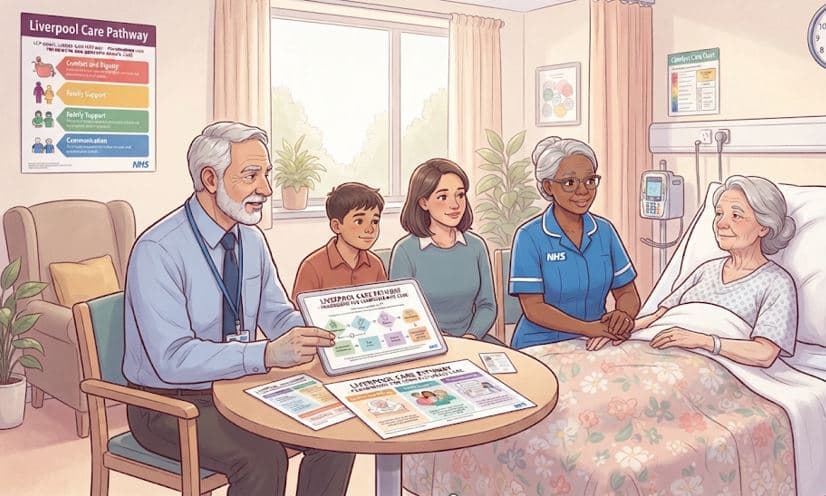
Liverpool Care Pathway (LCP): Why it was withdrawn
1. What was the Liverpool Care Pathway?
The Liverpool Care Pathway (LCP) was a nationally adopted framework for managing patients in the last days or hours of life in the UK.
It was developed in the late 1990s through collaboration between:
- Marie Curie Palliative Care Institute Liverpool
- Royal Liverpool University Hospital
- specialist palliative care clinicians and hospice teams
It was later promoted nationally across the NHS as a **“best practice model” for end-of-life care”.
2. Legal Status of the LCP (Very Important for Interviews)
Key point:
The LCP was NOT a law or statutory requirement.
It was:
- A clinical guidance framework
- An NHS-endorsed care pathway
- A locally implemented protocol
- Not legally binding legislation
What this means legally:
Clinicians were:
- Not legally required to place patients on the LCP
- Expected to use clinical judgement
- Still bound by:
- Common law duty of care
- GMC ethical guidance
- Mental Capacity Act 2005
- Consent law
3. Legal Framework Governing End-of-Life Care (UK)
Even though the LCP itself was not law, its use was governed by key legal principles:
(A) Mental Capacity Act 2005
Applies when patients may lack capacity at end of life.
Key principles:
- Assume capacity unless proven otherwise
- Support decision-making where possible
- Decisions must be in the best interests of the patient
- Least restrictive option must be chosen
This is crucial because LCP decisions often involved stopping fluids, antibiotics, or treatments.
(B) Consent and Refusal of Treatment
Under UK law:
- A competent patient can refuse any treatment, even life-sustaining treatment
- Treatment without valid consent may constitute battery
For LCP patients:
- If conscious and competent → consent required
- If not competent → best interests decision under MCA
(C) GMC Guidance (Medical Ethics Law in Practice)
Doctors must follow:
General Medical Council guidance:
Key legal/ethical requirements:
- Honest communication with patients and families
- Decisions must be individualised
- Do not initiate end-of-life care pathways without proper clinical justification
- Must ensure do not unlawfully hasten death
(D) Human Rights Act 1998
Relevant rights include:
- Article 2: Right to life
- Article 3: Freedom from inhuman or degrading treatment
- Article 8: Right to private and family life
Implications:
- Care must not be negligent or premature
- Families must be involved appropriately
- Dignity must be preserved
4. Why Was the LCP Used?
It was designed to ensure standardised good practice in dying patients:
Clinical aims:
- Symptom control (pain, agitation, breathlessness)
- Stop burdensome interventions
- Avoid unnecessary investigations
- Ensure dignified death
- Improve communication with families
5. How Was the LCP Implemented?
A patient would be placed on the LCP when clinicians believed:
- Death was expected within hours or days
- Condition was irreversible
- Senior clinician agreement was obtained (in theory)
It included:
- Anticipatory prescribing (morphine, midazolam, antiemetics)
- Withdrawal of non-beneficial treatments
- Hydration decisions (IV or SC fluids)
- DNACPR discussions
- Family communication guidance
6. Why Was the LCP Criticised? (Major Legal + Ethical Issues)
Why was it controversial?
Although many healthcare professionals viewed it positively, concerns arose that:
- Some patients were placed on the pathway without adequate assessment.
- Communication with families was sometimes poor.
- Decisions regarding hydration and nutrition were not always clearly explained.
- The pathway could be applied as a "tick-box" exercise rather than an individualised care plan.
1. Misdiagnosis of dying
Some patients placed on LCP were not actually dying.
Legal issue:
- Potential breach of duty of care
- Failure to reassess clinical condition
- Risk of negligent treatment withdrawal
2. Poor communication (major medico-legal failure)
Families reported:
- Not being told their relative was dying
- Lack of informed discussion about withdrawal of treatment
Legal implications:
- Breach of informed consent principles
- Breach of GMC communication duties
- Potential Human Rights Act concerns (Article 8)
3. Withdrawal of hydration and nutrition
One of the most controversial aspects.
Concerns:
- Patients not always reassessed properly
- Fluids stopped without clear justification
Legal issue:
- Must be based on best interests decision under MCA
- Not automatic withdrawal
- Risk of neglect allegations if misused
4. “Tick-box medicine”
The pathway was sometimes applied:
- Rigidly
- Without individual assessment
- Without senior review
Legal concern:
- Failure of clinical judgement
- Departure from accepted standard of care
5. Lack of senior oversight
Junior staff sometimes initiated LCP decisions.
Legal issue:
- Potential breach of duty of care
- Lack of consultant accountability
- Unsafe delegation
7. Independent Review and Withdrawal
The LCP was formally reviewed in 2013 by an independent panel led by Baroness Julia Neuberger.
Findings:
- Concept was sound
- Implementation was “inconsistent and sometimes poor”
- Communication failures were widespread
- Public confidence was damaged
Outcome:
- NHS phased out LCP by 2014
- Replaced with individualised end-of-life care guidance
8. What Replaced the LCP?
The UK moved to:
- Individualised end-of-life care planning
- NICE guidance on dying adults in last days of life
- Specialist palliative care review
Key shift:
LCP Approach | Modern Approach |
|---|---|
Standardised pathway | Individualised care |
Tick-box criteria | Clinical judgement |
Fixed structure | Flexible planning |
Limited communication emphasis | Strong communication focus |
Following the independent review led by Baroness Julia Neuberger, the LCP was phased out in England in 2014 and replaced by the Five Priorities for Care of the Dying Person, which emphasise:
- Recognition that a person may be dying.
- Sensitive communication.
- Shared decision-making.
- Involvement of those important to the patient.
- An individualised plan of care.
9. Legal Position Today (Post-LCP Era)
Modern end-of-life care must ensure:
1. Individual assessment
No automatic pathway use.
2. Documented decision-making
Clear rationale required.
3. Capacity assessment
Mental Capacity Act compliance.
4. Best interests decisions
Where patients lack capacity.
5. Family involvement
Where appropriate and lawful.
6. Avoid premature withdrawal of treatment
All decisions must be clinically justified.
10.NICE vs Liverpool Care Pathway
The key distinction is that NICE guidance provides the evidence-based standards, whereas the Liverpool Care Pathway (LCP) was a clinical tool intended to implement good end-of-life care.
NICE Guidance | Liverpool Care Pathway (LCP) |
|---|---|
National evidence-based recommendations produced by National Institute for Health and Care Excellence | Clinical pathway developed in Liverpool to guide care in the last hours or days of life |
Guidance, not a care plan | A structured multidisciplinary care document |
Covers assessment, symptom control, communication, hydration, and decision-making | Attempted to operationalise these principles at the bedside |
Current NICE guidance remains in use | LCP was phased out in England in 2014 |
Emphasises individualised care and regular review | Criticised when used as a protocol-driven "tick-box" process |
Supported by ongoing evidence reviews and updates | Replaced following the More Care, Less Pathway Review |
- NICE guidance and the Liverpool Care Pathway (LCP) are not alternatives.
- NICE provides the evidence-based framework for care of dying adults.
- LCP was a clinical tool/pathway designed to implement good end-of-life care in hospitals, care homes, and the community.
- The principles of the LCP were consistent with good palliative care practice:
- Symptom control
- Dignity and comfort
- Recognition of dying
- Effective communication
- Avoidance of futile or burdensome interventions
- The controversy was mainly due to implementation issues, not the underlying principles.
- Key concerns included:
- Poor communication with patients and families
- Inadequate senior clinical review
- Difficulty in accurately diagnosing dying
- Risk of a "tick-box" or protocol-driven approach
- Lack of individualised care in some cases
- The Neuberger Review (2013) concluded that the LCP should be phased out.
- The LCP was replaced by the Five Priorities for Care of the Dying Person:
- Recognise and regularly review when a person may be dying.
- Communicate sensitively and clearly.
- Involve the dying person in decisions where possible.
- Involve those important to the patient.
- Create an individualised plan of care.
- Current practice is guided by:
- NICE guidance
- The Five Priorities for Care
- The Mental Capacity Act 2005
- Professional judgement and multidisciplinary working
Ten Questions & Answers
1. What was the Liverpool Care Pathway?
- A multidisciplinary end-of-life care pathway
- Developed to transfer hospice principles into hospitals and other settings
- Used when a patient was thought to be in the last hours or days of life
- Focused on:
- Symptom control (pain, agitation, breathlessness)
- Comfort and dignity
- Communication with family
- Avoiding unnecessary interventions
2. What were the aims of the LCP?
- Improve quality of dying
- Standardise good palliative care practices
- Ensure effective symptom control
- Promote dignity and comfort
- Support communication and decision-making
- Reduce inappropriate or burdensome treatments
3. Why was the LCP controversial?
- Concerns about inconsistent implementation
- Some patients placed on it without adequate senior review
- Poor or unclear communication with families
- Risk of “tick-box” or protocol-driven care
- Difficulty in accurately identifying when a patient was dying
- Public concern that it may have hastened death (not supported by evidence)
4. Was the LCP illegal?
- No
- It had no legal status—it was a clinical guideline/framework
- All decisions still had to comply with:
- Mental Capacity Act 2005
- Common law principles of best interests
- GMC/NMC professional guidance
- Withdrawal of treatment remained lawful if in the patient’s best interests
5. Why was it withdrawn?
- Following the Neuberger Review (2013)
- Key findings:
- Variable quality of care
- Poor communication in some cases
- Over-reliance on a structured pathway
- Recommendation:
- Replace with a more individualised, flexible approach
6. What replaced the LCP?
- Five Priorities for Care of the Dying Person
- Recognise dying and review regularly
- Communicate sensitively
- Involve patient in decisions where possible
- Involve family/important others
- Individualised care plan
7. What is the role of NICE in end-of-life care?
- National Institute for Health and Care Excellence provides:
- Evidence-based guidance for care of dying adults
- Symptom control recommendations
- Standards for communication and decision-making
- NICE guidance supports clinical judgement, not rigid protocols
8. What are the ethical principles involved?
- Autonomy – respect patient wishes and advance decisions
- Beneficence – provide comfort and good symptom control
- Non-maleficence – avoid unnecessary or burdensome treatment
- Justice – fair access to good end-of-life care
9. What are the key lessons from the LCP?
- Clinical tools must not replace judgement
- Importance of:
- Clear communication with families
- Senior clinician involvement
- Regular reassessment
- Individualised care planning
- End-of-life care should be patient-centred, not protocol-driven
10. How would you summarise your view of the LCP?
- Good intentions and principles
- Problems with implementation, not concept
- Led to improved awareness of:
- Communication
- Shared decision-making
- Individualised care
- Influenced modern end-of-life care frameworks
The Liverpool Care Pathway was a well-intentioned clinical framework designed to improve end-of-life care by ensuring dignity and symptom control in dying patients.
However, although it was not a legal requirement, its implementation sometimes failed to meet legal and ethical standards, particularly around communication, consent, and individual assessment.
The key lesson is that end-of-life care must always be patient-centred, legally robust, and based on continuous clinical judgement rather than rigid protocols.
Useful Links
https://www.gov.uk/government/publications/review-of-liverpool-care-pathway-for-dying-patients
https://www.nice.org.uk/guidance/ng31
https://www.legislation.gov.uk/ukpga/2005/9/contents
https://www.ncbi.nlm.nih.gov/books/NBK547820/
https://pmc.ncbi.nlm.nih.gov/articles/PMC5922704/
https://pmc.ncbi.nlm.nih.gov/articles/PMC4477384/
https://www.nice.org.uk/guidance/ng31/evidence
https://www.nice.org.uk/guidance/ng31/documents/care-of-the-dying-adult-full-guideline2