
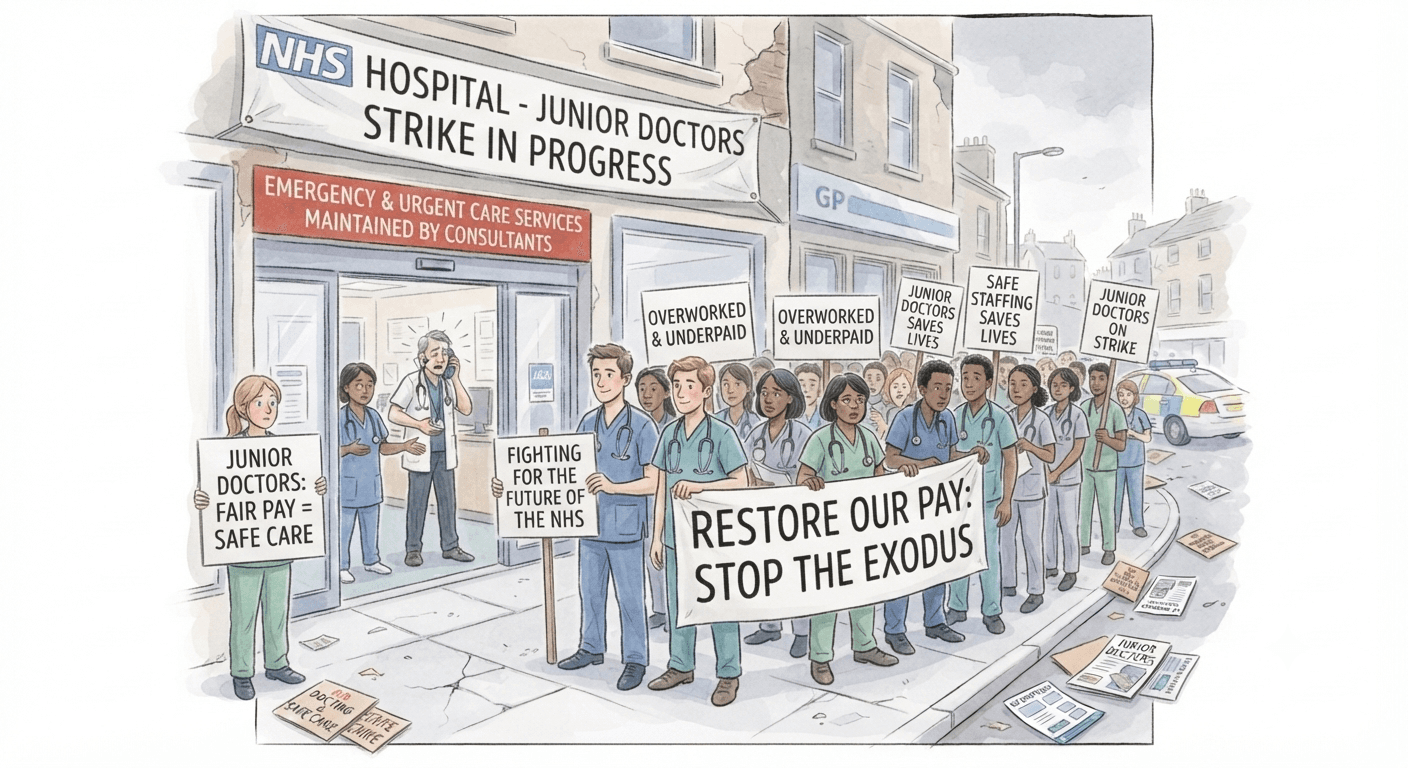
Junior Doctors’ Strikes (2023–2026)
Junior Doctors’ / Resident Doctors’ Strikes (2023–2026)
This is one of the highest-yield NHS hot topics for medicine interviews because it combines:
- NHS workforce pressures
- medical ethics
- professionalism
- patient safety
- NHS funding
- public trust
- doctor wellbeing
- health policy
The strikes are also highly relevant to understanding why many doctors are leaving the NHS and why waiting lists remain high.
Key Terminology
Junior Doctors vs Resident Doctors
In 2024, the British Medical Association officially began using the term “resident doctors” instead of “junior doctors.”
However:
- both terms are still commonly used
- interviewers may use either phrase
A resident doctor is:
Any doctor below consultant or GP level who is still in postgraduate training.
This includes:
- FY1/FY2 doctors
- specialty trainees
- registrars
Timeline of Major Strike Events
Background Before the Strikes
2008–2022
Doctors argue that NHS pay failed to keep up with inflation for over a decade.
The BMA claims:
- resident doctors experienced major real-terms pay erosion
- inflation rose faster than salaries
- workload increased significantly
This became worse after:
- COVID-19
- staffing shortages
- NHS backlogs
- burnout crisis
Origins of the Dispute
2021 — “DoctorsVote” Movement
A grassroots campaign called DoctorsVote formed online.
Goals:
- restore pay
- improve conditions
- organise industrial action
The movement gained strong support among younger doctors. (BMA)
Key Strike Dates (Very Important)
2023 Strike Dates
Strike Period | Length |
13–16 March 2023 | 72 hours |
11–15 April 2023 | 96 hours |
14–16 June 2023 | 72 hours |
13–18 July 2023 | 5 days |
20–23 September 2023 | 3 days |
2–4 October 2023 | 3 days |
20–23 December 2023 | 3 days |
2024 Strike Dates
Strike Period | Length |
3–9 January 2024 | 6 days |
24–28 February 2024 | 5 days |
July 2024 | Election-period strike |
Following negotiations with the new Labour government, doctors voted to accept a pay deal in September 2024. (BMA)
2025 Strike Dates
Industrial action resumed after disagreements over:
- pay restoration
- training bottlenecks
- job security
- workforce planning
Strike Period | Length |
25–30 July 2025 | 5 days |
14–19 November 2025 | 5 days |
17–22 December 2025 | 5 days |
Why Are Doctors Striking?
There are now two major issues.
1. Pay Restoration
What Does “Pay Restoration” Mean?
Doctors argue that:
- their salary has not kept pace with inflation
- their “real purchasing power” has fallen
The BMA argues resident doctors experienced over 20% real-terms pay loss since 2008. (The Guardian)
Understanding Real-Terms Pay
Example:
If:
- salary rises by 2%
- inflation rises by 10%
then:
- you are effectively poorer
This is called:
Real-terms pay erosion
Approximate Real-Terms NHS Pay Change Since 2010

NHS salaries drop in real terms
Approximate Pay Falls by Staff Group
NHS Staff Group | Approx Real-Terms Change Since 2010 |
Support workers | ~-2% to -4% |
Nurses | ~-5% to -9% |
Midwives | ~-10% to -14% |
Junior/Resident Doctors | ~-8% to -14% |
Consultants | ~-11% to -15% |
Why This Matters
Doctors say low pay contributes to:
- burnout
- low morale
- emigration abroad
- staff shortages
- reduced NHS retention
Common destinations for UK doctors:
- Australia
- New Zealand
- Canada
Current Resident Doctor Pay Scales (England)
The 2024 deal significantly increased salaries. (BMA)
2024–25 Pay Scales
Training Level | Approx Salary |
FY1 (Nodal Point 1) | ~£36,600 |
FY2/Core Training | ~£42,000 |
Specialty Registrar | ~£49,900 |
Senior Registrar | £60,000–70,000+ |
These figures exclude:
- night shifts
- weekends
- overtime
- London weighting
Pay Scale Graph
Approx Basic Pay Growth After Deal
2022–23 2024–25
FY1
£29k → £36.6k
FY2
£34k → £42k
Registrar
£40k → £49.9k
Senior Registrar
£51k → £61.8k
(BMA)
Percentage Pay Increases
2023–24 Deal
Average increase:
~13.2%
(backdated)
2024–25 Deal
Additional increase:
6% + £1000
Combined total:
~22.3% over two years
2. The Training & Jobs Crisis
This became one of the biggest NHS issues by 2025.
What Is Happening?
After foundation training:
- many doctors cannot get specialty training jobs
- competition ratios are extremely high
Example:
- tens of thousands apply
- limited training posts available
This means doctors may:
- remain in temporary jobs
- work as locums
- leave the NHS
- emigrate abroad
Why Is This Dangerous?
If doctors cannot progress:
- fewer consultants are trained
- GP shortages worsen
- NHS staffing gaps increase
This threatens:
- future NHS sustainability
- patient access to care
Ethical Issues
This topic is extremely valuable for:
- UCAT SJT
- MMI stations
- ethics interviews
The Four Pillars of Medical Ethics
1. Beneficence
Doctors should help patients.
Problem:
- strikes delay treatment
2. Non-Maleficence
“Do no harm.”
Question:
- do strikes indirectly harm patients?
3. Justice
Fairness and equality.
Doctors argue:
- fair pay is ethically necessary
- unsafe staffing is unjust
4. Autonomy
Doctors also have rights:
- employment rights
- right to protest
- right to safe conditions
Arguments Supporting the Strikes
Better Retention
Poor conditions drive doctors away from the NHS.
Burnout Threatens Patient Safety
Exhausted doctors:
- make more mistakes
- experience poorer mental health
Long-Term NHS Protection
Supporters argue:
Short-term disruption prevents long-term collapse.
Emergency Care Continues
During strikes:
- A&E remains staffed
- intensive care remains staffed
- emergency cover exists
Arguments Against the Strikes
Delayed Care
Operations and clinics are cancelled.
Public Trust Concerns
Some believe:
Doctors should never strike.
NHS Backlogs Worsen
The NHS already faces:
- long waiting lists
- bed shortages
- staffing crises
Media Controversy
Coverage has been politically divisive.
Some newspapers portrayed doctors as:
- “militant”
- unreasonable
- politically motivated
Doctors argued:
- coverage was unfair
- pay concerns were misunderstood
Government Position
The UK government argued:
- large pay rises are unaffordable
- public sector pay must remain controlled
- strikes damage NHS recovery
Health Secretary Wes Streeting criticised renewed strikes in 2025 as unnecessary after major pay increases. (The Guardian)
Impact on Patients
Effects of Strikes
During strikes:
- elective operations postponed
- outpatient appointments cancelled
- consultants cover emergency work
Potential consequences:
- longer waiting times
- anxiety for patients
- delayed diagnoses
NHS Waiting Lists
This connects strongly to:
- NHS backlog crisis
- winter pressures
- bed shortages
These are all linked NHS hot topics.
Comparison With the 2016 Strikes
2016 | 2023–2026 |
Focused on contracts | Focused on pay + workforce |
Concern over unsafe hours | Concern over retention |
Less social media influence | Strong online organisation |
Smaller workforce crisis | Severe staffing shortages |
Important Organisations
British Medical Association
Trade union representing doctors.
NHS England
Runs NHS services in England.
General Medical Council
Regulates doctors professionally.
Questions and Answers
Common Questions
- Is it ethical for doctors to strike?
- Should NHS workers strike?
- Do you support the strikes?
- Why are doctors leaving the NHS?
- How can retention improve?
- What is pay restoration?
- How do strikes affect patient safety?
- What is the training bottleneck crisis?
1. What are the junior doctor strikes about?
Answer:
The junior doctor strikes are industrial action taken by resident doctors in the NHS, mainly in response to pay erosion, working conditions, and concerns about recruitment and retention. The dispute has centred on restoring real-terms pay lost over time and improving safe staffing levels. Strikes are organised by the BMA and usually maintain emergency care provision.
2. Is it ethical for doctors to strike?
Answer:
It is ethically complex. Doctors have a primary duty to patients, but also a duty to ensure safe working conditions that enable safe care. If poor staffing, fatigue, and burnout threaten patient safety, advocating for change becomes an ethical obligation. Striking is generally considered a last resort when negotiations fail, and safeguards are in place to maintain urgent care.
3. How do strikes impact patients?
Answer:
Strikes can lead to cancellation of elective procedures, delayed outpatient care, and increased pressure on emergency departments. However, life-threatening and emergency care is prioritised, with senior cover maintained. While disruption is unavoidable, systems are put in place to minimise harm.
4. What are the arguments for junior doctors striking?
Answer:
- Pay erosion compared with inflation
- Unsafe staffing levels and burnout
- Recruitment and retention problems
- Impact on morale and training quality
- Long-term patient safety concerns due to workforce instability
5. What are the arguments against striking?
Answer:
- Delays in patient care and elective surgery
- Increased pressure on emergency services
- Public perception and trust issues
- Ethical concern about abandoning patients
- Financial and operational strain on the NHS
6. What would you do if you were rostered during a strike?
Answer:
I would follow NHS trust guidance, ensure safe handover of patients, prioritise emergency and high-risk cases, and work closely with senior staff. Clear communication, escalation of concerns, and maintaining patient safety would be my priorities. I would also ensure documentation and teamwork remain robust under pressure.
7. How would you explain a cancelled operation to a patient?
Answer:
I would apologise clearly and empathetically, explain that the cancellation is due to industrial action affecting staffing levels, reassure them that urgent cases are still prioritised, and arrange a new date as soon as possible. I would acknowledge inconvenience and ensure they understand their ongoing care plan.
8. What is the government’s role in the dispute?
Answer:
The government sets pay policy and negotiates with the BMA, often guided by the DDRB (pay review body). Its role is to balance fiscal constraints with maintaining a sustainable healthcare workforce. Effective resolution requires negotiation and long-term workforce planning rather than repeated cycles of dispute.
9. What ethical principles are involved?
Answer:
- Beneficence: acting in patients’ best interests
- Non-maleficence: avoiding harm from unsafe staffing
- Justice: fair pay and resource allocation
- Duty of care: maintaining essential services
- Professional integrity: advocating for safe systems
10. What is your personal view on strikes?
Answer:
I recognise the tension between patient care and workforce welfare. While strikes cause disruption, they reflect deeper systemic issues that may themselves compromise patient safety. I would support constructive resolution through negotiation, with industrial action as a last resort while ensuring emergency care continues.
11.“Do you support the resident doctor strikes?”
Answer:
I think the issue is extremely complex because there are valid concerns on both sides.
On one hand, doctors deserve fair pay, safe working conditions, and sustainable career progression. Poor retention and burnout can ultimately harm patient care if experienced staff leave the NHS.
However, strikes can also delay treatment and increase pressure on hospitals, so patient safety must remain the priority.
I think it is important that emergency care continues to be protected during industrial action, while the government and medical unions work collaboratively toward long-term workforce solutions.
High-Yield Summary for Interviews
One-Line Summary
The resident doctor strikes reflect the tension between protecting patient care today and preserving a sustainable NHS workforce for the future.
Statistics Worth Remembering
Useful Numbers
- ~22.3% total pay uplift over two years accepted in 2024 (The Doctor)
- FY1 basic pay increased from ~£29k to ~£36.6k (BMA)
- Doctors still argue real-term pay remains below 2008 levels (The Guardian)
- 2025 strikes resumed due to pay and training concerns (Reuters)
Useful Links
Official guidance & organisations
https://www.bma.org.uk/advice-and-support/nhs-delivery-and-workforce/pay/junior-doctors-pay
https://www.bma.org.uk/advice-and-support/nhs-delivery-and-workforce/industrial-action
https://www.gmc-uk.org/professional-standards/ethical-hub/industrial-action
https://www.gov.uk/government/organisations/department-of-health-and-social-care
Workforce & pay review
https://www.gov.uk/government/organisations/review-body-on-doctors-and-dentists-remuneration
https://digital.nhs.uk/data-and-information
NHS trust updates / strike information examples
https://www.wsh.nhs.uk/news/bma-resident-doctor-industrial-action-15-to-19-june-2026
https://www.wsh.nhs.uk/news/bma-resident-doctors-industrial-action-7-to-13-april-2026
https://www.hacw.nhs.uk/junior-doctors-strike/
https://www.newcastle-hospitals.nhs.uk/news/bma-resident-doctors-strike-june-2026/
News coverage (context)
https://www.thetimes.com/uk/healthcare/article/junior-doctors-england-call-off-strike-8qq3fzgdd