
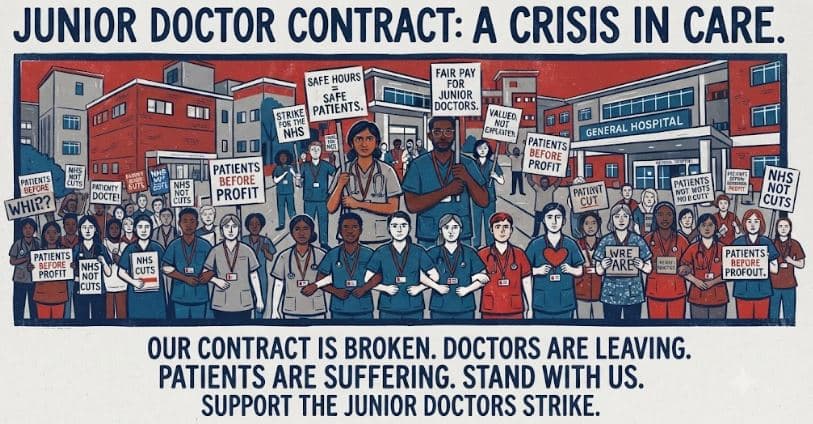
Junior Doctor Contract
Junior Doctor Contract
The junior doctor contract is one of the most important NHS hot topics because it combines:
- doctor wellbeing
- patient safety
- NHS staffing
- employment law
- medical ethics
- gender equality
- industrial action
Understanding the contract helps explain:
- the 2016 strikes
- the 2023–2026 strikes
- burnout
- workforce shortages
- NHS retention problems
What Is a Junior Doctor?
A junior doctor (now increasingly called a resident doctor) is:
Any fully qualified doctor in postgraduate training who is not yet a consultant or GP.
Important:
- junior doctors are NOT medical students
- they may have worked for many years
- they are fully qualified doctors with GMC registration
Training Pathway of a UK Doctor
Simplified NHS Training Pathway
Medical School (5–6 years)
↓
Foundation Year 1 (FY1)
↓
Foundation Year 2 (FY2)
↓
Core / Specialty Training
↓
Registrar (ST3–ST8)
↓
Consultant or GP
Types of Junior Doctors
Foundation Doctors
FY1
First year after medical school.
Responsibilities:
- ward jobs
- prescribing
- patient reviews
- discharge summaries
FY2
Second postgraduate year.
More responsibility:
- acute care
- specialty rotations
- leadership development
Core Trainees (CT1–CT2)
Doctors training broadly in:
- medicine
- surgery
- anaesthetics
- psychiatry
before specialising further.
Specialty Trainees (ST3+)
Doctors training in a chosen specialty such as:
- cardiology
- orthopaedics
- emergency medicine
- paediatrics
These doctors may already have:
- 5–10+ years experience
What Is the Junior Doctor Contract?
The junior doctor contract outlines:
- pay
- working hours
- overtime rules
- rest requirements
- leave entitlements
- rota protections
- training rights
The contract differs slightly across:
- England
- Scotland
- Wales
- Northern Ireland
Why Was the Contract Controversial?
The biggest controversy occurred in:
2015–2016
under then Health Secretary:
Jeremy Hunt
The government proposed major changes to:
- overtime pay
- weekend working
- pay progression
- safe working rules
This led to:
the 2016 junior doctor strikes
The Government’s Aim — “7-Day NHS”
The government wanted:
More consistent NHS services across weekdays and weekends.
The idea:
- improve weekend staffing
- reduce “weekend effect” mortality concerns
- increase service availability
Why Doctors Opposed the Contract
Doctors argued the proposals:
- reduced safety
- increased burnout
- cut effective pay
- worsened morale
Major Areas of Dispute
1. Overtime Pay Changes
Before the Proposed Changes
Many evenings and weekends counted as:
- unsocial hours
- enhanced pay time
Proposed Changes
The government proposed:
- extending “normal working hours”
- reducing enhanced overtime rates
Example:
- Saturday daytime could become “standard time”
Why This Was Controversial
Doctors argued:
- they would work harder for less money
- some could lose up to 30% overall earnings
- weekend-heavy specialties would be most affected
Especially:
- emergency medicine
- surgery
- acute medicine
Overtime & Unsocial Hours
Current Contract Principles
Enhanced pay generally applies:
- overnight
- weekends
- bank holidays
Simplified Overtime Structure
Time | Higher Pay? |
Nights | Yes |
Sundays | Yes |
Bank holidays | Yes |
Long shifts | Often |
2. Safe Working Hours
One of the biggest concerns was:
doctor fatigue
Doctors worried:
- longer hours
- more weekends
- inadequate rest
could increase:
- medical errors
- burnout
- unsafe patient care
Key Safe Working Limits
Current Protections
Doctors generally should not:
- work >72 hours in any 168-hour period
- work too many consecutive long shifts
- work excessive night shifts consecutively
Fatigue & Patient Safety
This became a major interview theme.
Common comparison used:
“You would not want an exhausted pilot flying a plane.”
The same principle applies to medicine.
Why Fatigue Is Dangerous
Fatigue can impair:
- judgement
- concentration
- prescribing accuracy
- communication
This links directly to:
Non-maleficence (“Do no harm”)
3. Pay Protection
What Is Pay Protection?
Some doctors switch specialty later.
Example:
- surgery → GP
- medicine → psychiatry
Without protection:
- salary could suddenly fall
Why This Matters
Hard-to-fill specialties include:
- psychiatry
- GP
- emergency medicine
- rural medicine
Pay protection encourages doctors to move into shortage areas.
Ethical Importance
Without pay protection:
- shortages may worsen
- underserved areas suffer
- patient access declines
This links strongly to:
Justice
4. Maternity & Academic Leave
The proposed contract initially risked:
- pausing pay progression during maternity leave
- disadvantaging academic trainees
This raised concerns about:
- gender equality
- discrimination
- fairness
Gender Pay Gap Concerns
Medicine already has:
- leadership inequalities
- pay disparities
- training interruptions
Critics argued:
Pausing progression during maternity leave would worsen inequality.
The 2016 Junior Doctor Strikes
Strike Timeline
Date | Duration |
January 2016 | 24 hours |
February 2016 | 24 hours |
March 2016 | 48 hours |
April 2016 | 48 hours |
Ballot Result
Approximately:
98% voted for strike action
among participating BMA members.
Why the Strikes Were Historic
They were:
- the largest doctor strikes in decades
- highly publicised
- ethically controversial
Ethical Debate
Arguments Supporting Strikes
Protecting Long-Term Patient Safety
Doctors argued:
- exhausted doctors are unsafe
- burnout harms patients
- poor staffing worsens NHS care
Fair Working Conditions
Doctors believed:
- safe hours are essential
- fair pay matters
- NHS sustainability requires retention
Arguments Against Strikes
Immediate Patient Harm
Cancelled:
- clinics
- operations
- appointments
Critics argued:
- doctors have special responsibilities
- striking risks patient trust
Ethical Principles Involved
Principle | Relevance |
Beneficence | Helping patients |
Non-maleficence | Avoiding harm |
Justice | Fair treatment/pay |
Autonomy | Doctors’ rights |
Outcome of the 2016 Dispute
Eventually:
- negotiations occurred
- compromises made
- strikes ended
The final contract included:
- stronger safety monitoring
- guardian roles for safe working
- revised pay structures
Guardian of Safe Working
A major innovation from 2016.
Role:
- monitor unsafe rotas
- investigate excessive hours
- protect trainee wellbeing
2018–2019 Contract Changes
Further amendments improved:
- exception reporting
- flexible training
- leave systems
These were agreed more collaboratively.
Connection to 2023–2026 Strikes
The newer strikes focused more on:
- pay restoration
- inflation
- cost of living
- staffing shortages
However, many underlying concerns remained:
- burnout
- unsafe workload
- poor retention
Junior Doctors Strikes – Latest Update (UK, June 2026)
Current situation
- Planned resident doctors’ strike in England (15–19 June 2026) was called off at short notice following a new government pay offer.
- The strike would have been part of ongoing industrial action over pay restoration and working conditions.
- The British Medical Association (BMA) has now paused action while members vote on the deal.
What is the new offer?
- Approx 6.6% pay increase by April 2027 (phased)
- Additional proposals include:
- More training posts (around 4,500 over 3 years)
- Contract and progression improvements
- Some exam/support reimbursements
2016 vs 2023 Strikes
2016 | 2023–2026 |
Focus on contract | Focus on pay erosion |
Unsafe hours concern | Cost-of-living crisis |
“7-day NHS” debate | Inflation & retention |
Overtime changes | Real-terms pay loss |
Common Interview Questions
- Why did junior doctors strike in 2016?
- What is the junior doctor contract?
- Is it ethical for doctors to strike?
- Why does fatigue matter in medicine?
- How can the NHS improve retention?
- What are hard-to-fill specialties?
- What is pay protection?
Eight Questions and Answers
1. What is your understanding of the junior doctors’ strike?
Answer:
The junior doctors’ strike refers to industrial action taken by resident doctors in the NHS due to disputes over pay, working conditions, and training concerns. The most recent strikes have focused on restoring pay erosion relative to inflation and improving working conditions to ensure patient safety and staff retention. While disruptive, the strikes arise from prolonged unresolved negotiations between the British Medical Association (BMA) and the government.
2. Do you think doctors should strike?
Answer:
Striking is a difficult ethical issue for doctors, as it can impact patient care. However, doctors also have a duty to advocate for safe working conditions, which directly affect patient safety. If staffing levels, fatigue, and morale are severely compromised, this can itself harm patients. Therefore, industrial action may be considered a last resort when other negotiation methods have failed, and essential emergency care is still maintained during strikes.
3. How do strikes affect patient care?
Answer:
Strikes can lead to postponed elective procedures, delayed outpatient appointments, and increased pressure on emergency services. However, during junior doctor strikes, emergency and life-threatening care is usually still provided, with senior cover in place. The NHS typically activates contingency plans to minimise risk, but some disruption is unavoidable.
4. How would you manage patient care during a strike if you were working?
Answer:
I would prioritise patient safety and follow trust and national guidance. This includes ensuring emergency care continues, effective handover of patients, clear escalation pathways, and supporting senior colleagues where required. Communication with patients and families would also be key to manage expectations and reduce anxiety.
5. What are the ethical principles involved in striking?
Answer:
Key ethical principles include:
- Beneficence: acting in the patient’s best interest
- Non-maleficence: avoiding harm
- Justice: fairness in resource allocation and workforce treatment
- Autonomy: respecting doctors’ rights as employees
Striking creates tension between duty to patients and duty to ensure a safe, sustainable healthcare system.
6. How should the NHS and government respond to strikes?
Answer:
They should prioritise constructive dialogue, fair negotiation, and evidence-based workforce planning. Addressing concerns such as pay erosion, burnout, and training bottlenecks is important to retain staff. Long-term solutions are preferable to repeated cycles of industrial action, which are disruptive to both patients and services.
7. What would you say to a patient whose operation is cancelled due to a strike?
Answer:
I would acknowledge their frustration and apologise sincerely for the disruption. I would explain that the cancellation is due to industrial action affecting staffing levels, reassure them that urgent and emergency care is still prioritised, and ensure they are given a new appointment as soon as possible. Clear, empathetic communication is essential.
8.“Why did junior doctors oppose the 2016 contract?”
Answer:
Junior doctors opposed the 2016 contract because they believed it would worsen working conditions and reduce effective pay, particularly through changes to overtime and weekend pay.
Many doctors were also concerned about patient safety, as they felt the proposed working patterns could increase fatigue and burnout.
There were additional concerns about fairness, including reduced pay protection for doctors entering shortage specialties and possible disadvantages for doctors taking maternity or academic leave.
Overall, the dispute reflected tensions between improving NHS service provision and maintaining safe, sustainable working conditions for doctors.
Key Statistics Worth Remembering
Topic | Figure |
Strike ballot support | ~98% |
Maximum weekly hours | ~72 hours in 168-hour period |
Foundation training length | 2 years |
GP training length | Usually 3 years after foundation |
The junior doctor contract debate centred on balancing NHS service expansion with fair pay, safe working hours, and long-term workforce sustainability.
Useful Links
Official guidance & organisations
- https://www.bma.org.uk/advice-and-support/nhs-delivery-and-workforce/pay/junior-doctors-pay
- https://www.bma.org.uk/our-campaigns/junior-doctor-campaigns/pay/junior-doctors-strike-doctors-guide-to-industrial-action-2023/taking-industrial-action
- https://www.bma.org.uk/advice-and-support/nhs-delivery-and-workforce/industrial-action
- https://www.gmc-uk.org/professional-standards/ethical-hub/industrial-action
- https://www.england.nhs.uk
- https://www.gov.uk/government/organisations/department-of-health-and-social-care
Workforce & pay review
- https://www.gov.uk/government/organisations/review-body-on-doctors-and-dentists-remuneration
- https://digital.nhs.uk/data-and-information
- https://www.aomrc.org.uk
NHS trust updates / strike information examples
- https://www.wsh.nhs.uk/news/bma-resident-doctor-industrial-action-15-to-19-june-2026
- https://www.wsh.nhs.uk/news/bma-resident-doctors-industrial-action-7-to-13-april-2026
- https://www.hacw.nhs.uk/junior-doctors-strike/
- https://www.newcastle-hospitals.nhs.uk/news/bma-resident-doctors-strike-june-2026/
News coverage (context)