
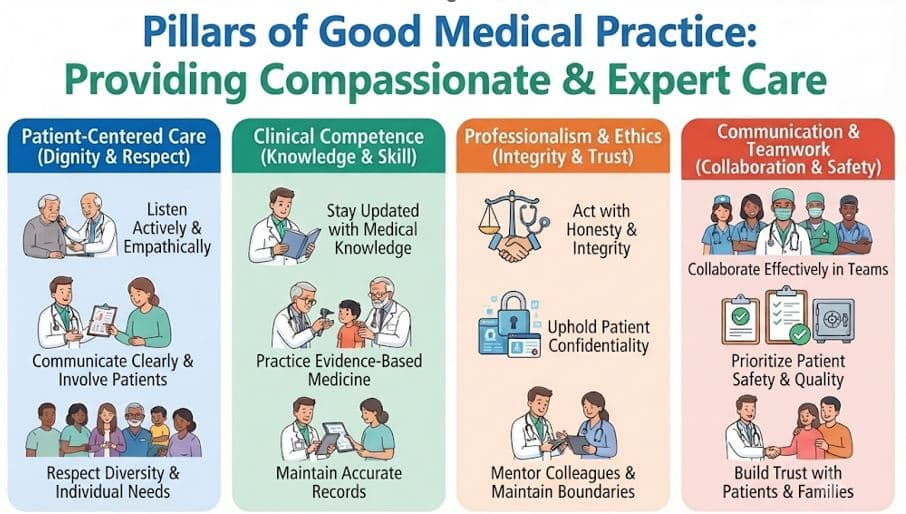
Good Medical Practice
What is Good Medical Practice?
Good Medical Practice (GMP) is the GMC framework that defines the professional, ethical, and clinical standards expected of doctors in the UK.
It tells doctors:
- How to treat patients safely and respectfully
- How to work in teams and maintain professionalism
- How to ensure patient safety and trust
It is the rulebook for what a “good doctor” should do in ethical scenarios
Why is it Important?
GMP exists to:
- Protect patient safety
- Maintain public trust
- Regulate doctors’ behavior
- Ensure consistent standards across the NHS
- Provide guidance for difficult ethical situations
UCAT link: If there is a conflict (e.g. safety vs confidentiality), GMP helps decide the correct professional action
2024 Update — What Changed?
The GMC updated GMP in January 2024 to reflect modern medicine.
Key Changes:
1. New Structure (4 Domains)
Old (2013) | New (2024) |
Knowledge, Skills & Performance | Knowledge, Skills & Development |
Safety & Quality | Patients, Partnership & Communication |
Communication & Teamwork | Colleagues, Culture & Safety |
Maintaining Trust | Trust & Professionalism |
2. More Focus on Patient-Centred Care
- Shared decision-making
- Clear communication
- Respect for patient preferences
- Stronger emphasis on informed consent
3. Workplace Culture
Now explicitly includes:
- Bullying
- Harassment
- Discrimination
- Toxic workplace environments
Ethics questions often involve reporting colleagues or unsafe culture
4. Digital & Modern Medicine
Includes guidance on:
- Social media professionalism
- Telemedicine
- Digital communication
- Remote consultations
5. Safety + Raising Concerns
Doctors must:
- Speak up about unsafe practice
- Escalate concerns properly
- Protect patients from harm
4. Core Principles
If you remember only this, you’re safe:
A GOOD DOCTOR:
- Puts patients first
- Communicates clearly
- Works within competence
- Raises concerns about safety
- Respects colleagues and patients
- Maintains professionalism at all times
Ethical Links (Very Important for UCAT SJT)
Autonomy
- Patients must be involved in decisions
- Must give informed consent
Beneficence
- Act in patient’s best interest
- Provide benefit through care
Non-maleficence
- “Do no harm”
- Escalate unsafe practice
Justice
- Fair treatment for all patients
- Equal standards across groups
UCAT SJT-Style Scenarios
Scenario 1: Unsafe colleague
A junior doctor notices a consultant repeatedly making prescribing errors.
Best action (GMP aligned):
- Raise concern to senior/clinical lead
- Ensure patient safety first
- Document appropriately
Not acceptable:
- Ignoring it
- Confronting aggressively in public
- Waiting “to see what happens”
Scenario 2: Bullying in hospital
A student sees a nurse being bullied by staff.
Best action:
- Support colleague
- Report through appropriate channels (Freedom to Speak Up Guardian)
Scenario 3: Social media post
A doctor posts patient details online (even anonymised).
GMP issue:
- Breach of professionalism and confidentiality risk
Scenario 4: Time pressure vs consent
Doctor rushes consent due to busy clinic.
Correct approach:
- Ensure informed consent even under pressure
- Delay procedure if necessary
Quick Revision Table (UCAT Memory Tool)
Theme | Key Idea |
Patient safety | Always first priority |
Communication | Clear + respectful |
Workplace culture | Must be safe + inclusive |
Consent | Must be informed |
Professionalism | Online + offline |
Raising concerns | Mandatory if safety risk |
Good Medical Practice = “Do what is safest, most ethical, most patient-centred, and most professional — always prioritising patient safety and trust.”
9. Common UCAT / MMI Questions + Model Answers
Q1: What is Good Medical Practice?
Model Answer:
Good Medical Practice is a GMC framework that sets out the ethical and professional standards expected of doctors in the UK. It ensures patient safety, promotes effective communication, and maintains trust in the medical profession. It was updated in 2024 to reflect modern challenges such as digital healthcare, workplace culture, and patient-centred care.
Q2: What should a doctor do if they witness unsafe practice?
Model Answer:
They should prioritise patient safety by raising concerns through appropriate channels, such as a senior doctor or designated safeguarding lead. If necessary, they should escalate further. GMC guidance emphasises that patient safety takes priority over hierarchy or fear of conflict.
Sixteen Questions and Answers
1. What is Good Medical Practice?
Answer:
Good Medical Practice is the GMC’s core ethical and professional guidance for doctors in the UK. It sets out the standards expected of doctors in areas such as patient care, communication, consent, confidentiality, and professionalism. Its main purpose is to protect patients, maintain public trust, and ensure safe, effective care.
2. Why is Good Medical Practice important?
Answer:
It is important because it provides a clear framework for safe and ethical practice. It ensures consistency across doctors, supports good decision-making, and helps maintain trust between patients and the medical profession. It also protects patient safety by setting clear expectations for professional behaviour.
3. What are the main principles of Good Medical Practice?
Answer:
The key principles include:
- Prioritising patient safety
- Working in partnership with patients
- Communicating effectively
- Acting with honesty and integrity
- Maintaining confidentiality
- Working within competence
- Raising concerns when safety is at risk
4. What should a doctor do if they witness unsafe practice?
Answer:
They should act immediately to protect patient safety. This includes raising concerns with a senior colleague or supervisor, following local escalation procedures, and documenting concerns. If necessary, they should escalate further externally. GMC guidance is clear that patient safety takes priority over hierarchy or fear of consequences.
5. What does GMC say about patient safety?
Answer:
The GMC states that patient safety must always come first. Doctors must act promptly if they believe patients are at risk, and must not ignore unsafe practice. They are also expected to escalate concerns appropriately and take action even if it involves challenging colleagues.
6. What does Good Medical Practice say about teamwork?
Model Answer:
It emphasises that doctors must work effectively with colleagues and respect the roles of other healthcare professionals. Good teamwork improves patient safety, reduces errors, and ensures coordinated care.
7. What does Good Medical Practice say about communication?
Answer:
Doctors must communicate clearly, honestly, and compassionately with patients and colleagues. Good communication supports informed consent, builds trust, and reduces misunderstandings or errors in care.
8. What is the GMC guidance on honesty and integrity?
Answer:
Doctors must be honest in all professional interactions, including with patients, colleagues, and regulators. This includes being open when mistakes happen (duty of candour) and not misleading patients or withholding relevant information.
9. What is the duty of candour?
Answer:
The duty of candour requires doctors to be open and honest with patients when something goes wrong that may have caused harm. This includes apologising, explaining what happened, and outlining steps taken to prevent recurrence.
10. What does Good Medical Practice say about competence?
Answer:
Doctors must only work within their limits of competence. If a task is beyond their ability, they should seek help or refer appropriately. They also have a responsibility to maintain and update their skills throughout their career.
11. What does GMC say about confidentiality?
Answer:
Doctors must respect and protect patient confidentiality at all times. Information should only be shared with consent or when there is a legal or safety justification, and only the minimum necessary information should be disclosed.
12. What should a doctor do if they make a mistake?
Answer:
They should prioritise patient safety, inform a senior colleague, and follow the duty of candour by being honest with the patient. They should reflect on the error, learn from it, and take steps to prevent recurrence.
13. How does Good Medical Practice support professionalism?
Answer:
It sets clear expectations for behaviour, including respect, integrity, accountability, and maintaining public trust. It ensures doctors act ethically even under pressure and treat patients and colleagues with dignity.
14. What does GMC say about raising concerns?
Answer:
Doctors have a professional duty to raise concerns if patient safety, dignity, or care is compromised. They should follow local procedures and escalate appropriately if concerns are not addressed.
15. Why was Good Medical Practice updated?
Answer:
It was updated to reflect modern healthcare challenges including digital medicine, increasing workload complexity, and the need for improved workplace culture, including addressing bullying and discrimination.
16. How does GMP relate to patient care?
Answer:
It ensures care is safe, ethical, and patient-centred by guiding doctors on communication, consent, professionalism, and teamwork, all of which improve patient outcomes.
Useful Links (High Yield)
- GMC Good Medical Practice (2024)
- NHS England
- British Medical Association (BMA)
- NHS England – Freedom to Speak Up
- NICE Guidelines