
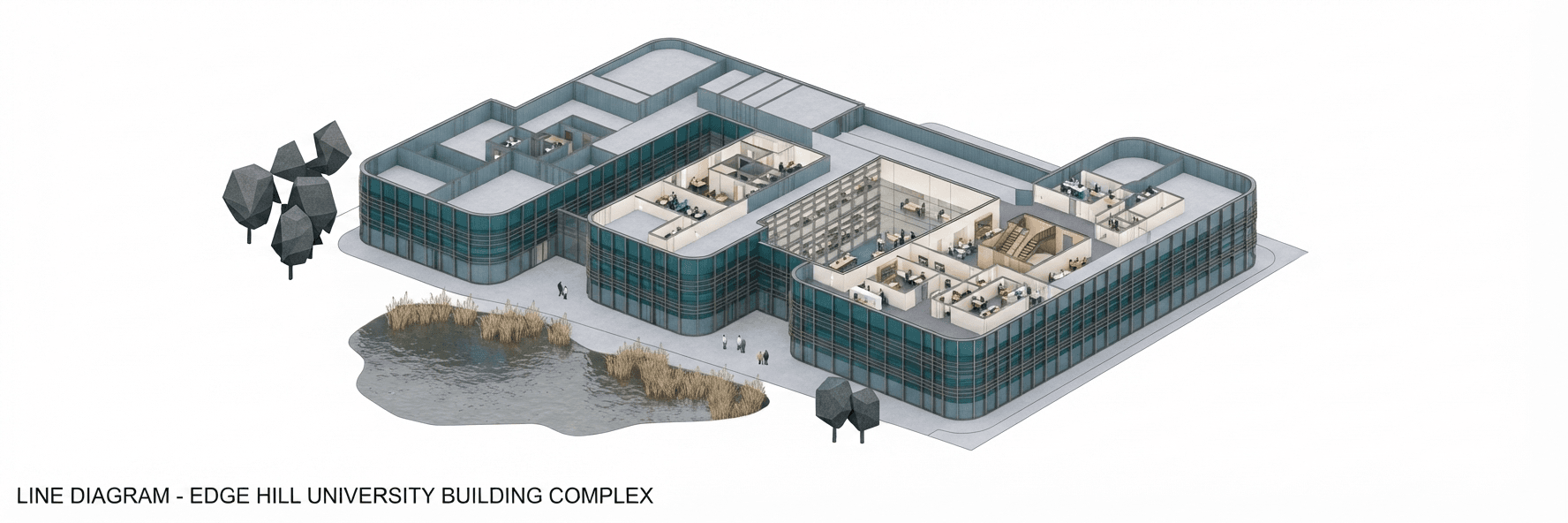
Edge Hill Medical School
Edge Hill Medical School: The Complete Applicant's Guide
A Cambridge Clinical admissions guide
Edge Hill is one of England's newest medical schools, built specifically to address a doctor shortage in the North West of England — and that founding mission runs right through its admissions process, from a regional applicant preference to an interview built around community-focused Good Medical Practice themes. Don't mistake "new" for "easier," though: a small, still-growing cohort against a large applicant pool makes Edge Hill one of the more competitive choices on a UCAS form, not a safety net.
This guide covers entry requirements, how the UCAT threshold actually works here, the MMI format, and Edge Hill's regional and widening-participation considerations.
Quick facts
Course | MBChB Medicine (5-year), plus MBChB Medicine with Foundation Year (6-year) |
Location | Ormskirk, Lancashire |
Admissions test | UCAT |
Interview format | Multiple Mini Interview (MMI) |
Personal statement | Not routinely used for interview selection; used to break ties or clarify borderline cases |
Regional focus | Priority for applicants from the North West of England |
Why applicants choose Edge Hill
Edge Hill was established to train doctors who will go on to serve the North West of England, and its course reflects that: a strong emphasis on primary care, community medicine, and addressing local health inequalities, alongside early clinical exposure and newer, purpose-built facilities. Because the school is young and growing — moving from a small initial intake toward a stated target of around 100 places — it can offer a genuinely close-knit, supportive learning environment, though this comes with real trade-offs worth knowing upfront.
Two honest realities worth sitting with before you apply: first, Edge Hill prioritises applicants from Lancashire, Merseyside, Greater Manchester, Cheshire and Cumbria — you can still apply from outside the region, but you'll need a strong application and a genuinely convincing, specific reason for wanting to study and work in the North West, not just a generic personal statement. Second, a small, still-growing cohort against reportedly 1,500+ applications a year makes Edge Hill genuinely hard to get into, even relative to established schools with two or three times as many places — a "newer school" label doesn't translate to lower competition here.
Entry requirements
A-level: AAA, including Biology and Chemistry with passes in the practical elements (CPAC) of both subjects, plus one other subject. There's a useful flexibility built in: if you achieve an A* in either Biology or Chemistry, your third A-level subject can be accepted at grade B rather than needing to be an A.
GCSE: At least 5 GCSEs at grade 6/B or above, including Mathematics, English, and Science (either separate Biology and Chemistry, or Dual Award/Combined Science). GCSEs are used as a minimum bar only — they are not scored or ranked.
A-level and GCSE resits: Accepted.
Foundation Year route: Edge Hill also runs an integrated MBChB Medicine with Foundation Year — a 6-year route that leads to the same MBChB qualification, aimed at applicants who don't meet the standard AAA bar but show strong potential. Entry requirements for the Foundation Year differ from the standard route, so check Edge Hill's own course page directly for current grades rather than assuming a specific figure.
Widening participation: Edge Hill runs its own Widening Access to Medicine Programme, and candidates who meet specific widening participation criteria, or who successfully complete this programme, receive an extended (lower) UCAT threshold — a genuine, concrete advantage rather than a soft preference, worth investigating properly if you think you might be eligible.
How the UCAT threshold actually works
Edge Hill's process, as set out in its own admissions policy, runs like this:
- Applicants are checked against the academic entry criteria above.
- Applicants meeting those criteria are then assessed against a UCAT threshold that Edge Hill sets fresh each admissions cycle, based on the scores achieved by that year's applicant pool — it is explicitly not fixed or carried over from the previous year.
- Applicants who clear the threshold are invited to interview.
- A Situational Judgement Test Band 4 result leads to automatic rejection, regardless of your cognitive UCAT score.
- Personal statements and references are not routinely used to decide who gets an interview, but may be used to differentiate between candidates if there's a tie at a cut-off point, or to clarify predicted grades and qualifications.
Edge Hill does not publish an official fixed UCAT cut-off, and is fairly quiet even by UK standards about historic thresholds. What is publicly reported: the median UCAT score among candidates who received an interview for 2023 entry was around 2,720 (on the old 3,600-point scale, which included Abstract Reasoning). Since the UCAT Consortium removed Abstract Reasoning from the 2026 sitting onward, moving the maximum score to 2,700, a roughly comparable figure on the new scale would sit somewhere in the region of 2,050–2,100 — but this is an estimated conversion of historic data, not a confirmed or published current threshold, so treat it as a general sense of the competitive landscape rather than a number to aim for precisely.
Because the threshold resets every year based on that cycle's applicants, and because Edge Hill's cohort is still small relative to demand, a strong, well-rounded UCAT performance across all sections matters more here than trying to hit one specific historic figure.
The interview: Edge Hill's MMI
If you clear the UCAT threshold, you'll be invited to a Multiple Mini Interview. Edge Hill hasn't disclosed granular detail about exact station counts or timings, though it's commonly reported as somewhere in the region of 6–8 stations, each lasting a few minutes, delivered virtually. Each station is scored independently, and your combined MMI score determines your ranking — so, as with any MMI-format school, a single weak station doesn't define your whole interview, but consistency across stations matters more than one standout answer.
Edge Hill has been genuinely explicit about what its stations map onto, all drawn from the GMC's Good Medical Practice framework:
- Understanding of, and motivation for, studying medicine specifically at Edge Hill
- Verbal communication skills
- Integrity and probity
- Empathy and compassion
- Awareness of current health challenges
- Ethical awareness
- Awareness of self and others
- Interpretation of data
Given Edge Hill's specific regional mission, it's genuinely worth researching health issues and healthcare delivery in the North West of England specifically — both communicable and non-communicable disease patterns in the region, and how they shape local healthcare provision — rather than relying only on generic NHS knowledge. Selectors are also reported to place real weight on reflection: not just stating what you learned from an experience, but articulating how it changed you and what you'll carry forward into practising medicine. Given Edge Hill's founding regional focus, being able to speak specifically and genuinely to why Edge Hill (rather than medicine in general) is worth preparing properly, especially if you're applying from outside the North West.
Fitness to practise and offer conditions
Applicants are expected to meet the GMC's Outcomes for Graduates and must be open and honest about health conditions, disabilities, or any criminal conduct that could affect future registration or practice — these declarations aren't held against you at the initial selection stage, but any offer is subject to appropriate clearance afterward, including a Declaration of Health questionnaire, potential Occupational Health assessment, and an Enhanced DBS check confirming clearance to work with children and/or vulnerable adults.
Reapplying
UCAT scores are only valid for the admissions cycle in which they were achieved — if you reapply to Edge Hill in a future year, you'll need to sit the UCAT again rather than reusing an old score.
Admissions volume (for context)
Edge Hill reportedly receives upwards of 1,500 applications a year against a cohort that has grown to around 63 places for 2026 entry, with a stated ambition to reach roughly 100 places over time. That implies a headline interview-stage success rate considerably tighter than many established schools, though reported post-interview offer rates (once you've made it to MMI) are said to sit in a more encouraging region of roughly a quarter to just over a quarter of interviewed candidates — treat both figures as industry estimates rather than officially published statistics, since Edge Hill itself hasn't published detailed multi-year admissions data.
How Cambridge Clinical can help
Edge Hill's combination of an annually-reset UCAT threshold, a genuinely regional selection mission, and Good-Medical-Practice-mapped MMI stations means generic medicine interview prep only gets you partway there. We help applicants build a strong, consistent UCAT performance, prepare properly for reflection-heavy MMI stations, and — where relevant — build a genuinely convincing case for why Edge Hill specifically, rather than a generic "why medicine" answer.
If you'd like a hand with any stage, visit cambridgeclinical.co.uk to find out more about our UCAT tuition and Edge Hill-specific interview coaching.
Edge Hill is a young, fast-growing medical school, and cohort size, UCAT thresholds, and published statistics are likely to shift more year to year here than at longer-established schools. Always confirm current entry requirements and process against Edge Hill's official Medical School admissions policy and course pages before finalising your application.