
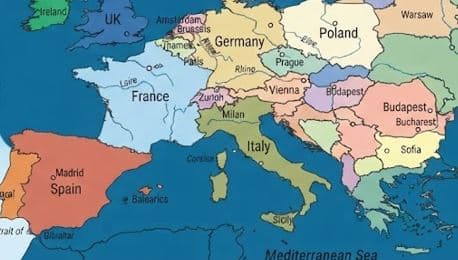
Common places in Europe to apply for medicine and dentistry
Common European Destinations for Medicine and Dentistry Applicants
A Cambridge Clinical admissions guide
Since Brexit, UK applicants are treated as international (not EU) students right across the EU, so the "cheap EU place" era is over for home-fee purposes — but Europe remains one of the most popular alternative routes into medicine and dentistry, offering English-taught degrees, generally more accessible academic thresholds than UK schools, and tuition that's still often well below UK international fees. This guide gives an overview of the countries UK and international applicants most commonly consider, what each is broadly known for, and the recurring differences worth understanding before choosing between them. For deep dives on Malta and Cyprus specifically, see our dedicated guides to those two destinations.
Quick comparison
Country | Typical course length | Typical annual tuition (medicine) | Entrance route |
|---|---|---|---|
Poland | 6 years | roughly €13,500–€19,000+ | Entrance exam or grades/interview, varies by university |
Hungary | 6 years | roughly €16,000–€17,000+ | Own entrance exam (science-based) |
Romania | 6 years | roughly €6,000–€10,000 | Entrance exam at most schools; some grade-only routes |
Bulgaria | 6 years | roughly €7,500–€10,500+ | Entrance exam (biology, chemistry, English) |
Czech Republic | 6 years | roughly €12,000–€18,000 | Entrance exam (Charles University's is notably competitive) |
Slovakia | 6 years | roughly €10,500–€11,000 | Entrance exam or grades, varies by university |
Italy | 6 years | Low at public universities (income-linked, often €1,000–€4,000), higher at private schools | IMAT entrance exam |
Ireland | 5–6 years direct entry, or 4-year graduate entry | roughly €30,000–€60,000 | HPAT (school-leaver) or GAMSAT (graduate entry), depending on route |
Latvia | 6 years | roughly €12,000–€14,000 | Grades-based or entrance exam, varies by university |
Malta / Cyprus | 5–6 years | see our dedicated Malta and Cyprus guides | Varies — see dedicated guides |
Dentistry programmes generally run 5 years (Poland, Malta, Latvia, Lithuania, Spain) or 6 years (Bulgaria, Romania, Croatia, Italy), with tuition typically in the €5,000–€23,000 range depending on country and university.
Poland
One of the most established destinations for English-taught medicine, with a large number of public medical universities running dedicated "English Division" programmes — Warsaw, Gdańsk, Silesia (Katowice), Poznań and others among the most recognised. Entry is generally by entrance exam or a combination of science grades and interview depending on the specific university. Poland is also a common destination for dentistry, with several universities (Medical University of Silesia among them) running well-regarded English-taught dental programmes.
Hungary
Hungary has built a strong reputation specifically around international medical and dental education, with Semmelweis University (Budapest), and the universities of Szeged, Pécs and Debrecen among the most established names. Admission is generally through the university's own science-based entrance exam. Hungarian degrees are well recognised across the EU, and Hungary's dental schools in particular are considered among the continent's most prestigious for international students.
Romania
Consistently one of the most affordable EU options for both medicine and dentistry, with schools such as Carol Davila (Bucharest), Iuliu Hațieganu (Cluj-Napoca), and Grigore T. Popa (Iași) commonly featuring in comparisons. Many Romanian schools admit largely on an entrance exam testing biology and chemistry, though some accept applications on grades alone — check the specific university's current policy, since this varies.
Bulgaria
Bulgaria pioneered English-language medical education for international students several decades ago and now hosts six established medical universities, including Sofia, Plovdiv, Varna, Pleven and Trakia (Stara Zagora). Entrance exams typically test biology, chemistry and English proficiency. Bulgaria is a genuinely popular choice for both medicine and dentistry, with tuition among the lowest in the EU.
Czech Republic
Home to Charles University, among the oldest universities in Europe and a particularly sought-after (and competitive) choice for international applicants, alongside Masaryk University and Palacký University. Entrance exams are a firm requirement rather than an occasional one here — Charles University's are described consistently as especially demanding.
Italy
Distinctive among these options for its admission route: the IMAT (International Medical Admissions Test), a standardised exam testing logical reasoning, general knowledge and sciences, used specifically for admission to English-taught medicine at Italian public universities. Public university tuition is often income-linked and can be genuinely low, but international places are typically very limited (sometimes as few as a few dozen per university), making Italy one of the more competitive routes on this list despite the lower headline cost.
Ireland
A longer-established destination than the Central/Eastern European options above, and the only one on this list still inside a broadly familiar UK-style application framework. Ireland offers both 5–6 year direct-entry programmes (via the HPAT, Ireland's school-leaver aptitude test) and 4-year graduate-entry programmes (via GAMSAT) at schools such as RCSI, UCD, and Trinity College Dublin. Tuition is considerably higher than Central/Eastern Europe — commonly cited in the €30,000–€60,000 per year range for international students — reflecting Ireland's closer alignment with UK and US-style medical education norms.
Latvia, Lithuania and other emerging destinations
Latvia (Riga Stradiņš University in particular) and Lithuania (Lithuanian University of Health Sciences) have both grown into established, well-regarded destinations for English-taught medicine and dentistry, generally positioned in the middle of the cost range between the cheapest options (Romania, Bulgaria) and the pricier established names (Hungary, Poland). Georgia and Serbia are also increasingly mentioned as lower-cost, more accessible options, though it's worth researching degree recognition and GMC/UKMLA pathways particularly carefully for any newer or less established destination — see our companion guide on problems with applying to medicine in Europe for more on this.
Malta and Cyprus
Both covered in dedicated guides given how much detail each involves — Malta for its Medical Maltese Proficiency Certificate requirement at the University of Malta specifically (a rule that catches many applicants off guard), and Cyprus for the University of Nicosia's evolution away from its original St George's, University of London franchise arrangement into its own independently accredited MD.
What's broadly consistent across these countries
English-taught, but not English-only in practice. Almost every school on this list teaches the full academic curriculum in English, but most also expect (or formally require) growing local-language proficiency for patient-facing clinical years — check exactly when and how much is required, since this is sometimes introduced partway through rather than at entry.
Entrance exams over UCAT/BMAT. Most schools use their own science-based entrance exam (biology, chemistry, sometimes physics) rather than the UK's UCAT/BMAT, though a handful of dental schools admit on grades and interview alone with no formal exam at all.
EU-wide recognition, but UK registration is a separate step. A degree recognised across the EU under the relevant mutual recognition directive doesn't automatically confer UK registration. Since 2024, graduates of overseas medical schools (EU schools included) need to pass the UK Medical Licensing Assessment (UKMLA) and complete a 12-month internship for full GMC registration, alongside meeting the GMC's English-language requirement — check your target school's actual track record of graduates successfully completing this route, not just its formal accreditation status.
Application timing is rolling and school-specific. Most schools accept applications from around February through the summer for September entry, and many operate on a rolling basis where places can close before any nominal deadline — so, as with the individual school guides in this series, earlier is safer than later.
Tips
Compare total programme cost, not just annual tuition — a cheaper six-year programme can end up costing more overall than a pricier five-year one, and Bulgaria's and Romania's six-year length is a common example where this catches people out.
Check each specific university's UKMLA/GMC track record (if UK registration is your eventual goal) or your target country's equivalent licensing pathway, rather than relying on general "EU-recognised" marketing language — recognition and a smooth registration pathway aren't quite the same thing.
If dentistry is your route, note that most European dental schools don't require anything UCAT/DAT-equivalent — grades, an entrance exam, or sometimes an interview alone — which is a genuinely different admissions landscape from UK dentistry applications.
Budget beyond tuition for application/exam fees (these add up quickly if you're applying to several schools across different countries), visa costs, document legalisation or translation, and living costs, which vary enormously between, say, Bucharest and Dublin.
How Cambridge Clinical can help
We help medicine and dentistry applicants compare European destinations against their specific budget, academic profile, and eventual country of practice.
If you'd like a hand with any stage, visit cambridgeclinical.co.uk to find out more about our application support for medicine and dentistry routes.
Tuition figures, entrance requirements and licensing pathways shift often across these countries and even between universities within the same country. Always confirm current details directly with each institution, and with the relevant licensing body in your intended country of practice, before finalising an application.