
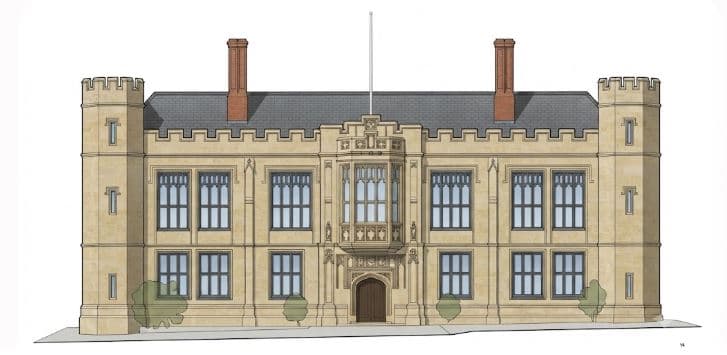
Bristol Medical School
Bristol Medical School: The Complete Applicant's Guide

Bristol runs one of the most distinctive selection processes of any UK medical school. Get your academic profile and UCAT sorted, and the rest of the field falls away — Bristol doesn't score your personal statement, doesn't weight your GCSEs beyond a minimum bar, and ranks you for interview almost entirely on one number. That makes it one of the more predictable schools to plan for, provided you understand exactly which parts of your application actually move the needle.
This guide covers everything you need: entry requirements, how the UCAT is used, the Gateway route, the interview format, and the application timeline.
Quick facts
UCAS code | A100 (Standard entry, MBChB) |
Course length | 5 years |
Gateway/Foundation route | A108 (6 years, widening participation) |
Admissions test | UCAT (required) |
Interview format | Multiple Mini Interview (MMI), online |
Personal statement | Not scored, except as a tiebreaker in exceptional cases |
UCAS deadline | Mid-October, 6pm |
Why applicants choose Bristol
Bristol's course is built around its clinical academy system — regional teaching hubs attached to hospitals and community services across the South West, where students get placement-based learning from early in the course rather than waiting until the clinical years. Cadaveric dissection remains part of the anatomy teaching, which isn't universal across UK schools any more. Between years three and four there's the option to intercalate, taking a full extra year toward a separate Bachelors or Masters degree. The final year is deliberately structured around the transition into a Foundation Year 1 post, rather than treated as a final academic hurdle.
The trade-off for that structure is a selection process almost entirely gated by UCAT performance, so it rewards applicants who prepare for that one exam properly rather than those who spread effort evenly across every part of the application.
Entry requirements
A-level: AAA, including Chemistry and one of Biology, Physics, Mathematics or Further Mathematics.
Contextual offer: ABB, for applicants who meet Bristol's widening participation criteria.
GCSE: Grade 7/A or above in Maths, and grade 4/C or above in English Language. GCSEs are used as a minimum bar rather than being scored or ranked.
International Baccalaureate: 36 points overall, with 18 at Higher Level, including 6,6 at Higher Level in Chemistry and one of Biology, Physics or Mathematics. Applicants meeting widening participation criteria can be considered with 32 points overall and 15 at Higher Level.
Scottish Highers/Advanced Highers: AA at Advanced Higher in Chemistry and one of Biology, Physics or Mathematics, alongside AAAAB at Higher.
Graduate applicants: Bristol considers graduates through the standard A100 course rather than running a separate accelerated graduate-entry programme. Graduates are generally expected to have achieved a 2:1 or above in their first degree, alongside A-level grades in the region of BBB including Chemistry and a second science subject.
Work experience: Not a formal requirement, and not scored during shortlisting, but Bristol encourages it, and interviewers can and do ask candidates to reflect on it during the MMI.
How the UCAT decides who gets an interview
This is the part of the Bristol process that catches people out if they haven't researched it properly: once you clear the academic minimums above, your UCAT score is what determines whether you're invited to interview. GCSEs and A-level grades are used as a pass/fail threshold, not as points that get added to your ranking, and your personal statement isn't read at this stage at all.
The combined score across the four cognitive subtests (Verbal Reasoning, Decision Making, Quantitative Reasoning, and, historically, Abstract Reasoning) is what gets ranked. The Situational Judgement Test is not used for shortlisting.
Two things worth knowing about the current cycle:
- 2026 was the first UCAT sitting without the Abstract Reasoning subtest, which shifts the scoring scale and means older "target score" benchmarks from before that change are no longer directly comparable.
- For 2026 entry, the threshold score to be invited to interview was 2240 for home applicants and 2270 for overseas applicants, based on Bristol's own published figures. Thresholds move every year depending on that year's cohort performance, so treat any specific number as a guide to where the bar has recently sat, not a fixed target.
Because of how much weight sits on this one test, UCAT preparation deserves to start early and run properly — this isn't a test you want to be practising for the first time three weeks before your sitting.
The Gateway to Medicine route (A108)
Bristol also runs a six-year Gateway to Medicine course for applicants from specific widening participation backgrounds who meet the eligibility criteria but might not otherwise meet the standard academic entry bar. It adds a foundation year onto the standard MBChB, and successful Gateway students progress directly into the same five-year course as standard entrants. If you think you might be eligible, it's worth checking Bristol's specific widening participation criteria directly, since eligibility is based on a defined set of circumstances rather than general disadvantage.
The interview: Bristol's MMI
If your UCAT clears the threshold, you'll be invited to a Multiple Mini Interview, currently run online. Expect a circuit of short, independently-assessed stations rather than one long conversation with a panel — each station is scored separately by a different assessor, so one shaky station doesn't define your whole interview, but it also means you need to reset and perform consistently rather than coasting on one strong answer.
Across recent cycles, Bristol's stations have centred on the domains set out in the GMC's Good Medical Practice framework:
- Communication and teamwork — how you listen, structure an answer, and work with others
- Ethical reasoning — scenario-based stations testing how you weigh competing principles, not whether you reach a "correct" answer
- Professionalism and maintaining trust — how you'd handle situations that test judgement and integrity
- Motivation and insight — including, sometimes, direct questions about your work experience or why medicine
Bristol doesn't release station questions in advance, and there's typically little to no separate preparation time built into each station, so candidates are expected to respond on the spot rather than having pre-read a prompt outside the door. Because personal statements aren't used for shortlisting, don't assume your interviewer has read yours in detail going in — answer as though your work experience and motivation need to stand on their own in the room, not as a follow-up to something already on file.
Application timeline
Stage | Typical timing |
|---|---|
UCAT registration | Opens early July — book early, popular slots fill fast |
UCAT sitting window | July–September |
UCAS application deadline | Mid-October, 6pm |
UCAT-based shortlisting | Autumn, after the deadline |
MMI interviews | December–February |
Decisions | From January/March onwards, rolling |
UCAS firm/insurance reply deadline | Typically early-to-mid May |
Deferred entry is accepted — if you apply for deferred entry, you still need to sit the UCAT in your actual application year, and your score is judged against that year's cohort and thresholds, not the year you'll actually start.
How Cambridge Clinical can help
Because Bristol's process is so front-loaded onto the UCAT, that's the single highest-leverage place to put your preparation time. We run structured UCAT tuition with Cambridge-trained tutors, followed by mock MMI circuits built around Bristol's actual station themes — ethical reasoning, Good Medical Practice scenarios, and on-the-spot motivation questions — so the format itself stops being what you're nervous about on the day.
If you'd like a hand with either stage, visit cambridgeclinical.co.uk to find out more about our UCAT tuition and Bristol-specific interview coaching.
Figures and thresholds in this guide reflect recent application cycles and Bristol's own published admissions statement. Entry requirements, UCAT thresholds, and interview format can and do change year to year — always confirm current details against the University of Bristol's official admissions pages before finalising your application.