
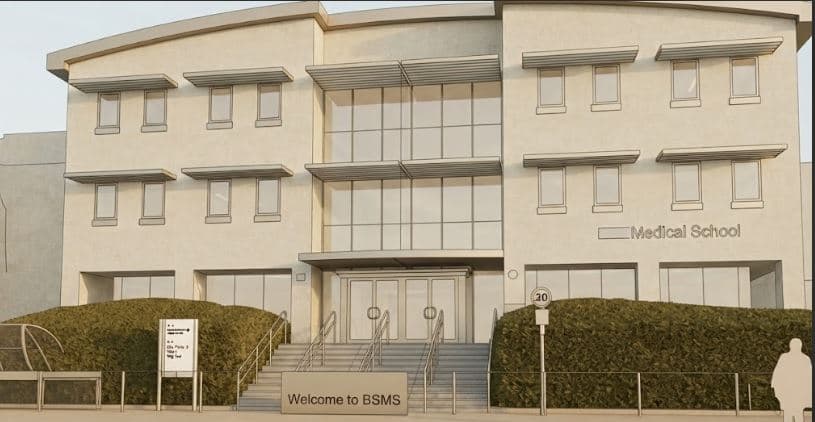
Brighton and Sussex Medical School
Brighton and Sussex Medical School: The Complete Applicant's Guide
A Cambridge Clinical admissions guide
BSMS runs one of the most UCAT-dependent selection processes of any UK medical school — its own admissions team states plainly that personal statements aren't used at any point in the process. That's unusual even among schools that lean heavily on the UCAT, and it means your preparation time is best spent almost entirely on the exam and the interview, not on redrafting your personal statement for the tenth time.
This guide covers entry requirements, exactly how BSMS scores and uses the UCAT, the MMI format, and the full application timeline.
Quick facts
UCAS code / institution code | A100 / B74 |
Degree awarded | BM BS |
Course length | 5 years |
Run jointly by | University of Brighton and University of Sussex |
Admissions test | UCAT (required) |
Interview format | Multiple Mini Interview (MMI), in-person or online |
Personal statement | Not used at any point in the admissions process |
UCAS deadline | Mid-October, 6pm |
Why applicants choose BSMS
BSMS is a joint medical school run by the Universities of Brighton and Sussex, teaching around 140 students a year toward a GMC-approved BM BS. Being a joint school gives students access to two separate university communities and campuses, alongside NHS placements across Sussex. Because BSMS doesn't score personal statements or weight GCSEs beyond a minimum bar, the process rewards applicants who treat the UCAT as the priority and take the MMI seriously as a distinct skill to practise, rather than applicants who've written the most polished narrative about why they want to be a doctor.
One detail worth knowing early: all qualifications must have been achieved within 10 years of your course start date. This is more relevant to mature applicants and career-changers than to school leavers, but it's a hard rule, not a guideline, so if your A-levels or degree are older than that, it's worth contacting BSMS admissions directly before you apply.
Entry requirements
A-level: AAA, to include Biology or Chemistry and one further subject from Biology, Chemistry, Mathematics or Physics. General Studies and Critical Thinking don't count. BSMS is explicit that your third A-level doesn't have to be a science or maths subject at all — they say they welcome applicants studying outside the mathematical and physical sciences.
Adjusted/contextual offer: AAB, for applicants meeting BSMS's adjusted offer criteria. Roughly 30% of interview places are reserved for applicants with contextual data, and they're ranked on UCAT separately from the wider applicant pool rather than competing directly against standard applicants.
GCSE: Grade 6/B or above in English (Language or Literature) and in Maths. For applicants with contextual data, grade 5/C is accepted instead.
International Baccalaureate: 36 points overall, including grade 6 at Higher Level in Biology or Chemistry, and grade 6 at Higher Level in one further subject from Biology, Chemistry, Mathematics or Physics. Adjusted offer applicants: 35 points overall.
Scottish Highers/Advanced Highers: AAA at Advanced Higher, to include Biology or Chemistry and one further subject from Biology, Chemistry, Mathematics or Physics.
Graduate applicants: Welcomed. You'll need at least BBB at A-level including Biology and Chemistry, and you should hold (or be expecting) a first or upper second class science degree that demonstrates solid knowledge of biology and chemistry. You'll be asked to supply a transcript as part of the academic assessment.
Access to Medicine route: For mature applicants (21+) who've had an extended break from education and haven't previously studied Biology and Chemistry at A-level or degree level, BSMS accepts a distinction-level pass on an Access to Medicine course as an alternative route in, alongside meeting the standard English and Maths proficiency requirements.
Work experience: BSMS doesn't set a specific requirement on the amount or type of work experience, but expects candidates to have a realistic understanding of what a career in medicine actually involves, in line with the Medical Schools Council's general work experience guidance.
How the UCAT decides who gets an interview
BSMS ranks applicants by UCAT score to select for interview, once academic requirements are met or predicted. There are two hard gates before your score is even ranked:
- SJT band. You need a Situational Judgement Test band of 1, 2 or 3. A Band 4 result leads to automatic rejection, regardless of how strong the rest of your UCAT score is.
- Academic threshold. You need to be meeting or predicted to meet the grade requirements above.
Once you clear both, your ranking is based on your combined score across Verbal Reasoning, Decision Making and Quantitative Reasoning — for 2026 entry onward, BSMS scores the UCAT out of 2,700 (900 per subtest), reflecting the UCAT Consortium's removal of the Abstract Reasoning subtest from the 2026 sitting. That's an important point if you're benchmarking against older cut-off figures: scores from 2025 entry and earlier were out of 3,600 (including Abstract Reasoning), so they aren't directly comparable to the new 2,700 scale.
For reference, BSMS's own published 2025 entry thresholds (on the old 3,600 scale) were 2,410 for home applicants with contextual data and 2,560 for home applicants without. These numbers move every cycle and the scale itself has now changed, so treat them as a sense of where the bar has recently sat rather than a fixed target — check BSMS's admissions pages directly for the live threshold in your application year.
Because personal statements play no role in the decision at any stage, and GCSEs are a pass/fail bar rather than a scored factor, your UCAT score is doing almost all of the shortlisting work. That makes early, structured UCAT preparation the single highest-value thing you can do for a BSMS application.
The interview: BSMS's MMI
If you're invited to interview, BSMS gives you a choice of format: in-person (early December or early January) or virtual via Zoom (late January or early February). International applicants are typically interviewed by MMI in February and March.
The MMI runs as a circuit of short, independently-assessed stations — the model most UK medical schools now use, where each station is marked separately so no single stumble sinks your whole interview, but consistency across stations matters more than one standout answer. Based on candidate experience and BSMS's stated priorities, expect stations built around:
- Communication and empathy — including role-play scenarios such as counselling a distressed patient or navigating a difficult conversation
- Ethical reasoning — scenario-based dilemmas testing how you weigh competing considerations
- Thinking clearly under pressure — presented through data interpretation or prioritisation-style tasks
- Reflection on experience and motivation — since your personal statement won't have been read, be ready to explain your work experience and motivation from scratch rather than assuming it's "on file"
Accounts of the exact number of stations vary — some describe around six to eight, others closer to eight to ten — so don't over-anchor on a specific station count; focus instead on being consistent across however many rooms you're rotated through. Several accounts also suggest the pacing is a little less rushed than some other schools' circuits, with some spare time in each station rather than being cut off mid-answer.
Admission statistics (for context)
For 2024 entry, BSMS received 1,103 home applications and invited 684 to interview (62%), making 384 offers — around 35% of home applicants received an offer, and 56% of those interviewed went on to receive one. For 2023 entry, international applications numbered 313, with 57 interviews and 31 offers. BSMS expects around 10 places for new international entrants for 2027 entry.
Application timeline (2027 entry)
Stage | Timing |
|---|---|
UCAT sitting | Summer 2026 |
UCAS application deadline | October 2026, 6pm |
UCAT-based shortlisting | After the UCAS deadline |
Interviews (in-person option) | Early December 2026 or early January 2027 |
Interviews (virtual option) | Late January or early February 2027 |
International interviews | February–March 2027 |
Offers | January–April 2027 |
Qualification results confirmed | August 2027 |
UCAT registration for UK sittings costs £70 (£115 outside the UK) for 2026, with a bursary scheme available for UK candidates who need it. You can only sit the UCAT once per cycle, and a score is valid for that cycle only — if you reapply in a future year, you'll need to sit it again.
How Cambridge Clinical can help
Given how much of a BSMS application rides on the UCAT and the MMI — with the personal statement carrying no weight at all — that's exactly where structured preparation pays off. We run UCAT tuition with Cambridge-trained tutors, followed by mock MMI circuits built around the communication, ethics and role-play themes BSMS's stations are known for, so the format itself isn't what you're nervous about on the day.
If you'd like a hand with either stage, visit cambridgeclinical.co.uk to find out more about our UCAT tuition and BSMS-specific interview coaching.
Figures and thresholds in this guide reflect recent application cycles and BSMS's own published admissions statements. Entry requirements, UCAT thresholds, and interview format can and do change year to year — always confirm current details against BSMS's official entry requirements pages before finalising your application.