
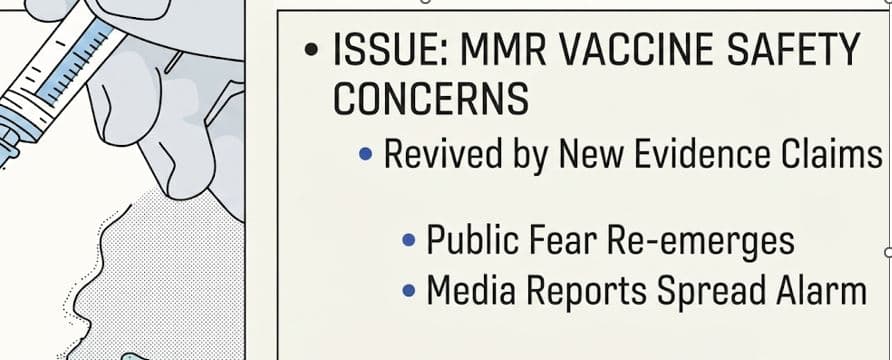
Andrew Wakefield, MMR & Autism Scandal
Andrew Wakefield, MMR & Autism Scandal
1. Overview (What happened?)
The Andrew Wakefield MMR scandal was one of the most damaging public health controversies in modern medicine.
In 1998, former doctor Andrew Wakefield published a paper in The Lancet claiming a link between:
- the MMR vaccine
- autism
- bowel disease
The study was later proven fraudulent and was fully retracted.
2. Why is this important?
The scandal:
- reduced vaccination uptake
- increased vaccine hesitancy
- contributed to measles outbreaks
- damaged trust in healthcare and science
It is now considered a major example of:
- scientific misconduct
- poor research ethics
- dangerous misinformation
3. What is the MMR vaccine?
The MMR vaccine protects against:
- Measles
- Mumps
- Rubella
Introduced in the UK in 1988.
Benefits:
- prevents serious illness and death
- protects vulnerable populations
- contributes to herd immunity
4. Timeline (HIGH YIELD)
1988
MMR vaccine introduced in UK.
1995
Vaccination uptake reaches ~95%, achieving herd immunity.
1998
Wakefield publishes paper claiming association between MMR and autism.
The study involved only:
- 12 children
1998–2004
Media coverage amplifies public fear.
Vaccination rates decline.
2004
Several co-authors retract interpretation of findings.
2010
The Lancet retracts the paper completely.
The General Medical Council strikes Wakefield off the medical register.
5. Why was Wakefield’s study flawed?
A. Tiny sample size
Only 12 children studied.
Too small for reliable conclusions.
B. No control group
No proper comparison group.
C. Biased sampling
Participants were selectively recruited.
D. Speculative conclusions
Claims were unsupported by evidence.
E. Conflict of interest
Wakefield failed to disclose financial links to lawyers suing vaccine companies.
F. Ethical misconduct
The GMC identified:
- unethical procedures on children
- poor consent processes
- dishonesty in reporting
6. Ethical issues (VERY IMPORTANT)
A. Non-maleficence (“do no harm”)
False information caused:
- reduced vaccination
- disease outbreaks
- preventable deaths
B. Scientific integrity
Researchers have ethical duties to:
- report data honestly
- avoid bias
- follow rigorous methods
Wakefield breached these principles.
C. Informed consent
Concerns existed regarding:
- how children were recruited
- parental consent processes
- invasive investigations performed
D. Conflict of interest
Failure to disclose financial motivations undermined trust.
E. Public trust
The scandal severely damaged:
- trust in vaccines
- trust in doctors
- trust in public health institutions
7. Public health consequences
Vaccination rates fell
Parents became fearful of vaccination.
Measles outbreaks returned
UK outbreaks occurred despite prior near-eradication.
Herd immunity weakened
This endangered:
- immunocompromised individuals
- babies
- vulnerable groups
Vaccine hesitancy increased globally
Effects continue today.
8. What is vaccine hesitancy?
Vaccine hesitancy means:
- delaying
- doubting
- refusing vaccination despite availability
Causes include:
- misinformation
- distrust
- fear
- social media influence
9. How should doctors respond to vaccine hesitancy?
Doctors should:
- remain calm and non-judgemental
- listen to concerns
- provide evidence-based information
- explain risks and benefits clearly
- maintain trust and empathy
10. Key lessons from the scandal
A. Importance of evidence-based medicine
Medical decisions must rely on high-quality evidence.
B. Importance of ethical research
Research misconduct can harm millions.
C. Importance of responsible science communication
Media reporting can strongly influence public behaviour.
D. Importance of public trust
Trust is essential for successful healthcare systems.
11. High-yield comparisons (excellent interview material)
Wakefield vs Lucy Letby
Similarities:
- major damage to public trust
- patient harm
- failures in oversight
Difference:
Wakefield involved fraudulent research and misinformation; Letby involved direct criminal harm.
Wakefield vs Yaser Jabbar
Similarities:
- ethical breaches
- public trust concerns
- failures affecting vulnerable children
Difference:
Wakefield involved public health misinformation; Jabbar involved surgical decision-making and governance failures.
12. High-yield summary (memorise this)
The Andrew Wakefield scandal demonstrates:
- dangers of poor scientific integrity
- impact of misinformation on public health
- importance of ethical research conduct
- importance of evidence-based medicine
- need to maintain public trust in healthcare
Core takeaway:
False medical information can cause population-level harm, making honesty, transparency, and scientific rigour essential responsibilities for all healthcare professionals.
13. Rapid-fire interview questions
- What is herd immunity?
- Why are vaccines important?
- What is evidence-based medicine?
- What is informed consent?
- What are conflicts of interest?
- Why is public trust important in medicine?
- How can misinformation spread?
- What is scientific misconduct?
- Why do some people distrust vaccines?
- How should doctors communicate uncertainty?
14. Example Questions & Answers
Question
“Does the MMR vaccine cause autism?”
Answer
No. Extensive scientific research involving millions of children has found no credible evidence linking the MMR vaccine to autism. The original Wakefield study was methodologically flawed, later retracted, and involved serious ethical misconduct. Current evidence strongly supports the safety and effectiveness of the MMR vaccine.
Question
“What ethical issues were raised by the Wakefield scandal?”
Answer
The scandal raised major ethical concerns regarding scientific integrity, non-maleficence, informed consent, and conflicts of interest. Publishing misleading data harmed public health by reducing vaccination rates and contributing to outbreaks of preventable disease. It also damaged trust in healthcare professionals and scientific research.
Question
“How would you speak to a parent refusing the MMR vaccine?”
Answer
I would approach the conversation empathetically and respectfully, recognising that parents usually want what they believe is best for their child. I would listen carefully to their concerns, provide evidence-based information about vaccine safety and effectiveness, and explain the risks of vaccine-preventable diseases. Maintaining trust and avoiding judgement would be important throughout the discussion.
Useful Links
The Lancet MMR paper (original publication context)
https://www.thelancet.com/journals/lancet/article/PIIS0140-6736(97)11096-0/fulltext
Lancet retraction of Wakefield paper (2010)
https://www.bmj.com/content/340/bmj.c696
General Medical Council (GMC) findings / misconduct ruling (Wakefield struck off)
Government / public health summaries
UK Gov / NHS-style overview of vaccine safety and MMR controversy
https://www.gov.uk/government/publications/mmr-vaccine-safety
UK Parliament / briefing on vaccine safety and public confidence
https://commonslibrary.parliament.uk/research-briefings/sn06906/
Major investigative / explanatory sources
BMJ investigation: “MMR scare was based on fraud”
https://www.bmj.com/content/342/bmj.c5347
BMJ investigative series (Brian Deer reporting on Wakefield case)
Nature Medicine timeline of the case
https://www.nature.com/articles/nm0310-248b
Public health & scientific consensus explanations
Gavi (vaccine alliance) – clear explainer
https://www.gavi.org/vaccineswork/can-mmr-vaccines-cause-autism
CDC MMR vaccine safety page (no autism link)
https://www.cdc.gov/vaccines/vpd/mmr/public/index.html
WHO vaccine safety / misinformation resources
https://www.who.int/news-room/questions-and-answers/item/vaccines-and-immunization-vaccine-safety