
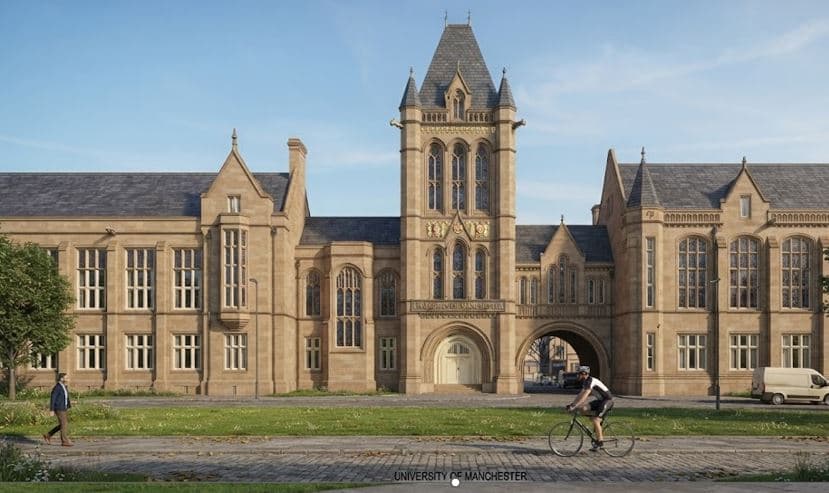
Manchester Medical School
University of Manchester Medicine: The Complete Applicant's Guide
A Cambridge Clinical admissions guide
The University of Manchester's Faculty of Biology, Medicine and Health runs the MBChB Medicine course (A106), the largest medical school in the UK with over 2,500 undergraduate medical students and around 401 funded places a year. Training takes place at the Stopford Building on the Oxford Road campus in Years 1–2, then across four Clinical Education Campuses — Manchester University NHS Foundation Trust (Oxford Road and Wythenshawe), Lancashire Teaching Hospitals NHS Foundation Trust, and the Northern Care Alliance NHS Foundation Trust — for Years 3–5, making Manchester the biggest single provider of healthcare graduates to the NHS in North West England.
Manchester's process runs on a two-stage logic: academic screening first, then a UCAT threshold calculated fresh each year from that year's applicant pool, followed by a five-station Multiple Mini Interview (MMI) that can be sat online or in person.
This guide covers entry requirements, how UCAT-based shortlisting and the SJT band cut-off work, the five-station MMI format, widening access routes, and the graduate-entry and non-standard pathways.
Quick facts
Course | MBChB Medicine (A106), plus Graduate Entry Medicine (A101) |
Location | Manchester, England |
Size | Largest medical school in the UK — around 401 funded places per year |
Admissions test | UCAT — mandatory for every applicant, including dental and graduate applicants |
Interview format | Five-station MMI, 8 minutes per station with 2-minute gaps, online (Zoom) or in person |
Shortlisting | Academic screening first, then a UCAT threshold recalculated each year; SJT Band 3 or 4 not currently considered |
Why applicants consider Manchester
Being the UK's largest medical school gives Manchester genuinely deep clinical placement capacity across four Clinical Education Campuses, and the course is built around Team-Based Learning and themed case discussions rather than a traditional lecture-heavy structure, supported by anatomy dissection, a dedicated Consultation Skills Learning Centre, and clinical exposure from the early years. Students can intercalate for a BSc, master's, or MB-PhD, and the course is ranked 6th in the UK for Medicine in the QS World University Rankings 2025. The final year includes a student assistantship placement where you take on most of the duties of a newly qualified doctor, and Year 4 ends with an overseas medical elective.
Entry requirements
A-level: AAA, including Biology/Human Biology or Chemistry, plus one further subject from Chemistry, Biology/Human Biology, Physics, Psychology, Mathematics or Further Mathematics. Combinations of very similar subjects (e.g. Biology and Human Biology, or Maths and Further Maths together) are not accepted as a pair, and offers are only made for three full A-levels — extra subjects beyond three won't be included in your offer.
A-level contextual offer: AAB, same subject requirements, for applicants who are under 21 on 1 September of entry, live in an area of disadvantage or low progression to higher education, and attended a UK school or college that has performed below the national average over multiple years.
UK refugee/care-experienced offer: ABB, same subject requirements, for applicants with over three months in care, or granted UK refugee status or a Ukrainian-scheme visa.
International Baccalaureate: 36 points overall, with 6,6,6 at Higher Level. Major subjects must include Chemistry or Biology plus another science (Chemistry, Biology, Physics, Psychology or Mathematics) at Higher Level, plus one further HL subject. If Maths and English Language aren't part of the Diploma, they're required at GCSE/IGCSE grade B (6) or above.
Scottish Highers and Advanced Highers: 4 Highers at AAAA by the end of S5 (achieved in one sitting, first attempt), plus at least two Advanced Highers at AA by the end of S6 — either three Advanced Highers at AAA including a science, two Advanced Highers at AA plus an A-level at A, or two Advanced Highers at AA plus a new Higher at A.
GCSE/IGCSE: At least seven GCSEs at grade A (7) or A* (8+), including English Language, Mathematics and two science subjects at minimum grade 6 (B); Dual Award or Core and Additional Science must be at BB (66). Applicants confirmed as WP+ or WP++ via Manchester's Contextual Data Eligibility tool need only six GCSEs at grade 7 or above. GCSE resits are permitted (list as a pending qualification on your UCAS form); a Level 2 BTEC at distinction can substitute for one GCSE, but short courses aren't accepted.
Resits (A-level): Manchester allows re-sits, but only of one of Year 12 or Year 13 — not both — and applicants who resat in Year 13 are expected to have achieved at least ABB at the first sitting, with A*A*A required on resit including one of the originally dropped subjects at the School's discretion. This is notably more permissive than some other UK medical schools that bar resits outright, but it comes with a materially higher resit grade requirement.
Graduate applicants: A minimum 2:1 Honours degree, plus at least BBB at A-level (or 32 points IB) achieved at first sitting. Graduates with a relevant science degree (most Biomedical and Life Sciences disciplines) are exempt from the standard subject requirements but must still meet the BBB threshold; other graduates need at least two science A-levels including Biology or Chemistry. Ordinary or ungraded degrees aren't accepted, and A-level resits purely to raise grades aren't accepted from graduates either. All graduate applicants must sit the UCAT, offer Maths at GCSE grade B (6), meet the English Language requirement, and provide an academic reference. Those with a relevant science or healthcare degree may prefer the separate Graduate Entry Medicine course (A101), a four-year route.
Work experience: Required, though Manchester isn't looking for a specific number of hours or a specific type of placement — shadowing doctors in a hospital or GP setting isn't essential. What matters is a clear, evidenced sense of what studying medicine and working as a doctor actually involves.
How UCAT-based shortlisting works
Applications are first screened against the standard academic threshold; those that don't meet it are rejected before any further stage. All applicants — including graduate and dental applicants — must sit the UCAT in the year they apply, since results are valid for one cycle only and must be re-sat on reapplication.
Manchester does not publish a fixed UCAT cut-off in advance. The UCAT page explains that the threshold is calculated after UCAT scores are received in November, based on that year's standard of scores, and it varies year on year — so a past year's threshold isn't a reliable guide to the current cycle. Historic thresholds and admissions statistics are published on Manchester's own application data page, which is the only source worth relying on for specific numbers, given how much the figure moves each year and how UCAT's format itself has changed recently (the Abstract Reasoning subtest was removed and question numbers/timings changed as part of a 2025 overhaul).
Unlike schools that only use the cognitive subtests, Manchester does factor in the Situational Judgement Test: applicants who score Band 1 or 2 and meet the UCAT threshold and minimum academic requirements will likely be invited to interview, but Manchester states it does not currently consider applicants who achieve Band 3 or 4 on the SJT. Manchester has flagged that further changes to the UCAT are expected from 2026 onwards and that this guidance may be reviewed once the details are known.
Widening access and contextual admissions
Manchester runs contextual admissions open to Home-fee applicants who meet the age, area-disadvantage and school-performance criteria described above, resulting in an AAB (rather than AAA) A-level offer.
Manchester also participates in the UKWPMED consortium alongside several other UK medical schools, plus its own local schemes:
- The Manchester Access Programme (MAP), for Year 12 students in Greater Manchester, which can lead to a lower UCAT threshold and a reduced ABB offer for applicants with a MAP flag.
- The Preston Widening Access Programme (PWAP), delivered at Lancashire Teaching Hospitals NHS Foundation Trust, which can lead to a guaranteed interview (once the UCAT criteria are met) and a reduced AAB offer for WP+ flagged applicants.
Full details of both schemes are on Manchester's widening participation programmes page. As with most contextual schemes, meeting a WP flag lowers the bar but doesn't remove the UCAT threshold or interview stage entirely.
The interview: five-station MMI
For entries from December through early March, interviews use a five-station Multiple Mini Interview format. You can choose to interview online via Zoom or in person on campus — both formats are assessed identically, with the only difference being attendance mode.
- Each station lasts 8 minutes, with a 2-minute gap between stations.
- No information is given in advance, and there is no reading or writing component at any station, online or in person.
- Your starting station is allocated at random, and you rotate through all five in sequence.
- Interviewers are drawn from University and clinical staff, plus patient/lay representatives, current medical students and simulated patients, all specifically trained for the process.
Areas typically explored include your ability to communicate spontaneously (rehearsed-sounding answers are explicitly said to land less well than natural ones), your motivation for medicine, previous caring experience, informed-layperson awareness of topical medical issues, and an ethical scenario where there's no single "correct" viewpoint being sought. Manchester is explicit that you won't be asked about your gender identity, sexuality, marital or parental status, race, religion, or social background. No offer is made without an interview, and Manchester states plainly that it does not endorse or recommend any commercial interview-preparation providers.
Non-standard and accelerated routes
Manchester accepts a small number of graduates directly into Year 3 of the five-year course from two specific sources: around 90 graduates a year from St Andrews University's 3-year Bachelor of Medical Sciences Honours degree (applying via St Andrews), and a few graduates annually from the International Medical University, Malaysia's 2-year phase 1 course (applying via IMU). Manchester also offers a small number of places to dental graduates holding full FDS, MFDS or MDF registration who are planning a career in Oral and Maxillofacial Surgery, applying via UCAS for A106 point of entry 3.
Unlike some UK medical schools, Manchester requires all of these routes — dental graduates included — to sit the UCAT and meet the Maths GCSE and English Language requirements; there's no UCAT exemption for accelerated entrants here.
Application process
Applications go through UCAS using course code A106 (institution code M20) for the standard five-year MBChB, or A101 for Graduate Entry Medicine, by the standard UK medicine deadline. As with all UK medicine applications, you're limited to four medical school choices. Successful applicants must complete satisfactory Enhanced DBS checks and health screening — based on HEOPS standards of medical fitness to train — before starting the course. Home tuition fees for 2026/27 are £9,790 (subject to the Government fee cap, which rises to £10,050 for 2027/28); international fees are £39,900/year for the pre-clinical years and £60,900/year from Year 3 onward, based on the rate applicable when entering the clinical phase.
Tips
Because the UCAT threshold is recalculated every year and isn't published in advance, treat your preparation timeline as the priority, and check Manchester's own application data page each cycle rather than relying on last year's number — historic UCAT format changes mean scores aren't always comparable year to year either.
The SJT band matters more at Manchester than at some other schools: a Band 3 or 4 currently rules an application out regardless of your UCAT total, so don't treat the SJT section as an afterthought in your preparation.
If any part of your A-level history involves a resit, check the detail carefully — Manchester's rule (ABB at first sitting, A*A*A required on resit including a previously dropped subject) is workable but stricter than a simple "resits accepted" policy suggests.
The MMI format rewards natural, unrehearsed answers over polished scripts — Manchester's own interview guidance says so directly, so over-rehearsing specific ethics-framework language or a fixed work-experience list is more likely to work against you than for you.
How Cambridge Clinical can help
We help Manchester applicants build UCAT and SJT preparation calibrated to a threshold that moves every year, alongside interview coaching for Manchester's specific five-station MMI structure — covering communication under time pressure, the "why medicine" question, caring-experience reflection, and ethical-scenario discussion.
If you'd like a hand with any stage, visit cambridgeclinical.co.uk to find out more about our UCAT tuition and Manchester-specific interview coaching.
Entry requirements, UCAT thresholds, and application deadlines can and do shift between application cycles. Always confirm current requirements against The University of Manchester's official MBChB course page before finalising your application.